


Boutique Pencil Pouch Hardware: Complete Specification, Material, and Manufacturing Guide

Boutique pencil pouch hardware—including zipper gauges, custom pullers, metal teeth, and snap closures—balances tactile retail appeal, smooth usability, and production durability while directly impacting landed costs and MOQ requirements. Selecting the right hardware components transforms standard stationery storage into high-value lifestyle products that meet strict global consumer safety standards and retail compliance expectations.
Why Does Hardware Selection Define Boutique Pencil Pouch Value and Durability?
In the competitive consumer stationery and lifestyle accessories market, hardware is often the primary touchpoint that conveys premium build quality. While exterior fabrics such as structured canvas, vegan leather, recycled RPET, or heavyweight linen establish initial visual appeal, the tactile sensation of opening and closing a pouch determines everyday customer satisfaction and brand perception. Low-grade zippers that catch, lightweight zinc sliders that bend under stress, or cheap plating that tarnishes rapidly will degrade an otherwise well-designed lifestyle product.
Premium stationery pouch hardware selection involves evaluating four key engineering dimensions:
Kinetic Performance: The glide force, engagement smoothness, and tooth alignment along straight lines, gusset curves, and perimeter box-corners.
Mechanical Integrity: Pull-tab tensile resistance, crosswise slider strength, tooth separation resistance, and bottom/top stop stability under repeated stress.
Visual and Tactile Finishing: Electroplating quality, rack plating versus barrel plating depth, matte versus polished textures, and weight-in-hand consistency.
Environmental and Chemical Compliance: Low-lead alloy composition, nickel-free skin contact coatings, non-phthalate pulls, and rust-resistant coatings capable of surviving varying shipping microclimates.
When developing commercial stationery lines, coordinating hardware tones—such as champagne gold, matte black, brushed antique brass, or rose gold—across pencil cases, desk organizers, wire-bound journals, and planner binders creates a cohesive collection aesthetic that commands higher retail price points.
Metal vs Nylon Zippers for Pouches: Which Is Right for Your Product Line?
Choosing between metal teeth, continuous nylon coil, and chunky plastic resin teeth represents the most significant functional and aesthetic decision in boutique pencil case manufacturing. Each zipper construction delivers distinct tactile characteristics, price structures, and assembly considerations.
Specification Feature | Nylon Coil Zipper (#3 / #5) | Plastic Resin / Chunky Zipper | Waterproof / Invisible Reverse Coil | |
|---|---|---|---|---|
:--- | :--- | :--- | :--- | :--- |
Aesthetic Tone | Minimalist, modern, lightweight | Heritage, luxury, vintage boutique | Bold, sporty, playful, streetwear | Technical, sleek, weather-resistant |
Glide Action | Exceptionally smooth, continuous | Moderately firm, structured click | Crisp, positive tooth engagement | Smooth with mild sealing friction |
Weight Factor | Extremely lightweight (low freight) | Heavyweight (substantial premium feel) | Medium weight | Low-to-medium weight |
Curved Corner Sewing | High flexibility around tight radiuses | Rigid; requires wider bend radius | Moderate flexibility; needs clearance | Excellent flex across seam lines |
Relative Unit Cost | Baseline cost (1.0x) | Higher cost (2.2x to 3.5x baseline) | Moderate cost (1.3x to 1.8x baseline) | Moderate-to-high (1.5x to 2.2x) |
Common Gauge Uses | Interior pockets, slim pen sleeves | Primary openings on luxury pouches | Youth, lifestyle, and oversized cases | Outdoor, travel, and tech organizers |

Evaluating metal teeth versus nylon coil zippers for aesthetic tone, glide flexibility, and seam integration.
When evaluating metal vs nylon zippers for pouches, design teams must balance product silhouette requirements against manufacturing feasibility. For instance, structured box-shaped pencil cases with 90-degree corner radiuses benefit from continuous nylon coil (#5 gauge) or specially polished corn-teeth metal zippers. Standard unpolished metal zipper teeth can scrape delicate writing instruments or catch along tight sewing margins during high-speed sewing line assembly.
How Do Custom Zipper Pullers and Trims Elevate Brand Recognition?
Off-the-shelf sliders can diminish the uniqueness of an artisanal or designer stationery brand. Developing custom zipper pullers for pencil cases allows stationery brands to turn functional hardware into branded focal points without excessive tooling expenses.
Popular custom puller constructions and techniques include:
Die-Cast Zinc Alloy Pullers: Engineered with custom 3D debossed logos, cut-out monograms, or geometric silhouettes. Zinc alloy provides substantial physical weight, high tensile yield strength, and crisp logo sharpness.
Debossed Genuine or Vegan PU Leather Tabs: Paired with miniature metal rivet studs or wire loops, leather pulls soften the tactile experience and pair naturally with classic cotton canvas and bookcloth collections.
Enamel-Filled Charms and Medallions: Hard or soft enamel infill introduces vibrant brand colors, seasonal character art, or custom motifs to children's, faith-based, or creator-led product lines.
Woven Jacquard and Silicone-Dipped Ribbons: Long grosgrain, herringbone, or matte silicone loop pullers offer urban utility and ergonomic grip for oversized pencil organizers and desk tool bags.
Dual-Tone Electroplated Hardware: Combining brushed body sliders with high-polished brand tags creates dimensional visual depth across high-end corporate gift sets.
To ensure flawless execution, puller loop holes, connector rings, and slider crown attachments must be dimensioned to prevent pinch binding or accidental release during daily pulling cycles.
How Does Stationery Pouch Hardware Selection Impact MOQs, Lead Times, and Unit Cost?
Balancing hardware specifications against supply chain realities is critical for maintaining commercial margins. Hardware costs are driven not only by raw material mass but also by surface finishing treatments, custom tooling requirements, and component sourcing minimums.
Tooling and Mold Costs: Custom zinc alloy pullers require private 3D steel molds. Tooling investments generally range from modest opening fees to comprehensive multi-cavity tooling for high-speed automated output. Once opened, custom molds remain viable for hundreds of thousands of cycles across multiple seasonal production runs.
Minimum Order Quantities (MOQs): Standard catalog zipper tape colors and stock metal finishes are readily available in low minimums (often 500 to 1,000 units). However, custom Pantone-dyed zipper tapes, specialized metallic tooth plating (such as pearl gunmetal or rainbow iridescence), and bespoke cast pullers typically require component MOQs between 2,000 and 5,000 pieces per colorway.
Lead Time Scheduling: Custom hardware molding, electroplating, and salt-spray curing require 12 to 18 days during the development and pilot sampling phase. Factoring component production into the master manufacturing timeline prevents assembly bottlenecks during mass cut-and-sew phases.
Landed Cost Optimization: Consolidating hardware specifications across multiple SKUs—such as using the same #5 zipper slider and custom puller across pencil cases, cosmetic bags, and folio journals—allows brands to hit combined volume tier pricing, drastically reducing individual component costs.
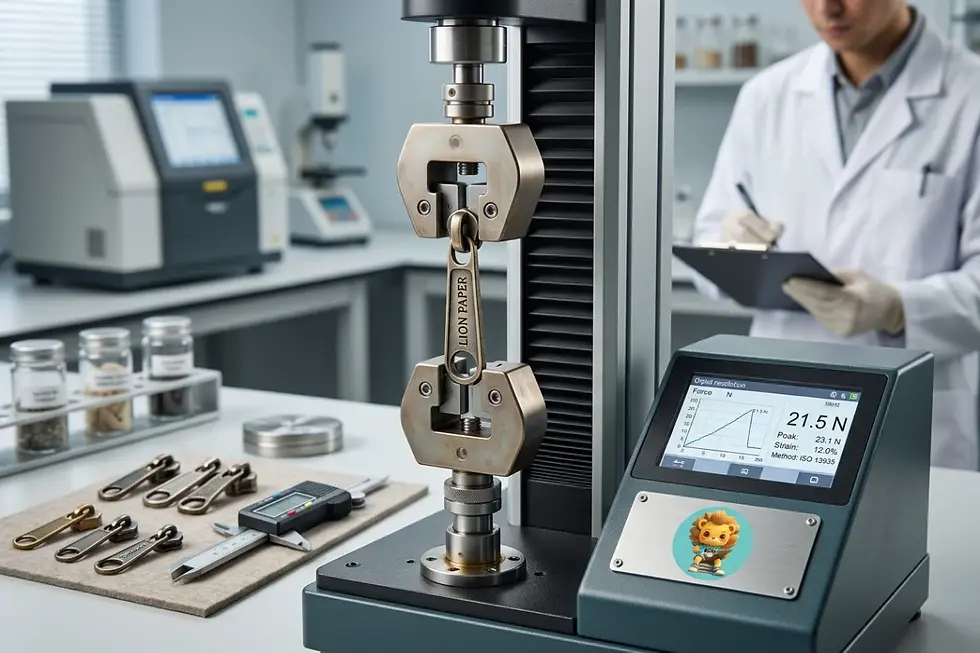
Mechanical tensile and torque testing ensures zipper pullers exceed international retail safety requirements.
What Manufacturing and Compliance Standards Apply to Boutique Pencil Case Hardware?
Stationery products frequently enter educational, youth, office, and creative lifestyle retail sectors where strict international product safety and physical performance standards apply. Boutique pencil pouch hardware must undergo rigorous physical and chemical screening before entering global distribution channels.
Key compliance and quality control standards include:
CPSIA and California Proposition 65: Hardware components, surface coatings, and metallic alloys must undergo certified third-party testing to confirm total lead content remains below 90 ppm for surface coatings and 100 ppm for substrates, alongside strict phthalate limitations on PVC and rubberized pull components.
Nickel Release Standards (EN 1811): Prevents allergic skin sensitization for European markets by testing prolonged direct skin contact thresholds on frequently touched metal sliders and decorative charms.
Salt Spray Corrosion Resistance (ASTM B117 / ISO 9227): Neutral salt spray (NSS) testing verifies that electroplated finishes resist oxidation, pitting, and discoloration for 24 to 72 hours under accelerated marine humidity, protecting goods during ocean freight transit.
Slider Pull-Off and Torque Testing (ASTM D2061): Measures slider-to-tape crosswise pull strength, pull-tab separation resistance (typically requiring minimum 150N to 200N force), and tooth holding strength to prevent choking hazards or sudden structural failure.
Colorfastness and Cross-Staining Resistance: Zipper tape polyester yarns must meet Grade 4+ dry/wet crocking and washing colorfastness to ensure bright dyed tapes never bleed into outer fabric panels or light-colored notebook covers packed alongside.
How Can Brands Develop Coordinated Stationery Sets Using China-Cambodia Dual-Site Synergy?
Modern lifestyle brands rarely sell pencil pouches in isolation. High-margin retail programs rely on synchronized collections comprising coordinated hardcover notebooks, wire-bound planners, desk pads, and matching pencil organizers. Executing these multi-category programs requires deep supply chain integration and design-to-manufacturing synergy.
Lion Paper Products operates an integrated China-Cambodia manufacturing network engineered for this exact requirement. Founded in 2015 with headquarters in Jiaxing, Zhejiang, Lion Paper combines a 3,000-square-meter design, prototyping, and material sourcing hub with an expansive 10,000-square-meter high-efficiency mass production base in Cambodia.
This dual-site model provides unique advantages for stationery brands:
R&D and Rapid Sampling in China: Rapid hardware tooling, custom puller prototyping, Pantone matching, and structural sample construction are executed with speed and precision at the Jiaxing engineering center.
Cost-Efficient Scaling in Cambodia: Once structural patterns and hardware approvals are finalized, high-volume mass production shifts to the Cambodia facility, optimizing landed costs, tariff efficiency, and stable containerized shipping to North America, Europe, Australia, and the Middle East.
Cross-Category Harmony: Lion Paper's capabilities spanning eight core product categories—including Bags & Organizers, Notebooks & Journals, Planners & Calendars, and Gift & Packaging—allow brand partners to match hardware finishes, cover textiles, foil stamping, and packaging across entire seasonal lines under unified ISO 9001 and AQL quality inspection standards.
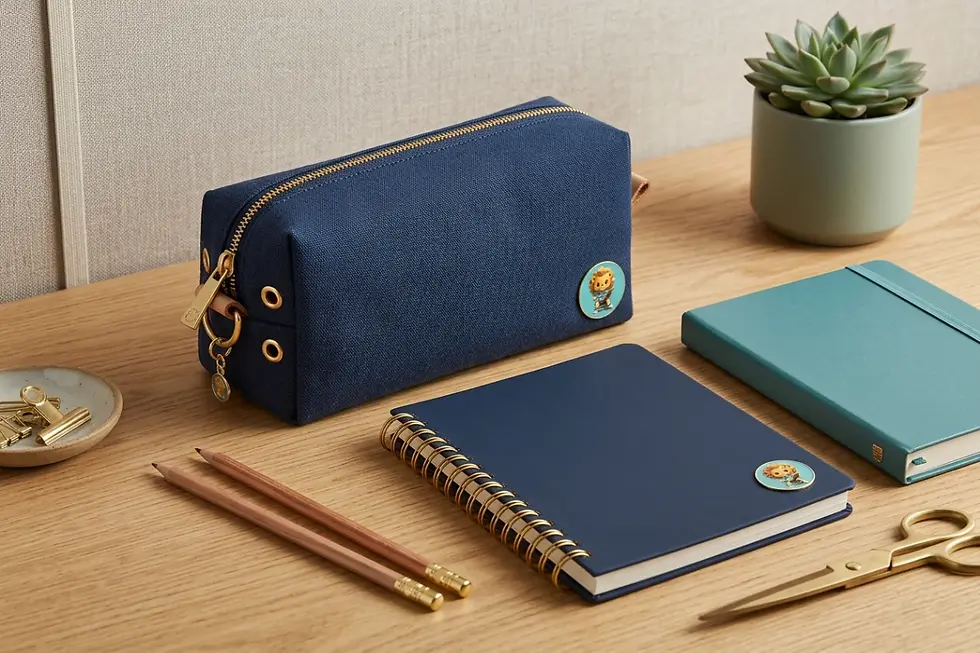
Coordinating hardware plating tones across pouches and journals creates a unified boutique retail collection.
What Should Be Included in an RFQ and Quality Control Checklist for Pouch Hardware?
To eliminate development delays and secure accurate supplier quotations, product development managers and procurement buyers should provide a comprehensive hardware technical pack within their Request for Quotation (RFQ).
Use this comprehensive specification checklist during initial sampling and factory handover:
Zipper System Specs: Type (nylon coil, metal corn tooth, plastic vislon, reverse waterproof), gauge size (#3, #5, #8), tape fabric (standard polyester, recycled RPET, cotton canvas), and exact Pantone color code.
Slider & Puller Specs: Slider locking mechanism (non-lock, auto-lock, pin-lock), puller material (zinc alloy, brass, faux leather, jacquard webbing), 3D logo execution (raised, recessed, laser-etched, color enamel), and final finish (matte, shiny, brushed, antique).
Electroplating & Coating Quality: Plating method (rack hanging plating for luxury smooth finish vs. barrel plating for cost economy), protective clear anti-oxidation lacquer topcoat requirement.
Supplementary Hardware: D-rings, swivel snap hooks, magnetic snap buttons, metal grommets, rivet reinforcements, and branded exterior metal nameplates.
Testing & Compliance Declarations: Required target market certifications (CPSIA, Reach, Prop 65, EN 71-3, SMETA social compliance, FSC chain-of-custody for paper packaging inserts).
Packaging and Protection: Individual tissue wrapping for metal pullers, scratch-protective PE film on polished nameplates, and moisture-absorbing desiccant packs inside bulk master cartons.
Ready to transform your lifestyle collection with custom-engineered organizers and complementary stationery? Share target price, pouch size, material, artwork, hardware, lining, packaging and MOQ with Lion Paper for a retail-ready pouch development brief.
Frequently Asked Questions
What is the best zipper gauge for everyday boutique pencil cases?
A #5 zipper (either nylon coil or polished metal) is widely considered the industry standard for main compartment openings on boutique pencil pouches. It provides the ideal balance of smooth glide action, substantial tactile feel, structural durability, and visual presence without adding excessive weight or stiffness to the pouch body.
Can custom zipper pullers be produced using recycled or sustainable materials?
Yes. Beyond recyclable zinc alloy and brass, custom pullers can be engineered using Global Recycled Standard (GRS) certified recycled polyester webbing, FSC-certified wood tabs, recycled genuine leather offcuts, bio-based PU, or post-consumer recycled (RPET) cords to support brand ESG objectives.
How do auto-lock sliders differ from non-lock sliders in pencil pouch manufacturing?
Auto-lock sliders contain an internal spring-loaded locking pin that prevents the zipper from opening unless the user actively pulls the tab. Non-lock sliders glide freely along the track without internal resistance. Non-lock sliders are generally preferred for stationery pouches and pencil cases to ensure smooth, effortless single-handed opening.
What is the typical lead time for custom molded metal zipper hardware?
Opening a custom metal puller mold and casting pre-production strike-off samples typically requires 10 to 14 working days. Once tooling and plating color swatches are approved, mass production of custom hardware components generally takes 15 to 20 days, running concurrently with pouch fabric cutting and printing prep.
FAQ
What is the best zipper gauge for everyday boutique pencil cases?
A #5 zipper (either nylon coil or polished metal) is widely considered the industry standard for main compartment openings on boutique pencil pouches. It provides the ideal balance of smooth glide action, substantial tactile feel, structural durability, and visual presence without adding excessive weight or stiffness to the pouch body.
Can custom zipper pullers be produced using recycled or sustainable materials?
Yes. Beyond recyclable zinc alloy and brass, custom pullers can be engineered using Global Recycled Standard (GRS) certified recycled polyester webbing, FSC-certified wood tabs, recycled genuine leather offcuts, bio-based PU, or post-consumer recycled (RPET) cords to support brand ESG objectives.
How do auto-lock sliders differ from non-lock sliders in pencil pouch manufacturing?
Auto-lock sliders contain an internal spring-loaded locking pin that prevents the zipper from opening unless the user actively pulls the tab. Non-lock sliders glide freely along the track without internal resistance. Non-lock sliders are generally preferred for stationery pouches and pencil cases to ensure smooth, effortless single-handed opening.
What is the typical lead time for custom molded metal zipper hardware?
Opening a custom metal puller mold and casting pre-production strike-off samples typically requires 10 to 14 working days. Once tooling and plating color swatches are approved, mass production of custom hardware components generally takes 15 to 20 days, running concurrently with pouch fabric cutting and printing prep.


Comments