


Bound Guestbook vs Sign In Cards: B2B Sourcing Guide for Event Stationery

Choosing between a bound guestbook and sign in cards depends on your target retail price, guest capacity, and keepsake value: casebound formats provide premium, all-in-one durability for high-end retail, whereas sign in card sets offer flexible group signing, modular packaging options, and lower bulk shipping costs. Stationery brands, gift retailers, and corporate buyers evaluate these two distinct formats based on production costs, user flow at events, and retail display requirements.
What Are the Key Structural Differences Between a Bound Guestbook and Sign In Cards?
The structural architecture of an event registry dictates its manufacturing workflow, packaging configuration, and archival permanence. When conducting event stationery product development, stationery brands evaluate how bookbinding compares to separate card printing.
A bound guestbook relies on rigid casebinding or thread-sewn hardcovers. It integrates inner text leaves, endpapers, headbands, ribbon bookmarks, and structured cover boards (typically 1.5 mm to 3.0 mm greyboard) into a single cohesive unit. The binding style can range from Smyth-sewn book blocks that open completely flat (180-degree layflat) to wire-O binding concealed inside a hard case. Because the pages are permanently bound into the spine, the book maintains a chronological, unified structure that resists leaf loss.
In contrast, sign in cards operate as a modular stationery system consisting of standalone cardstock units housed inside a secondary container, such as a two-piece rigid box, a magnetic closure presentation box, or a decorative acrylic holder. The cards are precision die-cut from thick paperboard or multi-ply specialty paper, allowing multiple guests to write personal messages simultaneously without forming a line.
Here is an overview of the core physical properties distinguishing the two formats:
Binding and Structural Integrity: Bound formats feature sewn or glued signatures locked permanently into a rigid spine, preventing leaf loss. Sign in cards are loose, die-cut sheets requiring external storage containers or presentation boxes.
Standard Dimensional Formats: Casebound guestbooks commonly use 8x10 inches, 9x12 inches, or 8.5x8.5 inches square. Sign in cards typically measure 4x6 inches, 5x7 inches, or custom novelty die-cut shapes such as arched or scalloped contours.
Assembly Complexity: Bound books require multi-stage folding, gathering, sewing, casing-in, and spine pressing. Card sets require precision sheeting, surface embellishment, collating, mechanical counting, and rigid box assembly.
In-Use Desk Footprint: A hardcover guestbook requires an open desk footprint of roughly 16x10 inches to 24x12 inches. Card displays occupy a compact footprint for the container, while allowing cards to be distributed across multiple tables or reception zones.

Smyth-sewn layflat binding ensures guestbooks remain completely flat for smooth signing.
How Do Bound Guestbooks and Sign In Cards Compare in Usability, Costs, and Specs?
Selecting between a bound guestbook vs sign in cards requires balancing production costs against retail usability. For stationery brand managers and retail buyers, unit economics, container logistics, and writing experiences determine product feasibility.
The following comparison table outlines the technical specifications, logistical parameters, and operational differences between casebound guestbooks and boxed sign in card sets:
Evaluation Metric | Hardcover Bound Guestbook | Boxed Sign In Card Sets |
|---|---|---|
:--- | :--- | :--- |
Typical Inner Substrate | 120–180 gsm woodfree, uncoated art paper, or FSC-certified offset paper | 250–400 gsm cardstock, cotton board, or multi-ply pasted art paper |
Cover / Box Material | 1.8–2.5 mm greyboard wrapped in bookcloth, linen, vegan leather, or printed art paper | 1.5–2.0 mm rigid greyboard gift box, drawer slide box, or tin container |
Page / Card Count | 48 to 120 pages (24 to 60 sheets), accommodating 100–300 entries | 50 to 150 individual cards per box set, expandable with booster packs |
Writing Flow Dynamic | Sequential single-user queue; one party signs while others wait | Distributed simultaneous access; multiple guests write concurrently |
Ink Bleed Resistance | Moderate to high; requires 140+ gsm paper to prevent fountain/gel pen ghosting | High; rigid 300+ gsm cards resist bleed-through, metallic inks, and markers |
Photo Integration | Accommodates photo inserts with photo corners or adhesive tape; requires spine spacers | Highly adaptable; cards can be paired with Polaroid clips or mini albums |
Landed Shipping Cost | Higher dimensional weight and volume per master carton | Compact packing density; lower freight cost per retail unit |
Retail Display Options | Shrink-wrapped flat, belly-banded on shelves, or featured in open book stands | Stackable retail shelf boxes, hang-tab cartons, or visual gift sets |
Keepsake Longevity | High; archival shelf storage alongside family photo albums | Moderate; requires structured post-event archiving in keepsake boxes |
What Manufacturing Feasibility and Material Specifications Define Custom Production?
Custom manufacturing of stationery goods requires precise engineering of paper substrates, surface finishes, and structural tolerances. Sourcing from a custom guest book manufacturer involves distinct production steps depending on the chosen configuration.
Hardcover Bound Guestbook Engineering
For hardcover guestbook OEM lines, paper grain direction and binding flexibility are critical parameters. Inner pages are printed on large sheets, folded into signatures (often 16 or 32 pages), and Smyth-sewn with high-tensile poly-cotton thread. Sewn signatures guarantee that the book lays flat when opened on an event welcome table, preventing guest frustration and protecting the spine from cracked glue.
Cover wraps are mounted over heavy greyboard. Popular wrap materials include:
Natural Linen and Bookcloth: Delivers a tactile, modern finish, highly receptive to metallic hot foil stamping (gold, rose gold, matte white, copper) and blind debossing.
Printed Coated Paper with Lamination: Allows full-color CMYK patterns, protected with anti-scratch matte lamination or soft-touch thermal films.
Faux Leather (PU): Provides a classic, luxury feel with heat-reactive color-changing debossing options.
Spine engineering is tailored based on whether guests will attach instant photos. If photo-mounting is an intended use case, manufacturers must add spine shims (spacers) to ensure the spine thickness accommodates the added volume without fanning the book open outward.
Sign In Card and Presentation Box Manufacturing
When manufacturing wedding sign in cards wholesale programs, card cutting accuracy and box construction define the final quality. Cards are printed on heavy board—such as 350 gsm FSC-certified uncoated paperboard—which provides a rigid, premium handfeel suitable for rollerball pens, fountain pens, and markers.
Key manufacturing processes for card sets include:
High-Precision Die Cutting and Edge Finishing: Eliminates burrs and rough edges. Edges can be finished with metallic foil gilding, painted edge color matching, or intricate die-cut contours.
Surface Embellishments: Applying spot UV, raised 3D gold foil, or blind letterpress indentation elevates card perceived value on retail shelves.
Rigid Presentation Boxes: Card sets require a custom-fitted structural box. A two-piece lift-off lid box or a magnetic closure box with a recessed ribbon pull ensures the cards remain secure and organized during transit and storage.
Card Counting and Automated Shrink Packing: Cards are mechanically counted and banded with printed belly bands before being placed into boxes, preventing missing pieces in final consumer packaging.
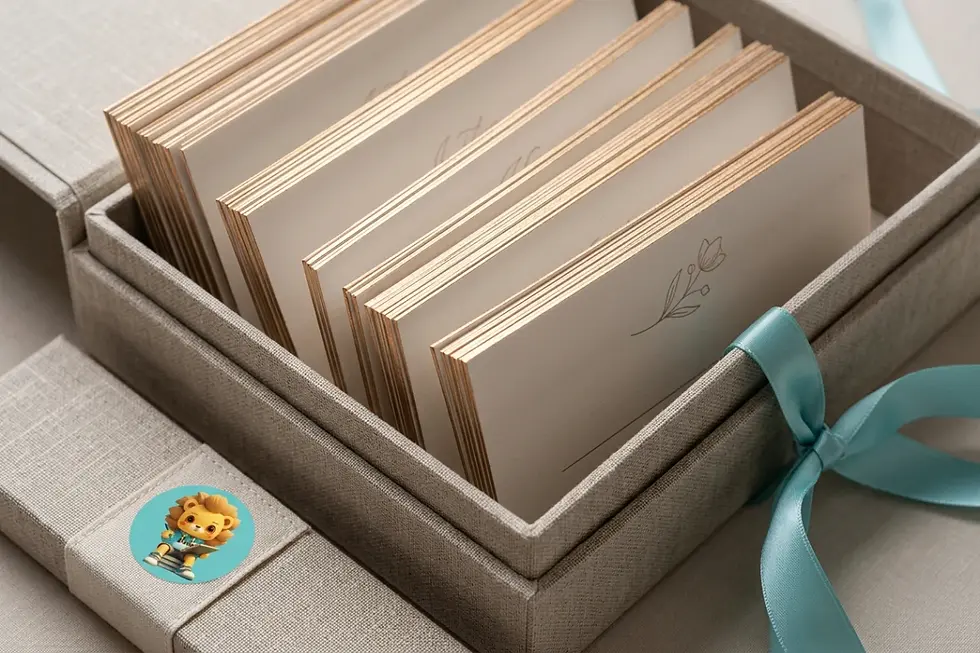
Precision-cut cardstock and edge foil gilding elevate modular sign in card collections.
How Do Channel Fits Differ Across Weddings, Hospitality, Corporate Events, and DTC E-Commerce?
Different sales channels and event settings create varying demand profiles for guestbooks and sign in cards. Product managers must align their assortment strategy with the specific use case, retail environment, and distribution channel.
Wedding and Bridal Retail
The bridal category represents the largest market share for custom guest registries. In this segment, visual aesthetics, tactile elegance, and unboxing appeal drive purchasing decisions.
Bound Guestbooks: Dominate traditional and luxury bridal registries. Couples value the permanent heirloom aesthetic, frequently choosing foil-stamped linen covers with ribbon markers and archival, acid-free pages.
Sign In Cards: Gain significant traction in contemporary, interactive wedding formats. Couples often pair cards with wooden drop boxes, custom glass message jars, or acrylic card holders, allowing guests to complete cards at their dining tables without queuing at a central registry stand.
Hospitality and Boutique Hotels
Boutique hotels, luxury lodges, vacation rentals, and fine dining venues require registry systems designed for continuous, high-frequency use.
Bound Guestbooks: The industry standard for hotel reception desks and lobby consoles. The solid casebound structure withstands daily handling over months or years, preserving guest notes chronologically.
Sign In Cards: Rarely used for hospitality lobby registries, but frequently utilized in hospitality gift shops as packaged destination stationery souvenirs.
Corporate Conferences, Memorials, and Galas
Corporate summits, charity galas, and memorial events prioritize signing speed, professional branding, and ease of message consolidation.
Bound Guestbooks: Preferred for formal galas, state visits, and retirement celebrations where distinguished attendees write extended remarks.
Sign In Cards: Essential for high-capacity corporate conventions, brand activations, and large memorial services. Distributing cards across multiple high-top cocktail tables eliminates bottlenecks, allowing hundreds of attendees to submit notes within tight event schedules.
DTC E-Commerce and Online Marketplace Fulfillment
Direct-to-consumer and cross-border e-commerce retail platforms evaluate products based on dimensional weight, damage rates, and customer review metrics.
Bound Guestbooks: Offer high average order values (AOV) and clear visual appeal in listing imagery. However, they require corner protectors or form-fitting mailer boxes to prevent corner-crush damage in transit.
Sign In Cards: Deliver compact packing volumes, reducing warehousing fees and international shipping costs per unit. The rigid presentation box provides structural defense during transit, reducing return rates caused by shipping wear.
What Decision Rules and Customization Recommendations Should Sourcing Managers Follow?
To build an optimized product catalog, sourcing directors and product managers should balance customer preferences with production minimums, retail price points, and margin targets.
Review the following decision framework to determine which format matches your brand roadmap:
Choose Bound Hardcover Guestbooks when:
Target retail price is in the mid-to-luxury tier ($28.00 to $65.00+ USD).
The brand identity emphasizes classic stationery heirlooms, archival preservation, and traditional craftsmanship.
The intended event has under 150 guests or allows dedicated time for sequential signing.
You require specialized structural features such as photo-spacer spines, Smyth-sewn layflat binding, and ribbon inserts.
Choose Boxed Sign In Card Sets when:
Target retail price falls in the accessible gifting tier ($15.00 to $32.00 USD).
Fast signing flow is required for events with 200+ attendees (such as large galas, corporate gatherings, or high-capacity weddings).
You intend to market modular add-ons, such as booster card packs, table prompt cards, acrylic display stands, or keepsake jars.
You aim to optimize ocean freight container utilization and lower fulfillment costs by maximizing units per pallet.
Many successful stationery and gift brands offer a hybrid catalog: featuring a flagship casebound guestbook line alongside modular boxed sign in card collections, capturing both traditional keepsake buyers and interactive event planners.

Retail-ready packaging and strict AQL quality control protect finished stationery goods during global transit.
How Does Lion Paper Support Custom Keepsake and Stationery Programs?
Founded in 2015 in Jiaxing, Zhejiang, Lion Paper Products (Jiaxing) Co., Ltd. is an integrated supply-chain partner for customized paper goods and creative products. We provide end-to-end solutions that turn ideas into commercial products, supporting brands, retailers, and e-commerce platforms from first sketch to first shipment.
Our dual-site supply network combines design, development, and mass production:
Jiaxing Facility (China): Spanning 3,000 square meters, this facility focuses on product planning, structural engineering, rapid sampling, accessory sourcing, and client support.
Cambodia Facility: Spanning 10,000 square meters, this plant provides high-efficiency mass production, automated assembly, and stable international export delivery.
With an annual notebook and paper product output exceeding 5 million units, Lion Paper manufactures across eight key categories: Eco Paper Products, Notebooks & Journals, Planners & Calendars, Stationery & Office, Bags & Organizers, Accessories, Gift & Packaging, and Home & Living.
Our manufacturing operations deliver clear B2B advantages:
Design-to-Manufacturing Integration: In-house engineers and material specialists convert your graphic files and brand guidelines into production-ready specifications, recommending the ideal board calipers, binding tensions, and foil tooling.
Flexible Scaling & Agile Manufacturing: We support multi-SKU seasonal launches, pilot runs, and large-volume replenishment programs.
Rigorous Quality Management: We maintain consistent batch quality using standardized SOPs, AQL inspection protocols, defect reference catalogs, and automated assembly processes.
Certified Global Compliance: We operate with compliance frameworks supporting ISO 9001, FSC, SMETA, WCA, GSV, FAMA, and CPSIA requirements.
Sustainable Material Options: We provide FSC-traceable papers, recycled greyboard, soy-based inks, and plastic-free retail packaging to meet global ESG standards.
Ready to develop your next event stationery collection? Share use case, capacity, page concept, cover style and target price; request a guestbook layout and construction proposal.
FAQ
What paper weight is best to prevent ink bleeding in custom guestbooks?
For bound guestbooks, 140 gsm to 180 gsm uncoated woodfree or FSC-certified offset paper is recommended to prevent ink bleed and ghosting from rollerball pens, gel pens, and fountain pens. For sign in cards, 300 gsm to 400 gsm paperboard or multi-ply cotton paper ensures rigidity and eliminates ink strike-through.
Can a bound guestbook accommodate photo attachments without bulging?
Yes. When engineering guestbooks intended for Polaroid or photo-strip mounting, manufacturers insert paper shims or spine spacers between signatures. These spacers match the added thickness of photos, keeping the front and back covers parallel when filled.
What is the typical minimum order quantity (MOQ) for custom guestbooks and card sets?
Standard OEM production MOQs generally start at 500 to 1,000 units per style for custom cover wraps, foil stamping, and bespoke packaging. Multi-SKU programs and flexible pilot runs can be tailored depending on material availability and dual-site scheduling.
How do shipping costs compare between bound guestbooks and boxed sign in card sets?
Boxed sign in card sets generally offer a denser, more compact packing profile, which yields higher unit counts per master carton and lower freight costs per item. Bound guestbooks require larger carton volumes and protective corner packaging to prevent impact damage, resulting in slightly higher dimensional shipping costs.


Comments