


Optimizing Bookstore Notepad Assortments: Sourcing, SKU Planning, and Manufacturing Guide

A profitable bookstore notepad assortment balances core functional desk tools—such as structured daily planners and reading trackers—with high-margin, impulse-driven mini memo pads placed near checkout displays. Successful retail buyers curate cohesive paper goods by pairing 80 to 120 gsm FSC-certified paper stocks with sturdy backing boards, distinctive literary cover graphics, and modular retail-ready packaging that maximizes floor space and inventory turnover.
What Strategic SKU Roles Define a Profitable Bookstore Notepad Assortment?
A commercial paper stationery collection in an independent or chain bookstore requires deliberate merchandise hierarchy. Bookstore stationery SKU planning categorizes notepads into three functional tiers: impulse point-of-sale items, daily workflow tools, and thematic or giftable stationery sets. Each category serves a distinct foot-traffic pattern, margin expectation, and price threshold.
Impulse Point-of-Sale (POS) Mini Pads: Measuring between 3x4 inches and 4x6 inches, these compact pads feature witty literary quotes, botanical patterns, or minimalist check-off boxes. Priced between $4.00 and $7.00 at retail, they leverage impulse purchasing near cash wraps and reading nooks to lift average basket size.
Functional Desk and Workflow Pads: Typically formatted in A5, B5, or standard 8.5x11-inch letter dimensions, these items target professionals, students, and avid readers. Common formats include hourly weekly overviews, prioritized to-do task blocks, and dedicated reading log sheets.
Premium Gift and Thematic Collections: These items combine gold foil stamped headers, heavy linen-textured chipboard backs, gilded paper edges, or coordinating pen loops. Positioned at higher retail price points ($12.00 to $18.00), they perform strongly during seasonal gifting windows such as Back-to-School and Q4 holidays.
SKU Category | Typical Dimensions | Sheet Count | Paper Spec | Target Retail Price | Retail Role |
|---|---|---|---|---|---|
:--- | :--- | :--- | :--- | :--- | :--- |
Retail Impulse Memo Pads | 3" x 5" / 4" x 4" | 50–75 sheets | 80–100 gsm Woodfree | $4.00 – $6.50 | Countertop add-on, high turnover |
Reading Log & Review Pads | 5" x 7" / 5.5" x 8.5" | 60–80 sheets | 100–120 gsm Uncoated | $7.00 – $10.00 | Literary lifestyle companion |
Weekly Master Desk Planners | 8.5" x 11" / A4 Landscape | 52 sheets | 100–120 gsm Fountain-Pen Friendly | $12.00 – $16.00 | Planned destination purchase |
Magnetic Grocery & List Pads | 3.5" x 8.5" | 50–60 sheets | 80–90 gsm Offset | $6.00 – $8.00 | Multi-use domestic impulse buy |
Maintaining this balanced ratio prevents assortment stagnation, allowing higher-frequency impulse memo pads to generate rapid inventory turns while larger desk formats establish the bookstore's reputation for dependable, high-grade wholesale bookstore paper goods.

Different notepad variants serve distinct retail use cases, from book logs to daily task organizers.
Which Format Variants Drive High Sell-Through in Literary and Lifestyle Retail?
Bookstore patrons exhibit specific buying behaviors that differentiate them from general office supply consumers. They prioritize tactile surface texture, typographically refined layouts, and designs that celebrate the reading culture. When developing custom notepad manufacturing for bookstores, brands focus on four core structural variants:
1. Dedicated Book Review and Reading Trackers
Bookstore-specific assortments thrive when they cater directly to reading habits. Single-sheet tear-off book review pads allow readers to log page counts, record memorable quotes, rate titles, and catalog personal reading goals. Using thicker 100 to 120 gsm uncoated paper stock prevents bleed-through from gel pens, highlighters, and fountain pens.
2. Undated Weekly and Daily Master Task Pads
Unlike bound planners that carry calendar obsolescence risks, undated desk planning pads offer evergreen sales velocity throughout the year. Landscape-oriented A4 or 8.5x11-inch formats provide spacious fields for habit tracking, daily prioritization grids, and meeting notes, serving home office workers and students alike.
3. Pocket Literary Memo Blocks and Matchbook Pads
These tactile, highly visual products make extensive use of creative novelty binding, such as gummed top edges with die-cut covers or matchbook-style folding flaps. Featuring witty literary themes, reading checklists, or library card motifs, they capture customer attention in high-traffic retail sections.
4. Magnetic Long-List Notepads
Measuring approximately 3.5x8.5 inches and equipped with an adhesive magnetic strip on the rear cardboard, these tall list pads serve kitchen inventory, grocery planning, and bookstore shopping lists. Their dual utility as refrigerator stationery expands the customer base beyond traditional book buyers.
How Do Material Specifications and Binding Methods Impact Retail Durability?
In retail environments where multiple shoppers handle floor display samples daily, paper quality and binding integrity directly affect perceived value and return rates. Specifying the correct raw materials ensures that products endure retail handling without curled edges, split spines, or paper dislodgement.
Paper Stock and Ink Compatibility: Offset uncoated woodfree paper remains the industry benchmark. For standard memo pads, 80 gsm to 100 gsm delivers cost balance and clean handling. For premium stationery collections, 100 gsm to 120 gsm stock provides fountain pen compatibility, eliminating feathering and ghosting.
Sustainable Sourcing and Traceability: Modern bookstore shoppers prioritize environmental sustainability. Utilizing FSC-certified (Forest Stewardship Council) traceable paper and post-consumer recycled (PCR) waste fibers meets institutional environmental guidelines while satisfying consumer preference for eco-conscious paper goods.
Backing Board Caliper and Rigidity: Notepads require rigid backing to allow writing while standing or holding the pad. Commercial specifications call for grayboard or kraft backing with thicknesses between 1.5 mm and 2.5 mm (approximately 800 gsm to 1400 gsm), preventing warping under variable bookstore humidity.
Head Binding Engineering: Notepads rely predominantly on flexible PVA (polyvinyl acetate) glue along the top edge, formulated for clean sheet separation without ripping the top edge of paper. Alternatively, top-wire spiral binding or micro-perforated stitch binding offers secure permanent retention for buyers who wish to preserve historical notes.
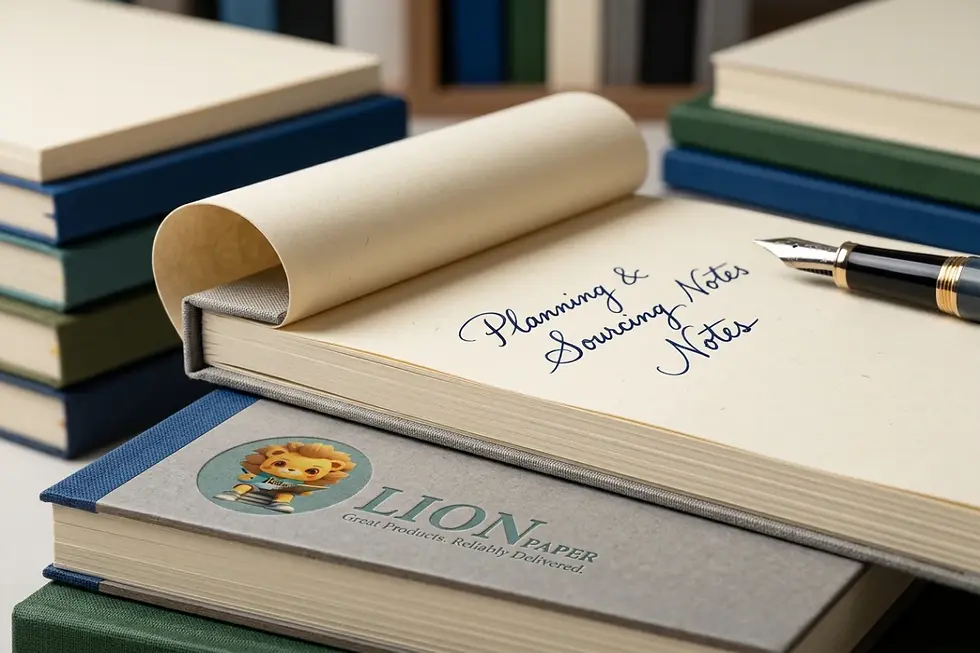
High-density woodfree paper and rigid backing boards ensure durability and smooth writing performance.
How Should Retail Buyers Structure Margins, Packaging, and Point-of-Sale Merchandising?
Optimizing retail profitability requires balancing manufacturing unit cost, freight impact, retail packaging footprint, and shelf display mechanisms. Bookstore buyers generally seek gross margins between 55% and 65% on paper goods, meaning a $10.00 retail notepad should carry a landed cost under $3.50 to $4.00.
To maximize retail performance, paper goods manufacturers configure products into practical retail-ready packaging formats:
Counter Display Units (CDUs): Pre-packed corrugated or rigid paperboard point-of-sale displays hold 12 to 24 units in a compact footprint. These displays sit directly on cash checkout counters, driving immediate impulse purchases with zero retail shelf assembly required.
Individual Protective Packaging: Clear biodegradable PLA sleeves or recyclable BOPP bags protect paper edges from shop wear and moisture during transport and customer handling. For high-end gift collections, printed belly bands with gold foil detailing provide product storytelling while keeping materials visible.
Retail Barcoding and Compliance Labeling: Every retail unit must feature scannable EAN/UPC barcodes, clear SKU identifiers, paper origin disclosures, and compliance marks (such as FSC logos) printed either on the belly band or an easily peelable back sticker.
How Does Lion Paper Support Custom Bookstore Paper Goods Sourcing via Dual-Site Synergy?
Lion Paper Products (Jiaxing) Co., Ltd., founded in 2015, operates as an integrated supply-chain partner for customized paper goods and creative lifestyle products, bridging design concepts to bulk delivery. With annual notebook and paper product output exceeding 5 million units, Lion Paper serves major retailers, independent stationery brands, and gift distributors across North America, Europe, Australia, the Middle East, and Southeast Asia.
Our manufacturing infrastructure combines design prototyping with scalable global manufacturing:
China Jiaxing Development Center (3,000 m²): Dedicated to product planning, structural engineering, rapid sampling, paper stock curation, and low-run pilot batch testing. This center allows bookstore buyers to test multiple artwork variants and format sizes before committing to large inventory volumes.
Cambodia Production Facility (10,000 m²): Configured for high-speed automated mass production, packaging optimization, and global container shipping. This dual-site synergy delivers tariff-efficient landed costs, robust volume scalability, and consistent production schedules.
Comprehensive Compliance Audits: Lion Paper maintains compliance systems verified through ISO 9001, FSC traceability, SMETA, WCA, GSV, FAMA, and CPSIA audits, ensuring safety and social responsibility across every retail shipment.
Through standardized operating procedures (SOPs), AQL defect sampling thresholds, and integrated quality control checkpoints, Lion Paper ensures color fidelity, precise pad gluing, and rigid pallet packaging from the first sample to final shipment.

Automated finishing lines ensure consistent spine binding strength and precise paper trimming.
What Technical Parameters Belong in an RFQ for Custom Bookstore Notepads?
When preparing a request for quotation (RFQ) for custom notepad manufacturing, procurement managers should define structural, visual, and logistical specifications clearly to obtain accurate pricing and lead-time projections.
Pad Dimensions: Width x Height (e.g., 4" x 6", 5.5" x 8.5", A5, A4)
Sheet Count: Number of inner leaves (commonly 50, 60, 75, or 100 sheets)
Paper Specifications:
Weight: 80 gsm, 100 gsm, or 120 gsm
Grade: FSC Woodfree Uncoated, Recycled Offset, or Cream Bond
Color: Natural white, ivory, or warm cream
Printing & Ruling:
Number of colors: 1C/0C (minimalist line/grid), 4C/0C (full color illustrations)
Edge detailing: Optional edge gilding, edge printing, or rounded corners
Spine Binding Method: PVA tear-off head glue, wire-o spiral, or perforated stitch
Backing Board: 1.5mm to 2.5mm grayboard, kraft chipboard, or magnetic backing
Retail Packaging:
Individual PLA/polybag, shrink-wrap, or printed paper belly band
Master carton pack size and Counter Display Unit (CDU) specifications
Compliance Requirements: FSC chain-of-custody, CPSIA, toxic-free ink certification
Supplying these explicit parameters enables manufacturing teams to calculate optimal sheet nesting on printing presses, reduce raw material waste, and present accurate per-unit landed costs.
To start planning your seasonal bookstore stationery collection, contact our custom stationery team with your pad dimensions, sheet counts, artwork specifications, target volumes, and retail packaging requirements for a complete manufacturing feasibility review.
FAQ
What is the typical minimum order quantity (MOQ) for custom bookstore notepads?
Standard production MOQs generally start at 1,000 to 2,000 units per design variant to achieve cost-effective offset printing. For multi-design collections or pilot testing, flexible production arrangements can accommodate split print runs across shared sheet layouts.
Which paper weight is best suited for literary and lifestyle notepads?
For everyday impulse memo pads, 80 to 90 gsm uncoated woodfree paper provides good performance at an economical cost. For premium desk pads and fountain-pen-friendly book review notepads, 100 to 120 gsm FSC-certified paper is recommended to prevent ink bleed and show-through.
Can custom notepads be delivered pre-packed in retail Counter Display Units (CDUs)?
Yes. Custom corrugated or rigid paperboard CDUs can be engineered, printed with matching branding, and packed with 12 to 24 units per display at the factory level, allowing retailers to unpack and position goods directly onto sales counters.
How does Lion Paper manage quality control across high-volume notepad runs?
Lion Paper uses standardized SOPs, raw material inspection for paper moisture and caliper, AQL 2.5 sampling standards during production, and drop-testing for master packaging to ensure batch-to-batch consistency and structural durability.


Comments