


Blank Notebook Inventory Versus Printed Covers: Sourcing Strategy and Risk Guide

Choosing between blank notebook inventory versus printed covers is fundamentally a balance between operational agility and marginal unit cost. Neutral notebook stock procurement allows brands to commit to standardized book blocks and postpone cover embellishment, significantly mitigating the risk of dead inventory when market trends shift. Conversely, mass-producing fully printed covers upfront achieves the lowest baseline manufacturing cost per unit, but introduces substantial custom printed cover inventory risk if creative designs underperform across retail channels.
What Is the Core Sourcing Difference Between Blank Stock and Printed Cover Inventory?
The fundamental distinction lies in where the decoupling point is placed within the paper manufacturing lifecycle. In traditional printed cover procurement, printing, surface lamination, stamping, case binding, or wire-o assembly are executed as a single, uninterrupted production batch. The entire stock is committed to a specific stock-keeping unit (SKU) before consumer demand is validated.
In contrast, adopting neutral notebook stock procurement divides manufacturing into two decoupled phases: producing standardized base components (such as stitched book blocks, neutral softcovers, or unprinted hardbound shells) and executing secondary finishing (such as screen printing, foil debossing, digital UV printing, or belly band labeling) on demand.
Fully Printed Cover Stock: Total upfront customization, minimum component modularity, maximum production yield efficiency at high volume, and zero late-stage design flexibility.
Blank Notebook Inventory: Standardized core specifications (paper grade, page count, grid ruling, trim size), maximum postponement capability, and rapid adaptation to seasonal design updates.
Semi-Assembled Hybrid Stock: Pre-assembled book blocks paired with blank exterior covers, awaiting custom stamping, edge gilding, or personalized retail packaging.
Understanding this structural decoupling enables procurement managers to align their manufacturing commitments directly with retail sell-through velocity, seasonal life cycles, and channel-specific customization requirements.
How Does Neutral Notebook Stock Procurement Improve Private Label Inventory Management?
Implementing neutral notebook stock procurement forms the foundation of resilient private label notebook inventory management. Brands managing multi-channel distribution—including direct-to-consumer (DTC) storefronts, corporate gifting, Amazon platforms, and physical retail distribution—frequently experience unpredictable sales velocity across individual visual variants.
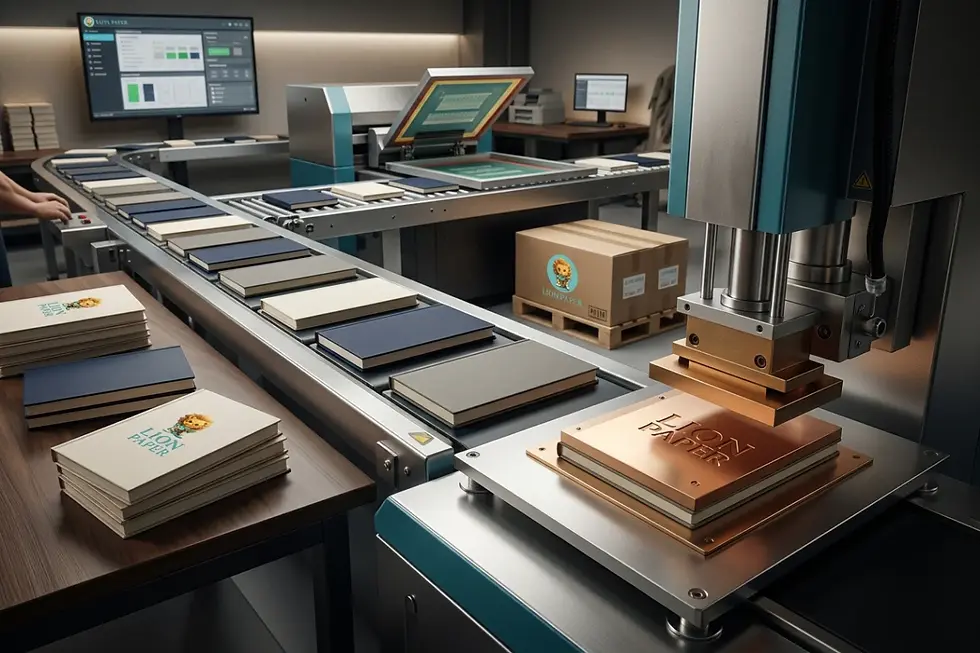
Decoupling inner book block production from late-stage surface embellishment shortens replenishment cycles.
When a brand holds neutral inner book blocks and blank cover shells, the same baseline raw inventory serves multiple end products. For example, a single production run of 20,000 units of an 80 gsm FSC-certified dot-grid, A5 neutral hardcover notebook can be divided dynamically:
5,000 units finished with gold foil stamping for a corporate holiday gifting client.
7,000 units decorated with seasonal silk-screen artwork for spring retail distribution.
3,000 units finished with minimal blind deboss logos for steady e-commerce replenishment.
5,000 units maintained in unprinted stock to absorb unexpected demand spikes or launch flash collections.
This postponement framework compresses customer replenishment lead times from twelve weeks down to ten business days. Rather than initiating pulp sourcing, sheet cutting, offset press runs, and full binding lines for every order, the manufacturing partner simply executes surface finishing, final quality inspection, and secondary packaging.
What Are the Financial and Operational Risks of Custom Printed Cover Inventory?
While running large offset print batches for specific cover artwork delivers attractive economies of scale, it exposes stationery brands to severe financial liabilities when demand diverges from forecasts. Custom printed cover inventory risk manifests primarily through three mechanisms: visual trend obsolescence, commercial capital lockup, and physical warehousing degradation.
Trend and Art Obsolescence: Consumer stationery preferences change rapidly across color palettes, typography, and graphic themes. An over-ordered graphic cover from Q3 cannot be repurposed once consumer interest transitions to new seasonal motifs, forcing steep clearance discounting or total write-offs.
Working Capital Stagnation: Capital tied up in finished, pre-printed stationery units restricts cash flow necessary for testing new product categories, sourcing innovative materials, or scaling proven marketing campaigns.
Physical Storage and Surface Vulnerability: Fully printed covers featuring delicate soft-touch coatings, matte films, or intricate hot foil stamping suffer degradation risks during prolonged warehouse storage, including edge wear, humidity-induced board warping, scuffing, and adhesive aging.
When an offset run produces 10,000 units of a printed design that only sells 4,000 copies, the real unit cost of the 4,000 sold units effectively doubles. Sourcing teams must calculate total landed cost not by the nominal purchase order invoice price, but by the net margin realized after accounting for unsold stock write-downs.
What Strategies Deliver Measurable Stationery Component Obsolescence Mitigation?
To safeguard procurement margins against dead stock, supply chain directors implement structured stationery component obsolescence mitigation practices. These methods distribute production commitments across raw materials, standardized sub-assemblies, and final packaging elements.

Modular component planning protects stationery brands against design obsolescence and inventory write-offs.
Standardized Universal Book Blocks: Keep inner sheet specifications uniform across 80% of notebook lines (e.g., standard 100 gsm acid-free cream paper with light-grey 5mm dot grid). Standardization allows bulk pulp purchasing and shared interior printing runs.
Modular Decorative Elements: Utilize exterior accessories—such as custom belly bands, printed slipcases, ribbon markers, graphic tip-in pages, or sticker sheets—to differentiate products while keeping the underlying notebook exterior neutral.
Batch-Split Surface Embellishment: Order primary notebook quantities in bulk to capture raw material tier pricing, but contractually split surface decoration into scheduled call-off releases linked to quarterly sales milestones.
Hybrid Print Technologies: Combine high-volume offset printing for steady evergreen core lines with agile industrial digital printing or laser etching for small-batch, personalized, or influencer co-branded capsule drops.
By isolating bespoke decorative aspects from structural paper components, stationery businesses maintain pristine inventory liquidity while preserving dynamic visual merchandising across physical and digital storefronts.
How Do Commercial Terms, MOQs, and Ownership Rules Compare Across Models?
Structuring supply contracts requires an understanding of how minimum order quantities (MOQs), cash commitments, unit manufacturing economics, and risk allocation shift between blank stock programs and pre-printed production batches.
Procurement Dimension | Neutral Blank Notebook Inventory | Custom Pre-Printed Cover Batches | Hybrid Component Stocking (Postponement) |
|---|---|---|---|
:--- | :--- | :--- | :--- |
Initial Production MOQ | High aggregate volume across shared blank base (e.g., 5,000–10,000 units) | Medium-to-high per specific SKU (e.g., 1,000–3,000 units per artwork) | High for book blocks (5,000+); Low per surface run (300–500 units) |
Nominal Unit Cost | Moderate (includes buffer for secondary finishing setup) | Lowest initial invoice cost per unit at scale | Balanced; low base cost with agile secondary finishing fees |
Obsolescence Exposure | Near zero (neutral stock is continually redeployable) | High (unsold covers cannot be repurposed) | Very low (covers/blocks held unprinted until call-off) |
Replenishment Lead Time | Rapid (7–15 days for decorative finishing) | Standard (45–60 days for complete manufacturing) | Highly agile (10–20 days for assembly and finishing) |
Working Capital Flexibility | High (capital allocated to liquid, versatile stock) | Low (capital committed to fixed visual assets) | High (deferred commitment on visual variations) |
Ideal Channel Application | Corporate gifting, POD, rapid replenishment DTC | High-volume retail programs with locked seasonal buys | Multi-SKU brand collections and omni-channel portfolios |
In standard contract terms, neutral blank stock programs often involve a shared raw material agreement where the manufacturer holds agreed baseline volumes of pre-assembled blocks or unembellished journals, while the client agrees to consume the inventory within a rolling 6 to 12-month horizon.
How Can Production Frameworks Balance Customization Agility and Unit Cost?
Balancing low production costs with design responsiveness requires integrating dual-stage engineering into initial product development. Rather than treating notebooks as monolithic finished goods, product development teams design them as modular assemblies.

Dual-stage production systems integrate high-volume manufacturing with agile finishing workflows.
Stage 1: Scaled Mass Manufacturing. Sourcing large-volume paper reels, high-speed automated folding, section sewing, spine gluing, and neutral hardback casing. This phase maximizes machine throughput and material yield, driving down foundational component costs.
Stage 2: Agile Secondary Personalization. Deploying specialized finishing cells for spot UV application, digital hot-stamping, precision screen printing, personalized laser engraving, custom band wrapping, and retail barcoding.
Dual-site manufacturing networks enhance this operational balance. For instance, high-volume standardized mass production can be executed in large-scale facilities optimized for automated output, while rapid prototyping, design adjustments, short-run testing, and specialized sampling take place within regional engineering hubs. This dual-site synergy ensures that private label brands capture the cost benefits of mass production without sacrificing the agility required for responsive seasonal merchandising.
What Checklist Should Procurement Teams Use for Component-Level Stationery RFQs?
To ensure pricing transparency and avoid unexpected surcharges during late-stage decoration, requests for quotation (RFQs) and purchase orders (POs) must outline technical specifications at both the component and assembly levels.
Book Block Substrate Specifications: Paper origin, FSC chain-of-custody status, basis weight (gsm), opacity rating, bulk thickness, shade (natural, cream, bright white), and ruling ink color specifications.
Cover Material Characteristics: Substrate type (recycled greyboard, thermo-PU, bookcloth, coated art paper, kraft board), thickness (caliper in mm or pt), corner rounding radius, and spine construction (square, round, flexible).
Surface Decorating Tolerances: Specific finishing techniques allowable on blank stock (e.g., blind debossing depth tolerances, foil adhesion performance, edge registration for digital printing).
Postponement Call-Off Terms: Storage duration limits for unprinted inventory, minimum release batch sizes for secondary finishing runs, turnaround SLAs, and secondary setup charges per SKU variant.
Packaging and Protection Standards: Individual shrink-wrapping, polybag thickness, barcode sticker placement, master carton drop-test ratings, pallet strapping, and moisture barrier requirements during warehouse staging.
Clear specification breakdowns in component-level contracts eliminate disputes regarding setup waste, registration accuracy, and unit cost adjustments across partial release orders.
How Does Lion Paper Support Agile OEM and ODM Stationery Sourcing?
Founded in 2015 in Jiaxing, Zhejiang, Lion Paper Products (Jiaxing) Co., Ltd. operates as an integrated supply-chain partner for customized paper goods and creative products rather than a conventional print facility. Lion Paper bridges the gap from first sketch to first shipment by combining in-house product planning, structural engineering, certified material sourcing, rapid prototyping, and automated mass manufacturing.
Our manufacturing ecosystem leverages China–Cambodia dual-site synergy to provide clients with optimal cost, capacity, and delivery flexibility. Our 3,000-square-meter Jiaxing facility concentrates on product design, structural innovation, fast sampling, and customer development support. Mass production, volume efficiency, and long-term delivery stability are driven by our 10,000-square-meter Cambodia facility, supporting an annual notebook production capacity exceeding 5 million units across wire-bound, spiral, perfect-bound, hardcover, and softcover formats.
Lion Paper serves lifestyle brands, major retailers, corporate buyers, religious organizations, e-commerce platforms, and creator-led brands across North America, Europe, Australia, the Middle East, and Southeast Asia. Our quality assurance framework relies on standardized operating procedures (SOPs), rigorous AQL sampling standards, defect mapping, and strict process controls. Supported by comprehensive compliance foundations including ISO 9001, FSC, SMETA, WCA, GSV, FAMA, and CPSIA audits, we specialize in sustainable product development using traceable papers, low-impact printing, and retail-ready packaging.
To optimize your brand's component inventory strategy, reduce obsolescence risks, and streamline production planning, contact our OEM/ODM supply chain specialists to share your forecast, target specifications, delivery schedule, and anticipated order volume for tailored samples and quotations.
FAQ
What is the typical minimum order quantity difference between blank inventory and printed covers?
Fully customized pre-printed covers typically require an initial manufacturing run of 1,000 to 3,000 units per graphic design to justify offset printing plate and setup costs. Under a neutral blank stock procurement framework, a brand can commit to an aggregate base run of 5,000 units across shared universal book blocks, then execute decorative cover finishing runs in agile batches as small as 300 to 500 units per variant.
Can softcover and wire-bound notebooks use blank stock inventory models?
Yes. Softcover notebooks can utilize neutral pre-assembled interior sections that receive personalized covers through short-run digital creasing and binding, or standardized covers that undergo post-assembly debossing. Wire-bound and spiral notebooks are well suited for postponement because pre-punched, standardized inner sheet pads can be bound quickly with digitally printed or stamped front and back covers on demand.
How does holding blank notebook stock affect the overall landed unit cost?
Holding blank stock may result in a slightly higher direct finishing cost per unit compared to an uninterrupted high-volume offset run due to secondary machine setups. However, because it prevents overproduction and eliminates dead inventory write-downs from underperforming designs, the effective net landed cost across the entire product lifecycle is frequently lower.


Comments