


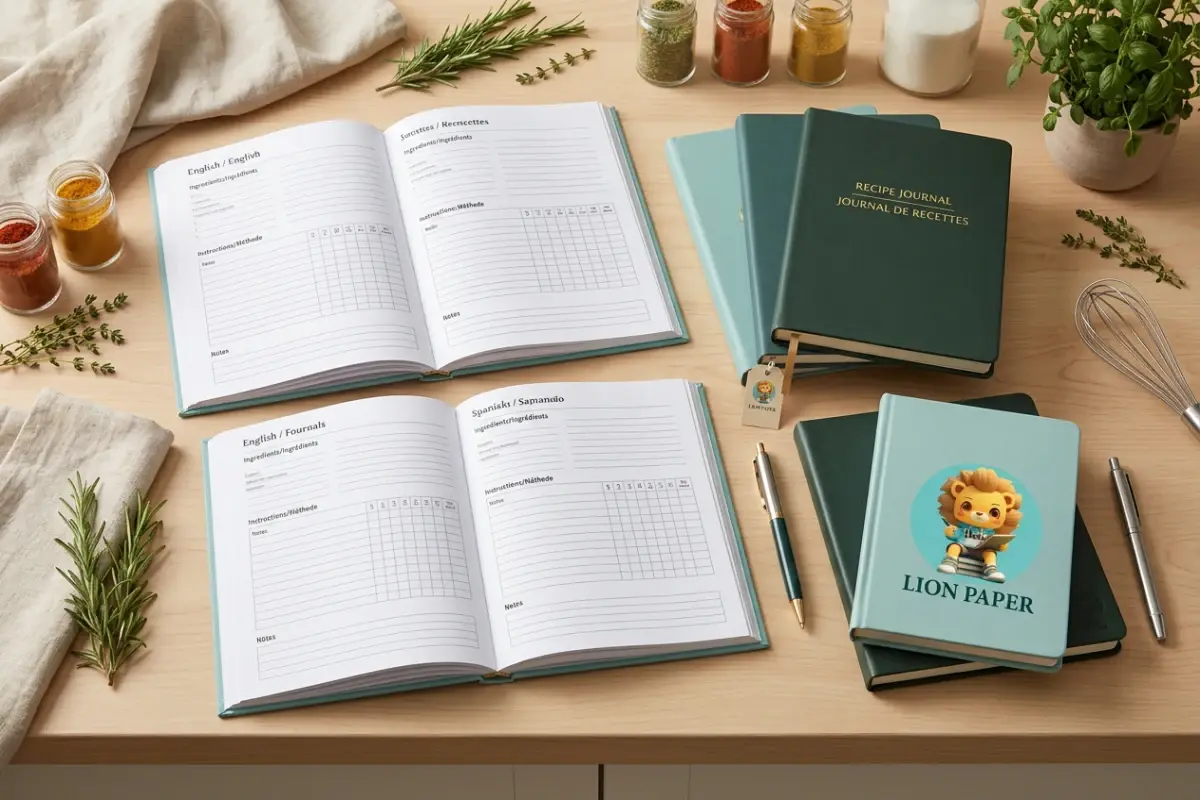
Bilingual Recipe Journals Wholesale: Custom Manufacturing Guide

Procuring bilingual recipe journals wholesale requires a balance between functional dual-language typography, durable kitchen-grade materials, and agile manufacturing workflows. Sourcing managers must account for regional language pairings, spill-resistant coatings, and lay-flat binding structures that endure demanding kitchen environments. Lion Paper leverages China-Cambodia dual-site production to deliver end-to-end custom bilingual recipe books, combining rapid pre-press prototyping with scalable, tariff-optimized bulk production.
What Are the Key Layout and Typography Principles for Custom Bilingual Recipe Books?
Designing effective custom bilingual recipe books demands a structured page hierarchy that accommodates two languages without cluttering the cooking workflow. Culinary journals present unique typographic challenges because recipe terminology, ingredient names, preparation verbs, and fractional measurements vary significantly across linguistic regions. When developing multilingual cooking journal printing projects, publishers and private label brands typically choose between three core layout architectures:
Side-by-Side Split Column Layout: The page is split vertically, placing the primary language on the left column and the secondary language on the right. This format works best for short-form recipes, cocktail journals, and quick culinary note-taking where readers scan parallel text blocks simultaneously.
Facing Page Mirror Layout: The left-hand page displays the complete recipe in Language A, while the right-hand page mirrors the exact structure in Language B. This approach is preferred for complex, multi-step baking formulas and heirloom family cookbooks because it preserves white space and maintains generous line spacing for handwriting.
Stacked Sectional Layout: Recipe titles, ingredient listings, and instructions are grouped in sequential horizontal blocks with bilingual subtitles (e.g., English paired with Spanish, French, or German). This structure maximizes horizontal line length for lengthy preparation notes.
Typographic harmony is essential. Different languages exhibit distinct text expansion ratios; for example, Spanish and French translations often require 15% to 25% more physical space than English, whereas Chinese or Japanese scripts require specialized baseline grid alignments and increased line heights. Sourcing teams must ensure their typography pairings maintain equivalent visual weight by selecting complementary sans-serif or legible serif font families. Furthermore, pre-printed conversion charts—translating Celsius to Fahrenheit, grams to ounces, and milliliters to cups—should be integrated into front or back reference sections to enhance retail value for international consumers.

Precision-engineered interior page grids balance dual-language typography and conversion tables for seamless kitchen utility.
Which Materials and Finishes Protect Multilingual Cooking Journals in Kitchen Environments?
Recipe notebooks operate in harsh environments exposed to moisture, cooking oils, flour dust, and fluctuating temperatures. Material selection directly determines product longevity, brand perception, and return rates. An experienced oem recipe journal manufacturer must recommend specialized cover substrates, protective laminations, and heavy inner text stocks designed specifically for culinary durability.
Cover engineering balances aesthetic appeal with wipe-clean functionality:
Water-Resistant Vegan PU Leather: Polyurethane leatherette offers a premium tactile feel suitable for luxury retail and lifestyle gift collections. Thermosensitive PU allows for crisp blind debossing and gold foil stamping while repelling oil and water splashes.
Reinforced Hardcover with Matte Anti-Scratch Lamination: Utilizing 1.8mm to 2.5mm high-density greyboard wrapped in printed art paper treated with scuff-resistant matte thermal lamination protects against fingerprints, liquid stains, and corner fraying.
Waterproof Coated Book Cloth: Premium book cloth treated with an invisible hydrophobic coating provides a classic European library aesthetic while preventing liquid absorption.
Inner paper stock must balance ink absorption with bleed-through resistance. Recipe writers use ballpoint pens, gel pens, permanent markers, and fountain pens. Standard 70gsm or 80gsm offset papers are prone to ghosting and ink bleeding when subjected to wet kitchen counters. High-performance private label recipe notebooks utilize 100gsm to 140gsm FSC-certified wood-free uncoated paper or cream wood-free paper. These stocks provide a smooth writing surface, high opacity, and rapid ink absorption that prevents smudging. For brands targeting sustainable markets, post-consumer waste (PCW) recycled papers with low-impact soy-based inks deliver high environmental performance without compromising paper strength.
Functional hardware upgrades further elevate user utility in the kitchen. Dual satin ribbon bookmarks allow cooks to mark the active recipe page and the measurement conversion table simultaneously. Reinforced elastic enclosure bands keep loose recipe clippings securely bound, while expandable back gusset pockets made from 250gsm kraft paper provide storage for family recipe cards and clipped magazine clippings.
How Does an OEM Recipe Journal Manufacturer Manage Multi-Language SKU Variations?
Managing multiple regional language editions—such as English/Spanish for North America, English/French for Canada and Western Europe, or English/Arabic for the Middle East—can escalate tooling costs if production runs are not structured efficiently. An experienced oem recipe journal manufacturer deploys sophisticated prepress workflows and flexible print scheduling to minimize unit costs across multi-SKU production batches.
To optimize manufacturing efficiency across bilingual editions, print engineers implement black-plate changeover protocols (K-plate switching). In this process, the standard CMYK process colors—used for background design elements, borders, culinary illustrations, and full-color food photography—remain static on the offset press cylinders across all SKU variations. Only the black (K) printing plate, which carries the localized recipe text and structural lines, is swapped between regional language runs. This methodology reduces plate-making costs by up to 60%, slashes press makeready time, and maintains absolute color consistency across diverse international markets.
Quality assurance for multilingual cooking journal printing requires rigorous pre-flight digital file verification and standardized operating procedures (SOPs). Optical character recognition (OCR) and automated digital proofing software cross-check language files against approved master manuscripts to eliminate font substitution errors, dropped diacritical marks (such as accents, tildes, and umlauts), and text reflow issues. In-line automated inspection cameras on binding and folding lines verify that the correct language signatures are gathered in sequential order, preventing mixed-language assembly defects during mass binding operations.

Black-plate changeover workflows allow cost-effective printing across multiple regional language editions without sacrificing color consistency.
What Binding, Format, and Retail Packaging Options Suit Private Label Recipe Notebooks?
Selecting the correct structural binding is the single most critical engineering decision for culinary journals. A recipe journal must remain open flat on a kitchen countertop without requiring the home chef to weigh down the pages with heavy kitchen utensils. Sourcing directors evaluate four primary binding methods based on use scenario, durability, and target price tier:
Binding Style | Lay-Flat Capability (180°) | Durability Level | Production Cost Tier | Recommended Retail Scenario |
|---|---|---|---|---|
:--- | :--- | :--- | :--- | :--- |
Smyth Sewn Casebound | Excellent (Opens true 180° flat) | High (Thread-locked signatures) | Mid to High Tier | Premium retail, lifestyle gift sets, heirloom journals |
Concealed Wire-O Hardcover | Superior (Full 360° rotation) | High (Rigid spine enclosure) | Mid Tier | Modern kitchen workbooks, interactive culinary planners |
Exposed Double-Spiral (Twin Wire) | Superior (Folds completely flat) | Moderate to High (Exposed metal) | Entry to Mid Tier | High-utility cooking notebooks, meal planners, classroom journals |
Flexibound (PU / Softcover) | Good (Soft spine flexibility) | Moderate (Glued and sewn) | Entry to Mid Tier | Portable culinary notebooks, DTC brand merchandise |
Standard trim sizes for bilingual recipe journals wholesale typically center on three standard commercial formats:
B5 Format (176 x 250 mm / 7 x 10 in): The international industry standard for culinary journals. It offers adequate surface area for dual-language recipe grids, prep-time metadata, ingredient checklists, and personal chef tasting notes without overcrowding the page.
A5 Format (148 x 210 mm / 5.8 x 8.3 in): A compact, portable format suited for cocktail journals, dessert notebooks, and promotional gift sets.
Custom US Standard (8 x 10 in / 8.5 x 11 in): Popular in mainstream North American retail superstores, accommodating large-print typography and multi-generational heirloom documentation.
Retail-ready packaging completes the private label offering. Retail buyers can choose from full-color printed belly bands with matte lamination and foil accents, biodegradable polybags with suffocation warnings, barcode labeling conforming to Amazon FBA and GS1 retail standards, or premium rigid two-piece gift boxes. Gift packaging enhances perceived value, protects pristine book edges during transit, and provides turn-key merchandising display solutions for department stores and boutique kitchenware retailers.
How Does Dual-Site Supply Chain Synergy Optimize Agile Prototyping and Scalable Mass Production?
Navigating global supply chain volatility, fluctuating freight rates, and international trade tariffs requires an agile, multi-node manufacturing infrastructure. Lion Paper addresses these operational challenges through a coordinated China-Cambodia dual-site supply chain strategy. This hybrid operational model bridges the gap between creative product development and cost-effective, high-volume manufacturing.
The Jiaxing facility in Zhejiang, China (spanning approximately 3,000 square meters) operates as the primary R&D, structural design, customer support, and rapid prototyping hub. In-house paper engineers and packaging specialists turn initial design sketches into physical, production-grade samples within 3 to 7 business days. The Jiaxing operation supports low-minimum pilot runs, intricate specialty finishes (such as edge gilding, holographic foil stamping, spot UV, and custom die-cut tab dividers), and multi-style seasonal testing. This agility enables stationery brands, creator-led communities, and DTC e-commerce platforms to validate bilingual recipe concepts in regional test markets before committing to high-volume capital investments.
Once product designs are market-tested and approved, mass manufacturing transitions seamlessly to the Cambodia production facility (spanning approximately 10,000 square meters). Equipped with high-speed automated folding lines, automated signature sewing systems, and high-capacity casebound casing-in machinery, the Cambodia facility delivers an annual capacity exceeding 5 million notebook units. Sourcing from Cambodia provides North American and European enterprise buyers with significant tariff mitigation advantages, competitive labor efficiency, and diversified geopolitical risk management.
Both manufacturing facilities operate under standardized Standard Operating Procedures (SOPs), centralized material procurement channels, and rigorous ISO 9001 quality management protocols. Lion Paper’s dual-site synergy provides wholesale buyers with total-cost efficiency, reliable container-load delivery schedules, and scalable replenishment pipelines that balance agile innovation with manufacturing economies of scale.

Automated casebound assembly and custom retail packaging ensure books arrive shelf-ready for global retail distribution.
What Specifications and Compliance Standards Are Essential for Global Export RFQs?
To obtain precise, actionable pricing from an oem recipe journal manufacturer, procurement teams must assemble a comprehensive Request for Quotation (RFQ) document. Ambiguous technical specifications lead to unnecessary revision cycles and inaccurate cost estimates. Sourcing managers should compile their bilingual recipe journals wholesale RFQ utilizing the following structured specification parameters:
Trim Dimensions and Orientation: Explicitly define width by height in millimeters or inches (e.g., B5: 176 x 250 mm, portrait orientation).
Page Count and Pagination: Specify total page count in multiples of 16 (for signature sewing) or multiples of 4 (e.g., 192 interior pages + 8 endpaper pages).
Cover Construction: Specify substrate thickness (e.g., 2.0mm greyboard), wrapping material (e.g., 157gsm coated art paper, fine linen cloth, or 0.8mm thermo PU leather), and surface finishes (e.g., matte anti-scratch lamination, debossing, foil stamping).
Text Paper Specifications: Indicate paper type (e.g., FSC-certified cream wood-free paper), basis weight (e.g., 120gsm), opacity rating, and interior print colors (e.g., 1C/1C black or 2C/2C PMS spot colors).
Binding Method: Designate exact binding structure (e.g., Smyth sewn casebound with round or square spine, head-and-tail bands, lay-flat design).
Multi-Language Version Breakdown: Detail total order quantity segmented by regional language SKU (e.g., 10,000 units total: 6,000 English/Spanish, 4,000 English/French).
Packaging and Compliance Requirements: State individual packaging (e.g., shrink-wrap with scannable barcode label), master carton packing limits (e.g., max 15 kg per double-wall carton), palletization standards (e.g., heat-treated ISPM-15 wooden pallets), and required market compliance audits.
International regulatory compliance is non-negotiable for commercial retail distribution. Custom bilingual recipe books entering North American, European, and Australian markets must comply with rigorous chemical and social accountability standards. Lion Paper maintains an audit-ready compliance framework covering ISO 9001 for quality assurance, FSC (Forest Stewardship Council) chain-of-custody for sustainable forest management, SMETA (Sedex Members Ethical Trade Audit) and WCA (Workplace Conditions Assessment) for ethical labor, GSV (Global Security Verification) for supply chain security, and FAMA authorization. Furthermore, all printing inks, coatings, and cover materials comply with CPSIA (Consumer Product Safety Improvement Act) and REACH standards, guaranteeing that heavy metal content, phthalates, and VOC emissions remain well within legal limits for household consumer goods.
Ensure your next product launch achieves optimal commercial performance by partnering with a dedicated paper goods manufacturing partner. Contact our team of paper specialists with your intended use, dimensions, page layout, target quantity, and packaging brief so we can evaluate your custom manufacturing options and deliver an optimized production quote.
FAQ
What is the typical minimum order quantity (MOQ) for custom bilingual recipe books?
Standard production MOQs generally start at 1,000 to 3,000 units per design for fully customized casebound journals. However, utilizing our dual-site framework, we can support smaller pilot test runs and multi-SKU splits (such as 1,000 units divided across two 500-unit language editions) utilizing efficient black-plate changeover printing methods.
How do you ensure the interior paper does not bleed when written on with kitchen pens?
We recommend 100gsm to 140gsm FSC-certified wood-free uncoated or cream wood-free paper. These high-density paper stocks provide high opacity and balanced ink absorbency, preventing ghosting and ink bleed-through from gel pens, ballpoint pens, and highlighters commonly used in cooking environments.
Can you handle complex non-Latin scripts such as Arabic, Chinese, or Cyrillic for multilingual recipe journals?
Yes. Our prepress engineering team possesses extensive experience in multilingual typography, bidirectional typesetting (for right-to-left scripts like Arabic and Hebrew), and non-Latin character encoding. We implement digital proofing protocols and optical character checks to prevent font substitution and text reflow errors.
What is the lead time for sampling and mass production of wholesale recipe notebooks?
Physical pre-production prototypes are typically completed and dispatched from our Jiaxing R&D center within 5 to 7 business days following digital artwork approval. Mass production at our Cambodia or China facilities generally requires 30 to 45 days depending on total order volume, binding complexity, and custom packaging specifications.


Comments