


The B2B Guide to Bible Cover Quality: Preventing Manufacturing Defects and Structural Failures

Quick Answer:
For faith-based publishers, religious gift brands, and global retailers, sourcing high-quality protective cases requires a deep understanding of functional durability. A Bible is not merely a book; it is a lifelong keepsake, carried daily, heavily annotated, and exposed to varying environmental conditions. Consequently, the protective cases built to house these texts must meet stringent structural standards. When a retail customer experiences a failure in their cover—whether a split seam, a broken zipper, or peeling synthetic material—it reflects directly on the brand’s equity.
Yet, behind every consumer complaint lies a specific manufacturing oversight. To maintain high Bible cover quality, procurement teams and product managers must move beyond aesthetic evaluations and master the technical mechanics of textile, hardware, and structural engineering. Partnering with a specialized Bible cover manufacturer who understands these failure points is the first step in mitigating supply chain risks. This guide provides an in-depth, technical analysis of why Bible covers fail, how to evaluate raw materials, and what steps B2B buyers must take to ensure long-term product integrity.
1. Sizing and Fit Failures: The Margin of Error in Bible Cover Manufacturing
One of the most common issues in custom production runs is a poor fit. Unlike generic book sleeves, Bibles come in highly diverse formats, from compact pocket editions to massive study Bibles. A mismatch of even 3 millimeters can render a cover unusable, causing either excessive sliding that damages the Bible’s gilded edges or an overly tight fit that warps the book's spine.
The primary driver of sizing failures is the failure to account for "bulk tolerance" during the pattern-making phase. When a Bible is inserted into the inner sleeves of a cover, the cover boards themselves require a clearance allowance. A professional Bible cover manufacturer must request the physical dimensions of the target Bible—or, ideally, a physical copy of the book itself—to conduct direct pattern modeling. Standard size charts (Small, Medium, Large) are often insufficient because page count, paper density, and cover thickness vary widely among different publishing houses.
Furthermore, the cover must accommodate different cover styles. A softcover leather-soft Bible behaves differently under pressure than a rigid hardcover Bible. If the pattern does not incorporate specific tolerances for these variations, the finished product will fail in retail settings, leading to costly returns and damaged brand reputation.
2. Spine Depth Calculations: Why Standard Book Dimensions Often Fail
Calculating the correct spine depth is a major challenge in establishing consistent Bible cover quality. Many buyers provide manufacturers with only three basic dimensions: length, width, and a flat spine thickness. However, flat spine measurements do not reflect how a Bible behaves when opened and closed.
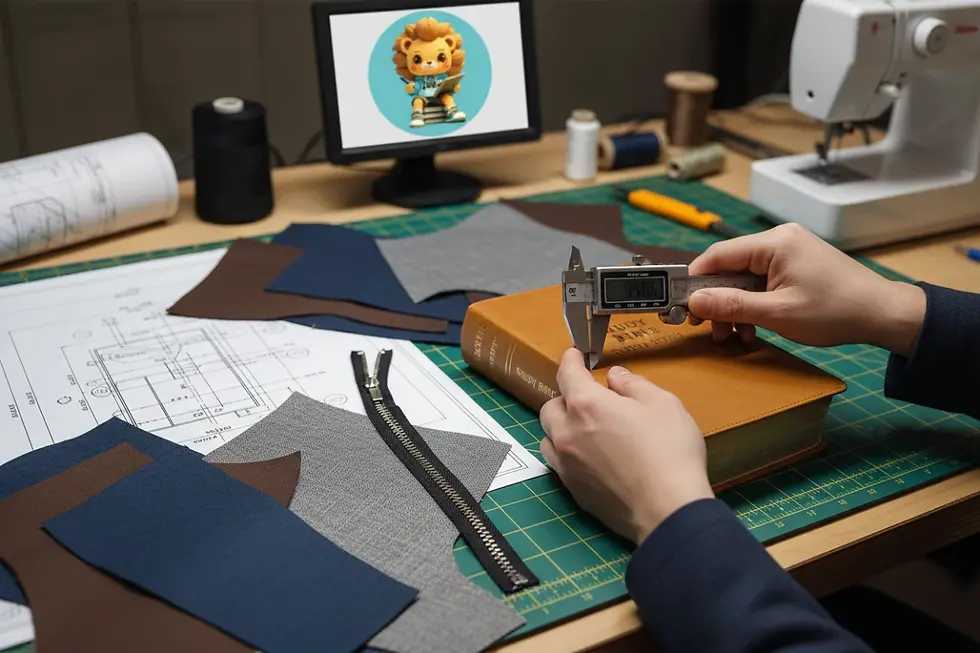
As a Bible opens, the spine expands outward, especially in Smyth-sewn or flexible softcover editions. If the spine of the protective cover is engineered too narrow, closing the cover puts immense leverage on the book’s binding, which can crack the spine of the Bible itself. Conversely, if the cover’s spine is too deep, the excess material bunches up, creating an unsightly gap and allowing the book to sag inside the cover.
To prevent this, pattern designers must utilize dynamic sizing formulas that calculate fabric bend allowances based on the specific Bible cover material used, ensuring the exterior spine moves in harmony with the book's natural hinge. This is why working with an integrated designer-manufacturer who understands paper engineering and structural dimensions is so critical to product success.
3. Zipper Tension and Structural Strain: Mitigating the Primary Failure Point
The zipper is the most heavily stressed mechanical component of any protective book case. In the retail market, a failed Bible cover zipper is the leading cause of product returns. The failure usually occurs at the two radius corners of the cover, where the zipper teeth are forced to curve.
To prevent zipper failures, product developers must specify the correct zipper gauge and type. A standard #3 nylon coil zipper is often too weak for heavy, multi-page study Bibles, whereas a #5 nylon coil or a molded plastic zipper offers significantly higher lateral pull strength. Furthermore, the zipper tape must be sewn with a consistent tension tolerance. If the tape is stitched too tightly around the curved corners, the zipper teeth will pinch together, causing the slider to stick and eventually strip the teeth. Quality control inspectors should physically test the zipper pull force along the entire track during both the prototyping and mass-production stages.
Additionally, zipper tape materials matter. A low-grade polyester tape will stretch and warp under repetitive pull cycles, while a high-density, pre-shrunk polyester tape maintains its dimensional stability. Ensuring the slider is made of a durable zinc alloy with a smooth, non-snagging internal bridge is also vital for long-term functional performance.
4. Stitching Failures: Balancing Tensile Strength and Clean Aesthetics
Stitching is the structural adhesive of sewn products. In high-volume manufacturing, stitch-per-inch (SPI) parameters and thread composition determine whether a seam will hold under pressure. For high-durability religious accessories, a stitch density of 7 to 9 SPI is generally recommended. Anything lower reduces the tensile strength of the seam, while anything higher can puncture and weaken synthetic materials like polyurethane (PU) leather, causing a "postage stamp" tear along the stitch line.

Thread selection is equally critical. Low-cost cotton threads degrade quickly when exposed to moisture and UV light, whereas high-tenacity bonded polyester or nylon threads provide the necessary tensile strength and abrasion resistance. Particular attention must be paid to "lockstitching" at the start and end of every seam. If the manufacturer fails to perform backstitching, the thread tails will unspool over time, leading to rapid seam unraveling at stress-concentrated areas like the zipper endpoints and pocket openings.
5. Handle Attachment: Reinforcement Techniques for Weight and Tension
A Bible cover handle must support not only the weight of the Bible but also any additional notebooks, pens, and study tools packed inside. Because the handle is gripped and pulled repeatedly, the attachment points are subject to severe shear stress. Simply sewing the handle onto the exterior surface fabric is a guaranteed path to failure.
To ensure excellent Bible cover quality, handles must be anchored using structural reinforcement. This involves inserting a rigid backing plate—typically made of non-woven fabric, heavy-duty Texon board, or plastic sheeting—inside the cover layers. The handle is then stitched through the exterior material and the backing board simultaneously, utilizing a reinforced "X-box" stitch pattern. For premium or heavy-duty designs, metal rivets or metal D-ring anchors are used to distribute the load across a larger surface area, preventing the fabric from tearing out under sudden tension.
6. Material Selection: Preventing PU Peeling, Fabric Fraying, and Degradation
Selecting the right Bible cover material is a balancing act between cost, aesthetics, and performance. Many brands opt for PU (polyurethane) or faux leather because it mimics the premium look of genuine leather at a fraction of the cost. However, poor-quality PU is highly susceptible to hydrolysis—a chemical breakdown caused by moisture and humidity that leads to cracking, peeling, and bubbling of the surface layer.
When sourcing synthetic leather for a custom Bible cover, buyers should specify "hydrolysis-resistant" PU, which is chemically formulated to withstand environmental exposure for several years without degrading. For canvas or nylon covers, the primary risk is fabric fraying at cut edges. This is prevented by using heat-cut edges or wrapping raw edges with internal bias binding tape before stitching. The material must also undergo standard testing for colorfastness to rubbing (both wet and dry) to ensure dyes do not bleed onto the Bible's delicate pages or the user’s hands.
7. Interior Architecture: Optimizing Lining Materials and Pocket Structures
The interior of a Bible cover is just as functional as the exterior. Typically, it contains sleeves to hold the front and back covers of the Bible, along with pen loops, card slots, and zippered mesh pockets. The choice of lining material is crucial because it comes into direct contact with the book.
If the lining material is too abrasive—such as cheap, stiff polyester—it will rub against the Bible’s binding and wear away the cover's finish. A soft, high-density 210D polyester, nylon taffeta, or brushed microfiber lining is preferred. Furthermore, internal pockets must be engineered to prevent bulk accumulation. If a pocket is designed with thick folded seams, it will press against the Bible when closed, leaving a permanent indentation on the pages. Clean-cut pockets with edge binding or heat-sealed borders keep the interior profile slim and protective.
8. Hardware Quality Standards: Selecting Snaps, Pullers, and Metal Accents
Hardware components—such as metal zipper sliders, snaps, buckles, and brand logo plaques—serve as both functional elements and visual indicators of product quality. Cheap zinc alloy hardware is prone to oxidation, plating discoloration, and breakage under mild pressure.
To preserve the long-term integrity of the product, all metal hardware should undergo a salt spray test to verify corrosion resistance. Zipper sliders must be constructed from heavy-duty alloys with durable electroplating (such as brass or nickel finishes) and sealed with an anti-oxidation lacquer. If plastic snaps are used, they must be tested for cycle life to ensure they do not lose their locking tension after repeated use. For premium covers, custom metal pullers must be structurally sound where they connect to the zipper slider, as this thin metal loop is a common breakage point.
9. The Essential Prototyping Stage: Physical Testing Protocols for Custom Bible Covers
Before authorizing a factory to begin mass production, a comprehensive prototyping phase is essential. Prototyping is where theoretical designs are translated into physical, manufacturable products. At Lion Paper Products, our 3,000-square-meter design and prototyping facility in Jiaxing, Zhejiang, focuses heavily on this phase, turning raw sketches into functional samples.
During prototyping, physical testing protocols should mimic real-world usage. This includes:
Cycle Testing: Opening and closing the zipper 1,000 times to check for teeth alignment and slide resistance.
Load Testing: Placing a weighted dummy book inside the cover and hanging it by the handle for 48 hours to inspect for seam slippage or handle distortion.
Environmental Chamber Testing: Exposing the cover materials to elevated temperature and humidity levels to check for adhesive failure, material warping, or PU hydrolysis.
These tests allow the design team to make crucial structural adjustments—such as shifting seam locations or adding reinforcement layers—prior to mass manufacturing.
10. Mass Production QC: Standardizing Inspection Across Dual-Site Facilities
Transitioning from a validated prototype to high-volume production requires strict operational standardization. For brands scaling their orders, utilizing a dual-site manufacturing model provides significant advantages. Lion Paper Products operates a 10,000-square-meter facility in Cambodia alongside its China prototyping hub, enabling seamless scaling, cost-efficiency, and duty-free benefits for global markets.
To ensure consistent Bible cover quality across different production sites, we implement standardized Standard Operating Procedures (SOPs) and an Acceptable Quality Limit (AQL) sampling system (typically AQL 2.5 for major defects and AQL 4.0 for minor defects). In-line quality control inspectors monitor critical check points, such as:
Fabric tensioning on the cutting table to prevent dimensional distortion.
Sewing machine calibration to avoid skipped stitches and uneven thread tension.
Final inspection protocols that require 100% of finished covers to undergo a manual zipper smooth-run test and a thorough loose-thread trim.
By unifying these quality standards across our dual-site operations, we ensure that every cover delivered to North America, Europe, or Australia meets the exact specifications of the original approved sample.
The B2B Buyer Checklist: What to Inspect Before Approving a Production Batch
To assist purchasing managers, category buyers, and QA teams, the following analytical table outlines the critical check points that must be inspected prior to signing off on a production shipment. This checklist translates the common failure points into actionable testing criteria.
Failure Point | Root Cause | Buyer Check (On-Site/Sample) | Prevention / Corrective Action |
|---|---|---|---|
:--- | :--- | :--- | :--- |
Sizing Discrepancies | Poor bulk tolerance calculation; lack of physical Bible model during pattern-making. | Insert the target Bible into the cover; check for sliding or extreme spine tension when closed. | Mandate that the factory use the actual Bible for pattern validation; establish a maximum $\pm 2 ext{mm}$ cutting tolerance. |
Zipper Splitting/Sticking | Incorrect zipper size (#3 instead of #5); excessive tension around the curved corner stitches. | Pull the zipper quickly around the corners; check for teeth separation or a jerky pull sensation. | Specify #5 nylon coil zippers; adjust corner sewing patterns to allow a slight relaxation of the zipper tape. |
Seam Unraveling | Lack of backstitching at seam ends; low-tenacity cotton thread; incorrect stitch density. | Gently pull apart joined seams to inspect for thread slippage; count stitches per inch (SPI). | Mandate the use of bonded polyester thread; enforce a standard of 7–9 SPI; require mechanical lockstitching. |
Handle Tear-Out | Missing internal backing reinforcements; weak single-line surface stitching. | Apply a sudden downward pull on the handle; inspect the exterior surface around the attachment point for stretching. | Require an internal Texon or plastic reinforcement plate; specify a reinforced X-box stitch pattern or rivets. |
PU Peeling/Cracking | Use of low-grade, moisture-sensitive polyurethane (ether-based PU prone to hydrolysis). | Conduct a standard peel test; review supplier chemical certificates for hydrolysis resistance. | Specify polyester-based or polycarbonate-based PU designed to pass a 3-year to 5-year hydrolysis test. |
Lining Tears | Thin, low-density lining material; sharp edges of the inserted Bible scraping the interior seams. | Inspect the interior sleeve corners; rub a rough surface against the lining to check for abrasion resistance. | Upgrade the lining material to 210D polyester or high-density nylon; ensure raw internal seams are bound. |
Hardware Rusting | Untreated zinc alloy or low-grade steel components; inadequate plating thickness. | Perform a 24-hour salt-spray test on metal pullers and snaps; check for magnetic pull (steel rusts easily). | Mandate corrosion-resistant brass, electroplated zinc alloy with anti-oxidation lacquer coating. |
Review Your Bible Cover Specifications: Partner with Lion Paper Products
Developing high-quality religious merchandise requires more than basic sewing. It demands technical expertise in material sciences, precise structural engineering, and rigorous quality control. At Lion Paper Products, we act as your strategic supply chain bridge from the first concept sketch to the final global delivery. By utilizing our dual-site capabilities in China and Cambodia, we help global brands, publishers, and retailers optimize their product designs, lower their landed costs, and maintain flawless batch-to-batch consistency. Protect your brand reputation and ensure your products withstand the test of time.
Request a Bible Cover Quality Sample today and collaborate with our engineering team to refine your manufacturing specifications.
FAQ-The B2B Guide to Bible Cover Quality
How can a buyer verify the hydrolysis resistance of synthetic leather?
Buyers should request a laboratory test report from the material supplier, specifically looking for the 'Jungle Test' results. This test subjects the material to 70°C and 95% relative humidity over several weeks. A PU material that survives a 3-week Jungle Test is generally rated to withstand 3 to 5 years of real-world use without cracking or peeling.
A #5 zipper has larger teeth and a wider tape width than a #3 zipper. This size difference provides significantly higher lateral strength, preventing the zipper from bursting open when the Bible cover is packed tightly. It also offers a smoother hand-feel when pulling around curved corners, reducing wear on the zipper teeth.
How does a dual-site supply chain benefit B2B buyers of religious accessories?
A dual-site model (such as China and Cambodia) balances speed and cost. The China facility handles complex prototyping, material sourcing, and rapid sampling. Once the design is locked, mass production is shifted to the Cambodia facility, which offers competitive labor rates and favorable tariff structures for major markets like the US and EU, all while maintaining unified quality control systems.
What are the environmental compliance requirements for Bible cover materials?
For international markets, materials must comply with local chemical regulations, such as REACH in Europe and CPSIA/Prop 65 in the United States. These regulations restrict the use of heavy metals, phthalates, and lead in consumer goods. Buyers should ensure their manufacturing partner holds FSC certifications for paper-based components and can provide compliant raw material test certificates.


Comments