


Comprehensive Guide to Artist Pencil Box Specifications and Sourcing Standards

Artist pencil box specifications dictate structural integrity, material tolerance, and functional fit, which are critical for preventing component failure, ensuring the safe transport of delicate art media, and achieving seamless integration into retail-ready stationery sets. Selecting the correct dimensions, materials, and closures ensures the protection of high-grade pigment cores and aligns with global distribution and compliance standards, laying a solid foundation for market-winning creative stationery programs.
What are the standard dimensions and material specifications for professional artist pencil boxes?
To develop a functional and durable art storage solution, brands must understand the precise dimensions of the media being housed. A standard professional colored or graphite pencil has an average length of 175mm to 180mm and a diameter of 7mm to 8mm (or up to 10mm for thick sketching sticks and charcoal pencils). Therefore, the internal dimensions of any protective casing must accommodate these metrics with sufficient clearance to prevent tip breakage.
Let's outline the core physical attributes for three common configurations:
Configuration / Capacity | Recommended Internal Dimensions (L x W x H) | Recommended External Dimensions (L x W x H) | Ideal Material Match |
|---|---|---|---|
:--- | :--- | :--- | :--- |
12-Piece Slim Set | 185 mm x 102 mm x 12 mm | 190 mm x 108 mm x 15 mm | Tinplate / Rigid Gray Board |
24-Piece Desktop Set | 185 mm x 195 mm x 14 mm | 192 mm x 202 mm x 18 mm | Tinplate / Premium Cardboard |
72-Piece Multi-Tier Set | 200 mm x 195 mm x 55 mm | 210 mm x 205 mm x 60 mm | PU Leather Case / Canvas Wrap |
When establishing your artist-pencil-box-specifications, the choice of substrate significantly impacts both the manufacturing cost and the user experience.
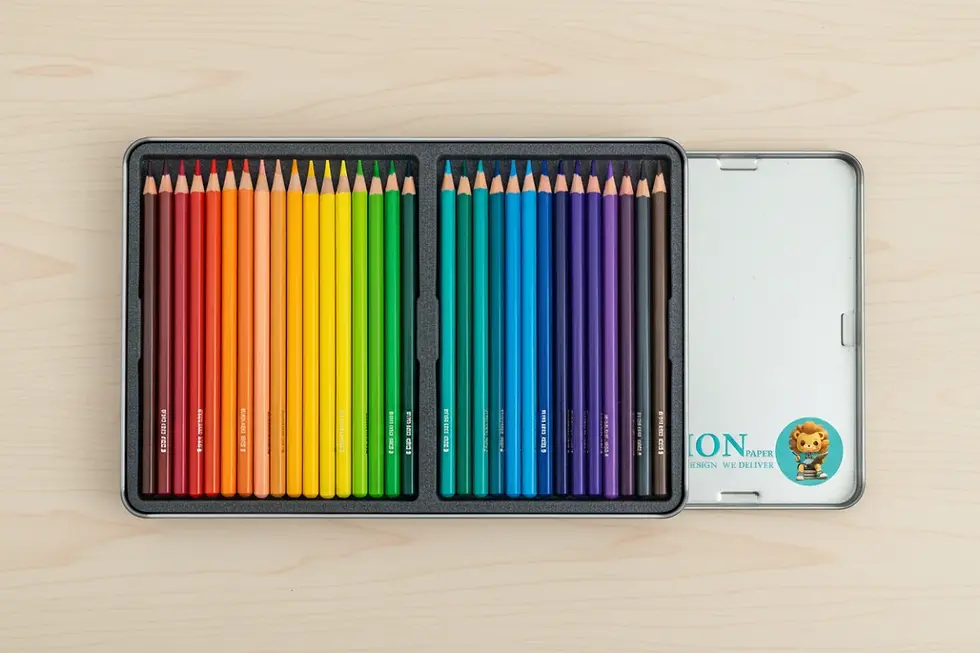
For tinplate structures, a key detail is the lid type. There are three primary designs: step-joint lids which fit flush with the bottom container, requiring precise stamping tolerances to maintain friction; slide-on lids utilizing track grooves where tolerance deviations must not exceed 0.1mm to avoid slipping or jamming; and hinged lids employing a rolled wire hinge, which prevent lid loss.
For paperboard options, a 120gsm to 157gsm art paper wrap is typically laminated onto a 1200gsm gray board. If the lamination pressure is uneven, microscopic air bubbles will form, leading to surface warping. When selecting textile alternatives, a 600D polyester with PVC backing provides excellent water resistance, whereas a 12oz natural cotton canvas offers a classic, premium texture that resonates with fine art communities.
How do custom pencil case manufacturing techniques ensure product durability and alignment with art supplies packaging standards?
Transitioning from a concepts phase to mass production requires specialized engineering. In custom pencil case manufacturing, structural integrity depends heavily on fabrication techniques. For rigid paperboard boxes, precision V-grooving ensures crisp 90-degree corners and stable structural walls. For textile-based organizers, reinforcement materials such as ethylene-vinyl acetate (EVA) foam or polyethylene (PE) board inserts are sewn into the lining to maintain shape under pressure.
To meet international art supplies packaging standards, manufacturers must ensure that every material surface touching the pencils is chemically stable and physically non-abrasive:
Phthalate-Free and Lead-Free Components: Compliance with CPSIA and REACH is non-negotiable for retail channels in North America and Europe. Every zipper, snap, lining, and coating must undergo chemical screening.
Flocked and Thermoformed Trays: Internal trays are typically crafted from PET or PS plastics (ranging from 0.4mm to 0.8mm in thickness). Flocked finishes add a soft, velvet-like layer that prevents the pencil casings from scratching and minimizes friction during transit.
Closure Mechanisms: Friction-fit lids, magnetic closures, or metal latches must endure rigorous cycle testing. For zippered fabric cases, using premium nylon coil zippers (size #3 or #5) with reinforced stitching prevents premature split seams, a common failure point in heavy-use environments.
Furthermore, custom pencil case manufacturing must account for chemical transfer. Acid-free and lignin-free parameters are vital. Acidic papers or adhesives can leach into wood pencil casings over time, causing discoloration of the exterior paint or even degrading the binding agents within the core pigments. To avoid this, high-quality water-based acrylic adhesives must be used instead of low-cost industrial glues.
In terms of tray layouts, a dual-tier tray system requires a reliable lifting mechanism. Often, a small woven ribbon tab (typically 10mm to 15mm wide) is secured to the upper tray's edge. The ribbon material must be securely heat-sealed to prevent fraying after repeated pulling. Additionally, spacing between the pencil slots in thermoformed trays must be meticulously engineered. A standard spacing of 1.5mm between pencils allows users to easily pinch and lift a single pencil while maintaining a compact overall box width.
What are the critical manufacturing tolerances and structural failure modes to monitor during pilot production?
During pilot production runs, maintaining narrow manufacturing tolerances is crucial to preventing defective products from reaching the packaging line. Even a 0.5mm variance in internal tray sizing can cause colored pencils to rattle, leading to fractured lead cores.
Below are the critical engineering tolerances that quality control inspectors must monitor:
Tray-to-Box Clearance: The gap between the inner plastic/paper tray and the outer box wall should be kept between 0.2mm and 0.5mm. An overly tight fit causes the tray to buckle, while an excessively loose fit leads to shifting and internal damage.
Hinge and Joint Tolerance: For metal tins, the hinge wire alignment tolerance must not exceed ±0.2mm. In rigid cardboard boxes, the magnetic flap alignment must be within ±0.3mm to ensure a secure, flush seal.
Stitching Density: In textile-based cases, a minimum of 8 to 10 stitches per inch is required. Loose stitching lowers tear resistance and reduces the overall lifespan of the item.
Common structural failure modes discovered during stress testing include hinge separation, delamination of specialty cover papers, and tray cracking. Repeated opening and closing can weaken paper or metal joints. This is avoided by utilizing reinforced fabric hinges or double-walled tin structures. High humidity can cause paper wraps to peel away from the gray board. Utilizing high-tack, water-based adhesives and maintaining balanced moisture levels during the curing stage prevents this issue. Low-temperature environments can make thin plastic trays brittle. Selecting high-impact polystyrene (HIPS) or polyethylene terephthalate (PET) prevents cracking during cold-weather shipping.
To guarantee consistency, a rigorous pilot production check-off sequence must be followed:
Incoming Material Verification: Confirming the moisture content of the incoming gray board is between 7% and 9%. Anything higher leads to warping; lower leads to cracking during folding.
Die-Cutting Precision Audits: Ensuring that die-cut creases are perfectly aligned within a ±0.15mm margin. This prevents skewing when the box is folded into its final shape.
First-Article Inspection (FAI): The first 50 units from the line are measured using digital calipers to confirm all internal clearances meet the engineering drawing specifications.
Repeated stress testing must also simulate extreme transit conditions. Vibration tables simulate ocean freight transit, where constant micro-vibrations can loosen friction-fit lids. Utilizing vacuum sealing or tight shrink-wrap packaging over the retail-ready box helps lock components in place, mitigating the risks of internal friction damage.

How can brands integrate artist pencil boxes into retail-ready stationery sets containing notebooks and planners?
Developing coordinated stationery collections has become a highly profitable strategy for design-led brands and major retailers. Successfully launching retail-ready stationery sets requires a cohesive approach to design, material choice, and structural packaging.
When co-packaging artist pencil boxes with premium notebooks, planners, or sketchbooks, the primary focus is creating a unified visual and tactile experience:
Material Coordination: Match the cover materials of your journals (such as FSC-certified Kraft paper, linen, or soft-touch PU leather) with the exterior of the pencil box. Utilizing matching custom foil stamping, debossing patterns, or pantone color palettes creates an immediate premium retail impact.
Modular Inner Trays: Design outer rigid gift boxes with customized cardboard or EVA foam inserts. These inserts should feature precision die-cut slots that hold both the sketchbook and the pencil box securely, preventing friction scratches during distribution.
Optimized Retail Shelving: Multi-piece sets should be designed with compact outer dimensions to maximize shelf space efficiency. Incorporating clear PET windows allows consumers to inspect the quality of both the storage case and the stationery without opening the tamper-evident seals.
In addition to direct retail packaging, brands must evaluate how these sets are displayed in physical retail environments. Utilizing corrugated Point-of-Purchase (POP) or Product Display Quick (PDQ) trays allows retailers to place the merchandise directly onto shelves with minimal setup. The dimensions of the individual retail-ready stationery sets must be modular, fitting perfectly within standard master shipping cartons and retail PDQ trays without wasting volume.
Furthermore, optimizing the volumetric weight of the complete assembly directly impacts the total landed cost. Heavy rigid boxes packed with premium stationery can incur high shipping fees. By utilizing lightweight but strong FSC-certified paper structures and organizing the layout to eliminate empty air pockets, manufacturers can maximize container loading efficiency by up to 15%. This structural optimization translates to substantial cost savings when shipping large volumes from production bases in Southeast Asia to target consumer markets globally.
Through coordinated stationery storage development, a brand can elevate a simple collection of individual items into a high-value, gift-ready set. This holistic design-to-manufacturing method ensures that the entire package looks harmonious on retail shelves while minimizing bulk during shipping.
At Lion Paper Products (Jiaxing) Co., Ltd., founded in 2015 in Jiaxing, Zhejiang, we understand how to bring these elements together. Utilizing our dual-site supply-chain model—where our 3,000-square-meter design and prototyping facility in Jiaxing handles fast sampling and product development while our 10,000-square-meter facility in Cambodia delivers cost-optimized mass production—allows brands to streamline this complex design-to-manufacturing process from the very first sketch to the first shipment.
What quality control protocols and compliance standards should global buyers include in their pencil box RFQs?
For international sourcing managers, ensuring that a factory can consistently meet both quality and regulatory standards is essential. When issuing a Request for Proposal (RFQ) for custom pencil cases or art storage components, the documentation must outline explicit testing protocols.
The quality control checklist should focus on three main areas:
Physical and Mechanical Performance:
Drop Testing: The fully loaded pencil box must survive drop tests from a height of 1 meter onto a concrete surface at multiple angles without opening or sustaining structural cracks.
Cycle Testing: Magnetic closures and metal hinges must operate smoothly for a minimum of 3,000 cycles without loss of structural tension or alignment.
Friction Resistance: Exterior prints and coatings must pass cross-hatch tape tests and crockmeter tests to verify ink adhesion and prevent color bleeding.
Global Regulatory Compliance:
Ensure materials comply with CPSIA, REACH, and EN71 safety regulations, especially for heavy metal limits and phthalate content.
Ensure all wood-based and paperboard elements are traceable through FSC chain-of-custody verification to support corporate environmental goals.
Factory Audit Requirements:
Partner with facilities that maintain valid ISO 9001 quality management systems and undergo social responsibility audits like SMETA, WCA, or BSCI. For brands targeting major retail outlets, possessing FAMA (Facility and Merchandise Authorization) and GSV (Global Security Verification) is critical for securing supply chain approvals.
To guarantee clear communication with the manufacturing facility, the RFQ must specify the exact Acceptable Quality Limit (AQL) standards. Most global retailers utilize ANSI/ASQ Z1.4 sampling plans:
Critical Defects (0% allowed): Any safety hazard, such as exposed sharp metal edges on tin boxes, mold, or toxic chemical content.
Major Defects (1.5% limit): Functional failures such as broken hinges, split seams on canvas cases, torn paper liners, or malfunctioning zippers.
Minor Defects (4.0% limit): Purely cosmetic issues such as minor surface scratches, slight color variations from the approved Pantone target, or small adhesive residues.
To test print durability, the ASTM D3359 cross-hatch tape test is standard. A grid of small cuts is made in the printed coating, and specialized adhesive tape is applied and pulled off. If more than 5% of the print transfers to the tape, the batch fails adhesion standards and must be coated with a protective matte or glossy varnish.
At Lion Paper, all processes are aligned with standardized SOPs, AQL sampling standards, and robust quality controls. With our extensive manufacturing capacity—producing over 5 million notebooks annually alongside diverse stationery categories—we help international buyers streamline their global logistics safely. Defining these technical specifications and quality limits inside the RFQ ensures that the manufacturing partner delivers reliable, compliant, and durable products that protect your brand's reputation.

To bring your next creative project to life, optimizing every element of design, material selection, and co-packaging is critical. To evaluate how we can elevate your brand's offerings while keeping manufacturing costs efficient and transit secure, Share the accessory + notebook/stationery concept, target quantity and retail price with Lion Paper to evaluate a coordinated sourcing, packaging and sampling solution.
FAQ
Can FSC-certified materials be used for both the pencil box and the inner trays?
Yes. While outer rigid boxes and sleeves are easily crafted from FSC-certified paperboard, inner trays can also be manufactured using molded pulp or FSC-certified folding boxboard inserts instead of traditional plastic blister trays. This achieves a 100% plastic-free, sustainable packaging solution.
How does the China-Cambodia dual-site model benefit global buyers?
The dual-site model provides a flexible, secure supply chain. Initial structural design, quick prototyping, and pilot runs are managed at our 3,000-square-meter Jiaxing facility in China for maximum speed and R&D integration. For large-scale production, our 10,000-square-meter Cambodia facility provides cost-efficient mass manufacturing, stable capacity, and tariff-reduction advantages for North American and European markets.
What is the typical lead time for custom sampling and mass production?
Custom sampling for physical prototypes generally takes 7 to 10 working days, depending on structural complexity and accessory sourcing. Once the sample is approved, mass production at our facilities typically spans 35 to 45 days, governed by standardized SOPs and strict AQL inspection standards to ensure consistent quality.


Comments