


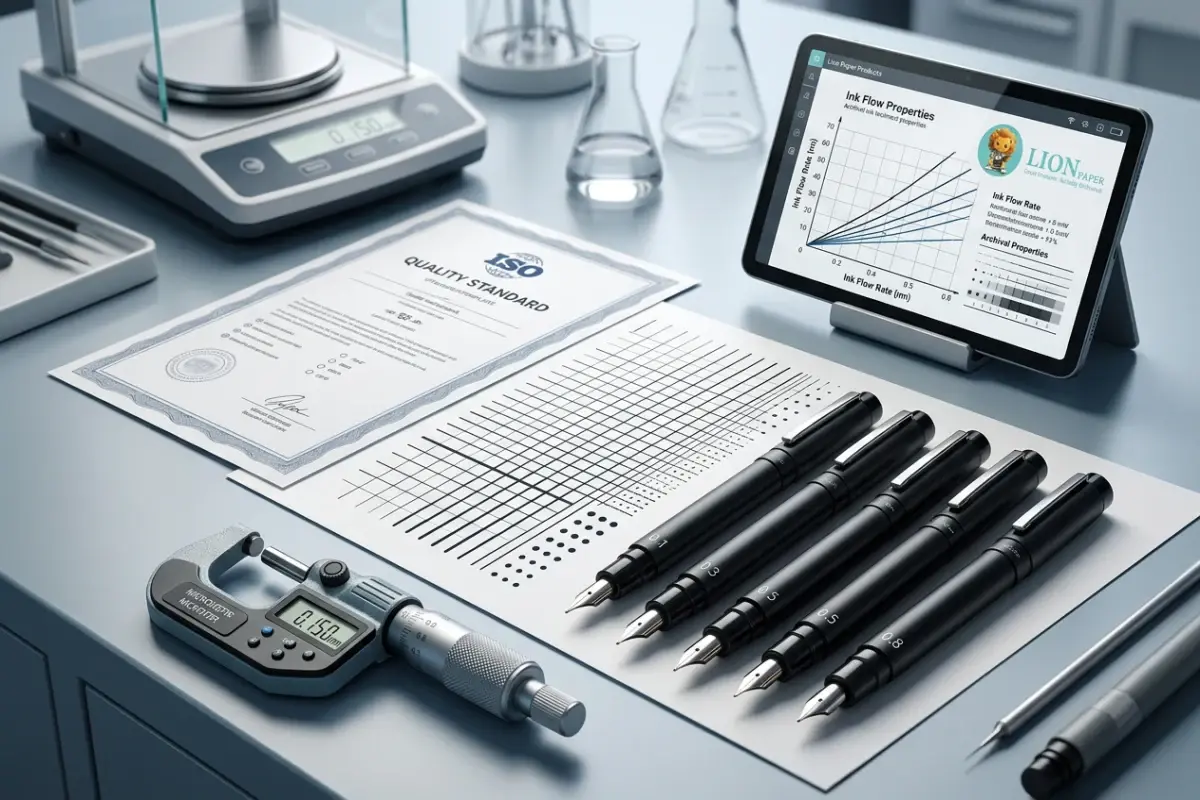
Archival Ink Technical Pen Manufacturing, Testing, and Quality Standards

An archival ink technical pen requires rigorous quality validation covering pigment lightfastness, chemical water resistance, airtight cap seal performance, and uniform ink flow across standardized GSM drawing surfaces before entering mass production. To prevent dry-out, feathering, and uneven line widths, professional pens combine fine micron-grade pigment dispersions with calibrated synthetic nib assemblies and airtight barrel sealing systems.
What Defines an Archival Ink Technical Pen and Its Performance Benchmarks?
An archival ink technical pen is a high-precision instrument engineered specifically for technical draftsmen, fine artists, archival conservators, and demanding journalers who require permanent line stability, optical density, and zero chemical degradation across decades of storage. Unlike conventional dye-based fineliners that dissolve readily when exposed to moisture, bleed through fibrous substrates, and fade under ultraviolet light exposure, an archival technical pen utilizes microscopic, insoluble pigment particles suspended in a neutral, acid-free water-based carrier vehicle. When deposited onto porous paper substrates, these micro-pigment particles mechanically anchor within the cellulose fibers rather than chemically staining them, resulting in crisp, permanent lines that withstand environmental aging.
To meet international stationery drawing pen manufacturing standards, these instruments must fulfill strict baseline physical and chemical criteria across several functional dimensions:
Pigment Particle Dispersal: The average pigment grain size must consistently measure below 0.5 microns to prevent clogging through micro-porous polyacetal, polyester, or metal-clad synthetic fiber nibs.
Chemical Stability: The liquid vehicle must maintain a strictly neutral to slightly alkaline pH between 7.0 and 8.5 to prevent acid-induced hydrolysis and long-term degradation of cotton-rag and wood-pulp paper stocks.
Optical Density: High inorganic pigment or carbon black loading ensures deep optical contrast with an optical density rating exceeding 1.40 OD in a single continuous stroke.
Solvent Resistance: Fully dried marks must exhibit complete insolubility against water, alcohol-based markers, highlighter solvents, watercolor washes, and mild alkaline cleaning agents.
Substrate Compatibility: Zero feathering, fiber bleeding, or strike-through on paper weights ranging from 70 GSM notebook sheets to 300 GSM heavyweight mixed-media boards.
Technical Parameter | Standard Dye-Based Fineliner | Archival Pigment Technical Pen | Target Validation Standard |
|---|---|---|---|
:--- | :--- | :--- | :--- |
Colorant Type | Water-soluble chemical dye | Inorganic / Carbon micro-pigment | Micro-dispersion particle sizing |
Lightfastness Rating | Fugitive (fades in 30–90 days) | Archival (100+ years lightfast) | ISO 12757-2 / ASTM D6901 |
Water Resistance | Bleeds and smears immediately | 100% insoluble after 60s dry | 24-hour total water immersion |
Solvent / Marker Wash | Highly reactive / smears | Insoluble (zero smear) | Alcohol marker overlay test |
Nib Tolerance | ±0.10 mm caliber variation | ±0.03 mm precision caliber | Optical micrometer profiling |
Cap-Off Longevity | 4 to 12 hours | 18 to 48 hours (formulation-dependent) | Controlled RH chamber test |
Maintaining these rigorous parameters requires an integrated manufacturing workflow where barrel polymers, internal ink reservoirs, feeds, and tips are calibrated to match the specific rheology of the micro-pigment ink.

Rigorous smudge and water resistance protocols verify that archival pigment ink remains fully insoluble after drying.
How Is Pigment Fineliner Performance Testing Conducted in the Laboratory?
Laboratory verification for an archival ink technical pen involves mechanical, chemical, and optical assessments designed to simulate real-world handling, shipping extremes, and long-term document preservation. Standard dye fineliners cannot survive these protocols, making pigment fineliner performance testing an indispensable phase during product development, pre-production sampling, and mass-market batch release.
1. Accelerated Lightfastness and UV Exposure Testing
Test strips drawn on acid-free 120 GSM paper undergo accelerated xenon-arc chamber exposure matching ASTM D4303 or ISO 105-B02 standards. Samples receive high-intensity irradiation equivalent to 50 to 100 years of indoor daylight exposure. Spectrophotometers measure the Delta E color shift; an archival pigment pen must maintain a Delta E value of less than 2.0 to confirm zero perceptible fading.
2. Smear Resistance and Curing Speed Protocol
Using an automated linear abrasion tester, lines drawn at calibrated downward forces (0.75 N to 1.5 N) are subjected to immediate and timed friction passes:
Dry Smear Test: A weighted felt pad passes across lines 5, 10, and 30 seconds after deposition to determine touch-dry and smudge-proof limits under normal hand pressure.
Water and Solvent Wash: After 60 seconds of air drying, the substrate is washed with distilled water, ethanol (70%), and ethyl acetate. Archival inks must exhibit zero haloing, ink drift, or feathering.
Highlighter / Alcohol Marker Compatibility: Standard fluorescent highlighters and 99% alcohol art markers are dragged perpendicular to the inked line at 1.0 N pressure. The archival baseline requires clean edges without streaking.
3. Paper Bleed-Through and Feathering Assessment
Because technical pens are frequently bundled with luxury journals, planners, and sketchbook collections, laboratories evaluate bleed-through on multiple paper types:
55 GSM ultra-lightweight fountain pen friendly paper
80 GSM wood-free offset printing paper
100–160 GSM uncoated bamboo and FSC-certified wood pulp journal paper
300 GSM hot-pressed watercolor stock
Automated digital microscopes inspect line edges at 50x magnification to confirm that the spread factor does not exceed 1.08x the physical nib diameter, verifying crisp line edges without fiber bleeding.
What Nib Durability and Ink Flow Standards Prevent Dry-Out and Line Breakage?
Nib failure and ink starvation represent the primary failure modes in technical drawing pens. High-precision drafting demands continuous, unbroken ink deposition whether the user holds the pen at a perpendicular 90-degree drafting angle or a natural 45-degree handwriting angle.
To ensure consistent ink flow and nib integrity, technical drawing pen quality control protocols measure several critical mechanical thresholds across production lots:
Writing Distance and Laydown Consistency
Automated spiral writing machines run pens on standardized paper drums at a constant speed of 100 mm/sec and a continuous load of 1.0 N. Quality assurance benchmarks demand a continuous writing track length of at least 600 to 1,000 meters per pen (depending on reservoir capacity) without line skipping, banding, or color dilution.
Nib Abrasion and Tip Crushing Resistance
Technical pens utilize metal-sheathed polyacetal, polyester, or sintered acrylic tips. A precision force gauge measures nib deflection under axial loads of up to 5.0 N:
Axial Compression: The tip must not push back into the metal collar under 4.0 N of sustained downward force.
Lateral Wear: After 300 meters of continuous mechanical drawing on textured paper, nib diameter deformation must remain within ±5% of the original manufactured caliber.
Cap-Off Time Verification
Archival inks contain film-forming polymers that can prematurely dry at the microscopic tip orifice if exposed to open air. Testing chambers set at 23°C and 50% Relative Humidity evaluate pens uncapped for 2 hours, 6 hours, and 24 hours. The pen must instantly restart writing within the first 10 mm of stroke application without manual wetting or excessive downward pressure.
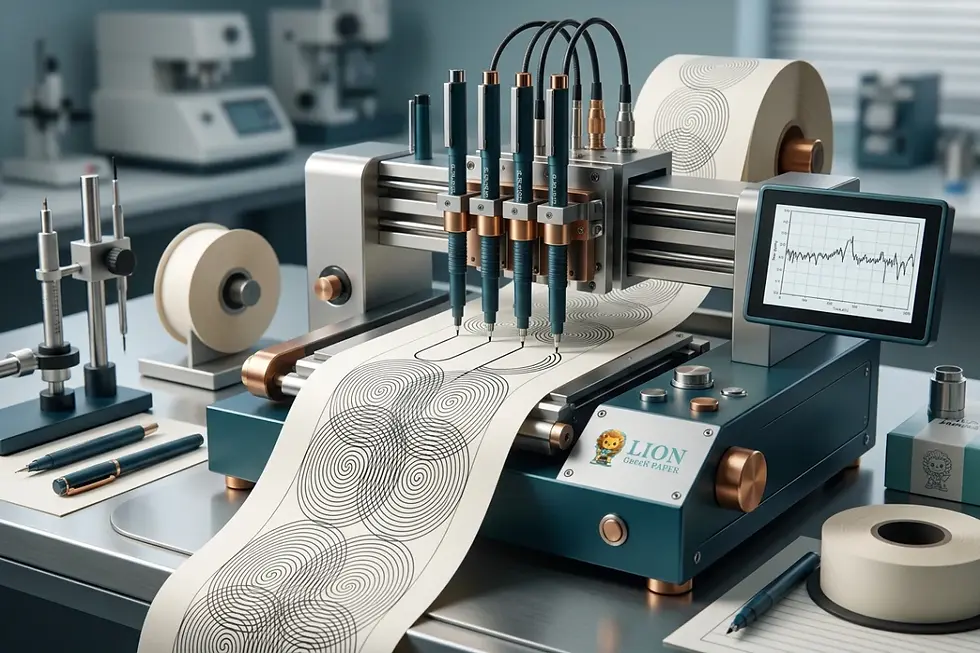
Continuous automated writing testing measures writing distance, nib abrasion, and continuous ink flow rates.
What Defect Classifications and AQL Acceptance Criteria Apply During Inspection?
During pre-shipment quality assurance, comprehensive waterproof archival ink pen inspection utilizes the international ISO 2859-1 (ANSI/ASQ Z1.4) sampling system. Random samples drawn from production lots are categorized across critical, major, and minor defect classifications based on functional and visual parameters.
The standard sampling parameters applied for commercial pen shipments include:
Sampling Level: General Inspection Level II, Single Sampling Plan
Critical Defects Acceptance Threshold: AQL 0 (Zero tolerance)
Major Defects Acceptance Threshold: AQL 1.0 / AQL 1.5
Minor Defects Acceptance Threshold: AQL 4.0
The following inspection framework defines the defect taxonomy applied during warehouse pre-shipment audits:
Critical Defects (AQL 0)
Visible ink leakage inside the inner cap, barrel joint, or tail plug.
Mold contamination or microbial degradation within water-based ink formulations.
Presence of sharp plastic burrs, damaged metal collars, or hazardous chemical odours violating CPSIA or EN 71-3 toxicity safety thresholds.
Major Defects (AQL 1.0 to 1.5)
Complete ink flow failure (dry pen on initial uncapping).
Line skipping exceeding 5 mm during standard continuous 100 mm stroke test.
Nib pushback into the sheath under less than 3.0 N downward force.
Incorrect nib size marked on barrel or cap (e.g., 0.1 mm tip labeled as 0.5 mm).
Cap fit loose (retention force below 4.0 N, causing cap detachment during transit).
Failure of ink water-resistance after 60-second dry time.
Minor Defects (AQL 4.0)
Slight silk-screen printing misregistration on the barrel or clip (>0.3 mm offset).
Minor surface scratches on non-functional clip or barrel surface.
Slight color mismatch on colored barrel end-plugs within Delta E 1.5 tolerance.
Barcode or packaging box label slightly skewed (<5 degrees).
Inspection Parameter | Inspection Method | Sampling Size (per 10,000 pcs) | Rejection Threshold |
|---|---|---|---|
:--- | :--- | :--- | :--- |
Initial Writing Function | Hand-draw five 100 mm lines on 80 GSM paper | 200 pcs (Level II) | >5 defective pens fails lot |
Airtight Cap Retention | Pull-force tensile gauge (Target: 6.0–12.0 N) | 32 pcs (Special S-3) | >1 unit out of spec fails lot |
Vacuum Seal Integrity | Vacuum chamber test at -0.04 MPa for 5 min | 32 pcs (Special S-3) | >0 leaking pens fails lot |
Weight / Ink Volume | Precision analytical balance (±0.01 g) | 50 pcs (Special S-4) | >2 units below target fails lot |
Barrel Print Adhesion | 3M 600 Cross-hatch tape peel test | 13 pcs (Special S-2) | Flaking > Class 1 fails lot |
How Do Manufacturing Controls Guarantee Barrel Sealing, Automated Filling, and Batch Stability?
Sustained manufacturing excellence for archival drawing pens requires tight environmental and mechanical process control across the entire injection molding, ink filling, and automated assembly line.
1. Barrel Material Selection and Injection Precision
Archival inks are sensitive to moisture loss through polymer permeability. High-grade technical pens avoid cheap polystyrene and instead utilize high-density polypropylene (PP) or engineered polyoxymethylene (POM) with low water vapor transmission rates (WVTR). Cap designs integrate dual-seal inner gaskets or elastomeric TPE seals that compress against the nib collar when capped, creating an airtight micro-chamber that isolates the tip from atmospheric air.
2. High-Precision Volumetric Ink Injection
Automated filling lines dose degassed pigment ink into synthetic fibrous reservoirs (sliver cores) using micro-diaphragm volumetric pumps. Precision control prevents two common production anomalies:
Under-filling: Causes premature ink starvation, reduced writing distance, and air bubbles within the reservoir feed.
Over-filling: Saturates the capillary buffer channels, causing ink sweating, burping under cabin pressure changes, or leakage during air freight.
3. Ultrasonic Welding and Assembly Quality Control
Tail plugs and collar sleeves are joined using calibrated ultrasonic welding or mechanical interference pressing. Pressure monitoring sensors on the assembly line reject any unit that fails insertion depth tolerances by more than 0.05 mm, ensuring that every internal capillary interface maintains continuous physical contact.

Integrating archival fineliners with optimized journal paper provides a cohesive, retail-ready product experience.
How Can Brands Bundle Retail-Ready Archival Pens with Premium Notebooks and Journals?
For stationery brands, creative lifestyle labels, and e-commerce sellers, packaging archival ink technical pens alongside matching paper products unlocks higher average order value (AOV) and provides an integrated creative experience. However, pairing fine-nib pigment pens with paper requires careful cross-category coordination.
When co-developing technical drawing pen sets and custom stationery, brands benefit from end-to-end supply chain integration:
Paper Sizing and Tooth Optimization: Smooth, hot-pressed or high-density calendered paper (100–160 GSM) minimizes nib drag and prevents felt fiber wear, making it ideal for 0.05 mm to 0.8 mm micro-nibs.
Co-Branded Gift Sets and Tooling: Packaging pens in custom thermoformed blister trays, FSC-certified paperboard presentation boxes, or EVA foam inserts fitted inside luxury journals creates a unified retail presentation.
Multi-Nib Starter Kits: Curating coordinated sets (such as 0.05 mm, 0.1 mm, 0.3 mm, 0.5 mm, 0.8 mm, and flexible brush tips) caters directly to urban sketchers, architectural illustrators, and journaling enthusiasts.
Compliance and Safety Documentation: Exporting bundled sets across North America and Europe requires comprehensive certification, including ISO 9001 quality management, FSC chain-of-custody paper traceability, CPSIA lead and phthalate compliance, and SMETA/WCA social audits.
Leveraging a dual-site supply chain network—combining rapid design prototyping, ink compatibility testing, and packaging development at a dedicated development center with scalable mass assembly and packaging facilities—ensures that brands achieve stable batch quality, regulatory compliance, and total-cost efficiency from initial concept to global delivery.
To begin tailoring your private-label pen collection, custom journal bundle, or retail-ready creative kit, Share target use, ink claim, nib sizes, pack count and retail price; request a fineliner/marker test specification and sample set.
FAQ
What is the difference between dye-based ink and archival pigment ink in technical pens?
Dye-based inks dissolve fully in water, providing vibrant color but low resistance to moisture, light, and chemical solvents. Archival pigment inks utilize microscopic solid colorant particles suspended in a liquid carrier. Once dry, pigment particles bind securely to paper fibers, offering superior lightfastness (resistant to UV fading for decades), total water insolubility, and zero smearing when overlaid with alcohol markers or highlighters.
How do manufacturers prevent archival technical pens from drying out quickly?
Manufacturers utilize airtight high-density polypropylene (PP) or polyoxymethylene (POM) barrels combined with inner elastomeric cap gaskets that seal tightly against the nib collar. In addition, chemical humectants and surfactants are balanced within the water-based pigment formula to retard surface evaporation while maintaining fast absorption once drawn onto paper substrates.
What AQL standard is typically applied during pre-shipment inspection for technical drawing pens?
Pre-shipment inspection typically follows ISO 2859-1 (ANSI/ASQ Z1.4) General Inspection Level II. Standard acceptance criteria are set to AQL 0 for Critical Defects (leakage, chemical non-compliance), AQL 1.0 to 1.5 for Major Defects (dry pen, line skipping, loose cap, incorrect nib label), and AQL 4.0 for Minor Defects (slight cosmetic scratches, packaging alignment).
Can archival technical pens write smoothly on all notebook paper weights?
While technical pens can write on most paper stocks, optimal performance requires smooth, uncoated paper between 100 GSM and 160 GSM with balanced surface sizing. Very rough textured paper can accelerate synthetic nib abrasion, while heavily coated or non-porous synthetic papers can increase dry times and hinder the pigment from anchoring into the fibers.


Comments