


Airport Gift Shop Stationery Wholesale: Travel Retail Sourcing Guide

For airport gift shop stationery wholesale, travel retailers must prioritize space-efficient compact notebook formats, multi-tiered price architecture spanning impulse to premium gifting, and durable retail-ready packaging. Sourcing via integrated dual-site manufacturing facilities ensures agile prototyping, high-margin unit economics, consistent international compliance, and reliable replenishment cycles tailored for high-traffic, footprint-constrained travel retail environments.
What Is the Strategic Assortment Architecture for Airport Travel Retail Stationery?
Operating an airport retail concession requires maximizing revenue per square foot under strict retail footprint limits. Unlike traditional high-street bookshops or department stores, an airport gift shop caters to passengers who navigate tight boarding windows, luggage weight constraints, and specific gifting occasions. A high-performing airport stationery assortment balances immediate utility, souvenir memorability, and effortless portability.
To construct an optimal product mix, concessionaires categorize stationery items into four primary performance tiers:
Compact Souvenir Journals (40% of Assortment): Portable notebooks featuring destination-specific debossing, regional skyline foil stamping, or cultural iconography that serve as lightweight keepsake gifts.
Travel-Utility Notebooks & Planners (25% of Assortment): Functional pocket planners, passport-sized grid notebooks, and undated itinerary journals purchased for immediate in-flight productivity or travel documentation.
Stationery Gift Sets (20% of Assortment): Packaged writing sets combining a hardcover notebook, a weighted metal pen, and accessories within a travel-ready presentation box targeted at executive and last-minute gift buyers.
Impulse Accessories (15% of Assortment): High-margin add-ons such as themed bookmarks, adhesive note sets, magnetic page markers, and compact pencil pouches placed near checkout counters.
By organizing the product assortment across these distinct functional categories, airport concessions capture both functional travelers seeking immediate writing solutions and leisure travelers looking for curated destination mementos before departure.
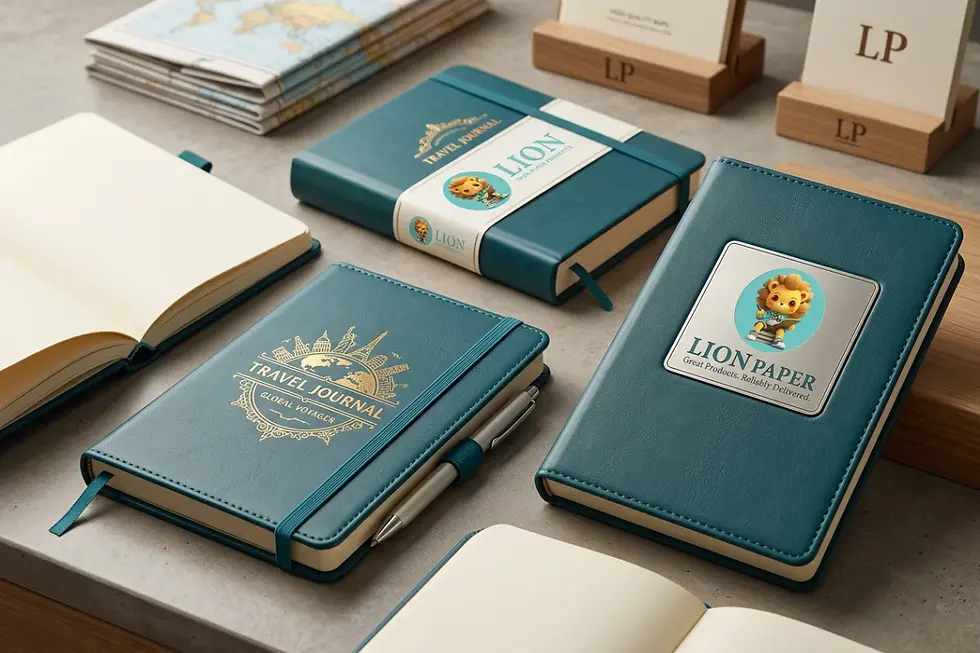
Compact travel journals engineered with durable bindings and functional closures for mobile travelers.
Which Compact Journal Formats and Paper Specifications Perform Best in Travel Retail?
Physical footprint and portability dictate stationery sales velocity within airport terminals. Bulky, heavy desk journals rarely convert well because carry-on baggage allowances constrain travelers. Sourcing programs must focus on engineered dimensions, protective bindings, and bleed-resistant paper weights that perform reliably across varied travel environments.
Successful travel retail stationery sourcing programs prioritize specific structural configurations:
Standardized Compact Sizes: A6 (105 x 148 mm), B6 (125 x 176 mm), and slim pocket formats (90 x 140 mm) generate the highest sales volume. These sizes slip easily into laptop sleeves, carry-on backpacks, and personal tote bags.
Durable Binding Constructions: Flexible softcover flexi-bound structures reduce overall product weight, whereas premium casebound hardcovers with rounded spine corners resist transit wear while displayed on high-turnover retail shelving.
Functional Travel Enclosures: Elastic closure bands, reinforced interior expandable back pockets for ticket stubs and boarding passes, dual grosgrain ribbon bookmarks, and integrated elastic pen loops are mandatory functional attributes.
Internal Paper Weight and Opacity: FSC-certified 80 GSM to 100 GSM acid-free woodfree or fountain-pen-friendly ivory paper provides an optimal balance between low physical weight and high opacity, preventing ink show-through across rollerball, ballpoint, and gel inks.
Developing a specialized compact travel journal OEM collection allows travel retailers to customize interior page templates—incorporating world time zone maps, measurement conversion tables, and lined itinerary layouts that directly resonate with modern global travelers.
How Should Airport Retailers Structure Price Tiers and Unit Economics?
Airport stationery merchandising relies on distinct price architecture designed to capture three distinct purchasing mindsets: the low-friction impulse buyer, the purposeful souvenir seeker, and the premium corporate traveler. Clear tiering eliminates decision friction and accelerates checkout velocity in time-sensitive retail hubs.
Retail Price Tier | Target Retail Price Range | Target Gross Margin | Primary Target Buyer | Key Product Format & Features |
|---|---|---|---|---|
:--- | :--- | :--- | :--- | :--- |
Tier 1: High-Impulse Add-Ons | $8.00 – $14.99 | 68% – 75% | Budget-conscious travelers, quick impulse shoppers | Pocket memo 2-packs, themed sticky notes, elastic strap bookmarks, novelty luggage tags |
Tier 2: Core Souvenir & Travel | $15.00 – $28.00 | 65% – 72% | Destination tourists, leisure vacationers, journalers | A6/B6 hardcover notebooks, foiled softcover journals, undated travel planners |
Tier 3: Executive & Luxury Gift | $29.00 – $48.00 | 60% – 68% | Business class passengers, last-minute gift buyers | Vegan leather bound journals, boxed notebook and pen sets, linen presentation boxes |
Wholesale airport gift shop notebooks positioned within Tier 2 deliver the most reliable volume and total gross margin contribution. Sourcing these products with optimized bill-of-materials costs ensures retailers can withstand airport concession fee structures while maintaining healthily profitable operations.
What Packaging, Barcoding, and Display Solutions Maximize Terminal Sales?
Airport retail shelves operate under tight spatial parameters where product visibility and immediate tactile appeal determine conversion. Unprotected paper goods can rapidly deteriorate from heavy handling by thousands of daily transit passengers. Sourcing programs must integrate protective, shelf-ready retail packaging that minimizes stock shrinkage and display maintenance.
To safeguard merchandise while optimizing visual merchandising, wholesale packaging specifications must address several structural requirements:
Protective Resealable Sleeves & Shrink Wrap: Ultra-clear poly-wrapping protects covers against scuffing, fingerprint grease, and dust while enabling shoppers to inspect foil stamping and tactile cover textures.
Informative Belly Bands (O-Bands): High-opacity paper belly bands printed with clear English descriptions, tactile feature callouts (e.g., "100 GSM FSC Paper," "Expandable Inner Pocket"), and visible barcode placement allow customers to understand product value without removing protective seals.
Standardized Scannable GS1 Barcoding: Pre-printed, high-contrast GS1-compliant EAN/UPC barcodes on outer packaging accelerate point-of-sale scanning and streamline inventory control across multi-terminal retail concessions.
Anti-Theft Integration: Packaging structures should incorporate discreet interior cavities or designated flat surfaces capable of housing EAS (Electronic Article Surveillance) security tags or RFID tracking labels without damaging paper corners.
Countertop Display Units (CDUs): Compact, high-density corrugated cardboard or acrylic display spinners allow concessionaires to merchandise 24 to 48 pocket notebooks within a minimal 12-inch footprint near terminal registers.

Protective retail-ready packaging with belly bands and barcodes optimized for high-turnover travel retail.
How Does Dual-Site Manufacturing Stabilize Travel Retail Supply Chains?
Travel retail demand fluctuates significantly between peak summer holiday schedules, international trade conferences, and seasonal winter holidays. Retailers who rely on single-region or uncoordinated supply chains often experience inventory stockouts during peak flight periods or excessive carrying costs during lulls. Leveraging an integrated China-Cambodia dual-site supply network provides travel brands with strategic manufacturing flexibility.
Lion Paper Products operates an integrated cross-border operational network designed to resolve these supply chain vulnerabilities:
Rapid Development & Sampling in Jiaxing: Lion Paper's 3,000-square-meter Jiaxing facility concentrates on product engineering, graphic adaptation, structural prototyping, and low-volume pilot runs. Rapid physical sampling allows retail buyers to finalize cover debossing, foil dies, and packaging structures within short design development cycles.
Scale Manufacturing in Cambodia: The 10,000-square-meter Cambodia manufacturing base delivers high-volume production efficiency, stable ocean freight scheduling, and advantageous international tariff structures for North American and European retail destinations.
Standardized Quality Governance: Operating under automated production lines and standardized operating procedures (SOPs), Lion Paper delivers an annual notebook output exceeding 5 million units while enforcing rigorous AQL inspection standards across both production bases.
Multi-Category Sourcing Consolidation: Retailers can consolidate custom notebooks, travel planners, cosmetic organizer pouches, writing accessories, and premium packaging boxes within unified shipping containers, significantly reducing landed logistics costs.
This coordinated dual-site strategy allows travel retail buyers to transition from initial concept sketches to global multi-terminal replenishment with predictable lead times and reduced commercial risk.
What Technical Specifications Define a Compliant Airport Stationery Program?
Building a successful private label airport stationery program requires strict adherence to international material safety, forestry traceability, and quality benchmarks. Travel retailers operating in international terminals must comply with cross-border safety standards across multiple destination jurisdictions.
Technical Parameter | Specification Standard | Retail Function & Commercial Value |
|---|---|---|
:--- | :--- | :--- |
Forestry Sourcing | 100% FSC-Certified / Recycled Paper Base | Meets corporate ESG mandates and international consumer eco-standards |
Cover Material Options | Recycled PU Leather, Linen, 2mm Recycled Greyboard | Ensures structural rigidity, scratch resistance, and premium tactile feel |
Internal Paper Stock | 80–100 GSM Acid-Free Ivory Woodfree Paper | Bleed-proof, smooth writing surface suitable for all pen types |
Binding Technology | Section-Sewn Casebound / Flexible Pur-Glue | Allows notebook to lay completely flat (180°) for effortless writing in transit |
Safety & Social Audits | ISO 9001, SMETA, WCA, GSV, CPSIA, FAMA | Ensures ethical labor practices, factory security, and chemical safety compliance |
Finishing Techniques | Blind Debossing, Precision Foil Stamping, Spot UV | Delivers durable destination graphics that resist abrasive transit friction |
Standardizing these technical benchmarks across your stationery catalog ensures that every production batch matches strict visual, tactile, and safety parameters required by premier travel concessionaires.

Standardized manufacturing lines ensure consistent quality and scale for travel retail stationery programs.
How Can Concessionaires Launch a Custom Private Label Stationery Line with Lion Paper?
Developing an exclusive, private-label airport stationery line allows travel concessionaires to capture higher gross margins, build destination prestige, and prevent price competition from standard consumer stationery brands. Lion Paper manages the entire manufacturing progression from initial concept design through to dock delivery.
Product Conceptualization & Category Planning: Concessionaires share their retail channel requirements, target terminal demographics, preferred formats, and planned launch schedules. Lion Paper's design engineering team evaluates dimensions, material pairings, and packaging structures tailored specifically for travel retail displays.
Rapid Prototyping & Material Sourcing: The Jiaxing facility produces physical samples incorporating target cover textures, foil samples, custom ribbon markers, and functional pockets for buyer evaluation and merchant line reviews.
Comprehensive Mass Production: Upon prototype approval, bulk manufacturing commences across automated lines utilizing FSC-certified materials, precision section-sewing, and automated casing-in technology.
Rigorous Quality Control & Packaging: Every production batch undergoes multi-stage AQL quality inspection, barcode scan verification, and retail-ready carton packing optimized for protective container transit.
Global Logistics & Replenishment Coordination: Coordinated ocean and air freight logistics manage deliveries to regional distribution centers or designated freight forwarders, supporting seamless seasonal rollout schedules.
To build a high-turnover, high-margin travel stationery collection for your airport retail concessions, connect with our private-label manufacturing team to review custom formats, protective packaging options, minimum order volumes, and launch timelines.
Frequently Asked Questions About Airport Stationery Sourcing
What are the standard minimum order quantities (MOQ) for custom airport gift shop notebooks?
For custom private-label notebooks, minimum order quantities typically begin at 1,000 to 3,000 units per design variation, depending on cover materials, bespoke tooling requirements, and custom page printing. Utilizing standard catalog cover materials and shared internal page layouts allows retailers to split volume across multiple destination foil stamps to test regional demand.
How are destination landmarks and city graphics applied to withstand heavy travel wear?
Premium airport stationery utilizes deep blind debossing, heat-burnished stamping, or high-adhesion metallic foil stamping on scratch-resistant PU leather, durable buckram cloth, or matte-laminated hard covers. These methods embed the graphics below the primary contact surface, preventing peeling or scratching during transit.
Can Lion Paper provide retail-ready packaging with pre-applied barcodes and security tags?
Yes. Lion Paper provides full retail-ready packaging services, including custom belly bands, individual poly-wrapping, printed GS1 scannable barcode labeling, master carton shipping marks, and structural accommodations for internal anti-theft security tags.
How does FSC certification protect airport retailers against regulatory compliance risks?
FSC certification provides end-to-end chain-of-custody documentation confirming that the wood fibers used in paper production originate from responsibly managed forests. This documentation ensures international airport concessionaires satisfy environmental regulations and consumer sustainability expectations across North American, European, and Asia-Pacific markets.
FAQ
What are the standard minimum order quantities (MOQ) for custom airport gift shop notebooks?
For custom private-label notebooks, minimum order quantities typically begin at 1,000 to 3,000 units per design variation, depending on cover materials, bespoke tooling requirements, and custom page printing. Utilizing standard catalog cover materials and shared internal page layouts allows retailers to split volume across multiple destination foil stamps to test regional demand.
How are destination landmarks and city graphics applied to withstand heavy travel wear?
Premium airport stationery utilizes deep blind debossing, heat-burnished stamping, or high-adhesion metallic foil stamping on scratch-resistant PU leather, durable buckram cloth, or matte-laminated hard covers. These methods embed the graphics below the primary contact surface, preventing peeling or scratching during transit.
Can Lion Paper provide retail-ready packaging with pre-applied barcodes and security tags?
Yes. Lion Paper provides full retail-ready packaging services, including custom belly bands, individual poly-wrapping, printed GS1 scannable barcode labeling, master carton shipping marks, and structural accommodations for internal anti-theft security tags.
How does FSC certification protect airport retailers against regulatory compliance risks?
FSC certification provides end-to-end chain-of-custody documentation confirming that the wood fibers used in paper production originate from responsibly managed forests. This documentation ensures international airport concessionaires satisfy environmental regulations and consumer sustainability expectations across North American, European, and Asia-Pacific markets.


Comments