


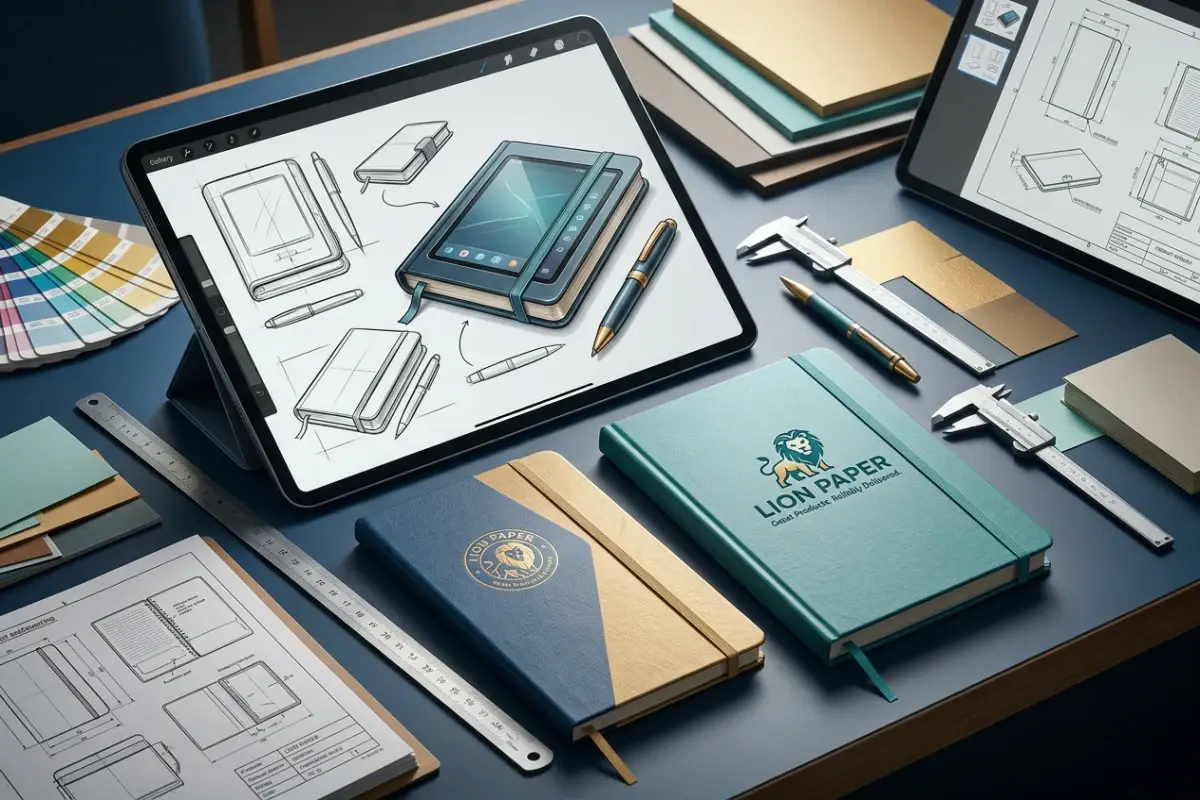
AI Stationery Concept Shortlist Manufacturing: Engineering Feasibility and RFQ Guide

To achieve successful AI stationery concept shortlist manufacturing, product development teams must filter generative digital designs through structural feasibility, material compatibility, and unit economics before engineering physical tooling. Converting 2D AI mockups into commercial paper goods requires translating visual styling into calibrated technical specifications, verifying spine geometry, validating surface finishing tolerances, and executing rapid physical prototyping through an agile supply-chain framework.
How Do You Conduct a Stationery Manufacturing Feasibility Assessment on Generative AI Concepts?
Generative AI rendering engines frequently produce compelling aesthetic concepts that defy physical bindery mechanics, substrate limitations, and standard converting processes. A rigorous stationery manufacturing feasibility assessment evaluates digital visuals against industrial production parameters to filter unbuildable concepts before capital is committed to sampling.
When shortlisting visual concepts generated by Midjourney, Stable Diffusion, or proprietary design algorithms, engineering teams evaluate five foundational feasibility criteria:
Structural Mechanics and Spine Geometry: AI tools often render seamless book blocks with impossible spine curvatures or zero-hinge clearance on thick covers. Feasibility analysis determines whether the visual requires case binding, flexi-bound construction, wire-o integration, or exposed thread Smyth-sewing.
Substrate Physical Limitations: Generative imagery frequently illustrates ultra-thin pages holding high-opacity deep solid inks with zero show-through. Commercial feasibility assesses whether specified text stock (such as 80 gsm to 120 gsm woodfree or FSC-certified offset paper) can realistically carry heavy ink densities without strike-through or fiber cockling.
Finishing Registration and Foil Realism: Digital mockups often position intricate metallic foil stamping or multi-level embossing over deep fabric grains or across board folding scores. Manufacturing review calculates whether die-stamping tolerances (typically +/-0.5 mm) can hold fine line weights without bridging.
Assembly and Enclosure Fit: AI concepts regularly feature integrated magnetic flaps, interior slip pockets, or elastic pen loops positioned where cover boards hinge, which can cause board warping or magnetic misalignment if structural shims are omitted.
Scalable Unit Cost Modeling: A visual concept featuring eight custom-dyed components, two-tone edge gilding, and bespoke cast-metal closure hardware might look attractive in an AI render, but commercial viability depends on whether the Bill of Materials (BOM) meets targeted retail margins at volume.
By systematically scoring generative concepts against these production realities, brands can eliminate unmanufacturable designs within hours rather than discovering structural failures weeks into physical toolmaking.
What Are the Key Disconnects Between AI Mockups and Production-Ready Specifications?
Generative AI platforms generate pixel-based approximations of light, texture, and geometry. They do not operate within CAD-based sheet-imposition constraints, caliper gauges, or grain-direction physics. Recognizing where visual renders diverge from manufacturing reality is critical when refining concepts.
Design Attribute | Generative AI Mockup Interpretation | Production-Ready Physical Reality |
|---|---|---|
:--- | :--- | :--- |
Book Spine and Opening Angle | Renders perfectly flat 180-degree lay-flat opening on ultra-thick hardcovers without visible hinge indents or crease channels. | Requires calibrated spine board gaps, specialized PUR adhesive or thread-sewn signatures, and scored endpapers to prevent cover lift. |
Material Texture and Grain | Visualizes seamless transitions between heavy linen weaves, vegan PU leather, and mirror-finish metallic foils. | Substrate textures introduce surface variations; foil adhesion requires matched temperature dies, sizing lacquers, and precise pressure settings. |
Paper Caliper and Swell | Shows 300-page book blocks maintaining razor-sharp, zero-radius outer corners with no swell at the binding edge. | Folding signatures increases bulk along the spine fold; book blocks require precise hydraulic pressing and three-knife trimming to eliminate uneven margins. |
Color Consistency and Inks | Uses non-gamut RGB lighting with glowing iridescence, neon gradients, and deep blacks. | Physical printing relies on standardized CMYK plus spot Pantone (PMS) formulations governed by Delta-E tolerances and paper absorbency. |
Closure and Hardware Placement | Floats elastic bands, rivets, ribbons, and snap locks without structural backer plates or clearance grooves. | Hardware requires recessed board routing, reinforced backing layers, and safety clearance from board perimeters to prevent mechanical failure. |

Evaluating spine mechanics and signature sewing to ensure 180-degree lay-flat performance.
Bridging these discrepancies requires moving past surface aesthetics and compiling technical production packages that define exact tooling profiles, material weights, and machine tolerances.
How Do You Convert an AI Mockup to Stationery RFQ Packages?
Transitioning an approved visual render into an AI mockup to stationery RFQ (Request for Quotation) document requires disassembling the concept into quantifiable engineering parameters. Factory estimators cannot quote accurately on image files alone; they require precise dimensioning, substrate grades, and finishing layers.
To build an actionable RFQ from an AI render, follow this four-phase conversion framework:
Define Closed and Open Trim Dimensions: Translate generic aspect ratios into standard metric cutting sizes (e.g., A5 at 148 x 210 mm, B5 at 176 x 250 mm, or custom North American formats like 7 x 9 inches). Explicitly specify cover board overhang (typically 3 mm standard) and internal page trim.
Deconstruct the Cover Architecture: Categorize the outer shell into core board caliper (e.g., 1.5 mm, 2.0 mm, or 2.5 mm greyboard/FSC paperboard), covering material (e.g., 157 gsm coated art paper with anti-scratch matte lamination, thermo-reactive PU, or woven bookcloth), and interior liner paper specifications.
Specify Text Block Mechanics: Detail page counts in divisible signatures (multiples of 8, 16, or 32 pages), inner sheet base weight (such as 100 gsm acid-free FSC ivory paper), grid rulings (5 mm dot grid, 7 mm ruled, or custom CMYK planner layouts), and binding method (Smyth-sewn casebound, flexi-cover, section sewn with exposed spine, or double-wire binding).
Isolate Value-Added Finishing Layers: Provide separate callouts for decorative embellishments shown in the render. Detail hot-foil stamping areas in square centimeters, spot UV gloss varnishes, blind debossing depths, painted or gilded page edge finishes, ribbon marker widths (e.g., 5 mm or 7 mm satin/grosgrain), and elastic band tension specifications.
Providing this granular technical breakdown enables manufacturing partners to return transparent line-item pricing, accurate yield estimates, and clear lead-time projections without multi-week clarification delays.
What Custom Notebook Technical Specifications Must Be Defined Before Tooling?
Before initiating physical sample tooling or mass manufacturing, engineering teams must lock in comprehensive custom notebook technical specifications. Establishing these parameters protects brand integrity and ensures visual fidelity carries through mass production.
| CUSTOM NOTEBOOK ENGINEERING SPECIFICATION |
| 1. CORE BINDING & ARCHITECTURE | | • Format: Casebound Hardcover / Smyth-Sewn Block / Square Spine | | • Board Caliper: 2.0 mm High-Density FSC Greyboard | | • Signature Structure: 12 signatures x 16 pages (192 total pages) | | • Lay-Flat Capability: 180-degree flat opening across spread |
| 2. SUBSTRATE SELECTION | | • Cover Wrap: 120 gsm FSC Recycled Bookcloth laminated to board | | • Endpapers: 160 gsm High-Bulk Uncoated Woodfree Paper (Matched PMS) | | • Text Block: 100 gsm Acid-Free Ivory Woodfree (Bleed-resistant) |
| 3. FINISHING & DECORATIVE TREATMENTS | | • Cover Embellishment: Precision Hot-Foil Stamping (1 Color, Front) | | • Edge Treatment: Matte Solid PMS Sprayed Page Edges | | • Extras: 2 x 7 mm Grosgrain Ribbons, Back Expandable Pocket (0.5 mm)|
| 4. QUALITY TOLERANCES & COMPLIANCE STANDARDS | | • Finishing Registration: +/- 0.5 mm maximum drift | | • Quality Acceptance: ISO 9001 / AQL Level II Major 2.5, Minor 4.0 | | • Compliance Framework: FSC Chain of Custody, CPSIA, Prop 65 |

Establishing exact technical specifications and tooling die-lines from shortlisted AI mockups.
Locking down these structural attributes prevents costly mold and die revisions during pre-production while establishing clear quality acceptance thresholds for downstream inspection.
Which Physical Attributes and Functional Constraints Cannot Be Validated by AI Images?
Generative AI excels at visualizing color palettes and ambient styling, but paper products are tactile goods governed by haptic feedback and physical wear. Sourcing and product managers must validate several performance characteristics physically that cannot be simulated on screen:
Paper Opacity and Feathering Resistance: Digital screens cannot calculate fountain pen ink interaction, alcohol marker strike-through, or dry time on uncoated fibrous surfaces. Physical paper evaluation is mandatory to confirm writing performance.
Haptic Tactility and Soft-Touch Friction: AI images cannot communicate the hand-feel of rubberized soft-touch coatings, coarse linen weaves, or fine pebble-grained vegan leathers. Texture defines consumer perception and requires tactile swatch review.
Spine Elasticity and Binding Durability: Machine stress testing measures how well glue formulations (like EVA versus PUR) withstand repeated flexing, extreme temperature shifts, and heavy daily usage without signature detachment.
Cover Board Warp Resistance: Moisture absorption in paper covers and adhesives can cause structural warping. Balanced board laminations—matching grain direction and tension across outer wrap and inner endpapers—can only be verified through physical ambient stability testing.
Hardware and Elastic Longevity: The stretch recovery of elastic bands, retention force of interior pockets, and magnetism of hidden flap closures require mechanical cycle testing to prevent premature fatigue in consumer hands.
Addressing these functional constraints early via disciplined prototyping prevents consumer returns and negative retail reviews.
How Does an AI Design to Physical Sampling Workflow Function in Dual-Site Manufacturing?
Executing an efficient AI design to physical sampling workflow requires seamless coordination between rapid structural prototyping and cost-effective mass production. Modern stationery supply chains leverage dual-site capabilities to maximize development speed while safeguarding unit economics.
AI Ideation & Shortlisting │ ▼ Engineering Review & DFM (China Jiaxing R&D) ──► (Digital 3D CAD & Die-lines) │ ▼ Rapid White Dummy & Wet Sampling (3-5 Days) ──► (Substrate & Finishing Approval) │ ▼ Pre-Production Pilot Run & Tooling Lock │ ▼ Mass Production & Scaled Assembly (Cambodia Hub) ──► (ISO 9001 / AQL Compliance) │ ▼ Global Retail Distribution & DTC Delivery
In this integrated manufacturing model, initial concept analysis, design for manufacturability (DFM) adjustments, structural CAD die-line creation, and high-speed prototyping occur within an agile technical center, such as Lion Paper's 3,000-square-meter Jiaxing facility. Prototyping specialists produce unprinted white dummies within 48 to 72 hours to verify physical proportions, followed by fully printed "wet samples" incorporating precision hot stamping, custom debossing, and exact paper stocks.
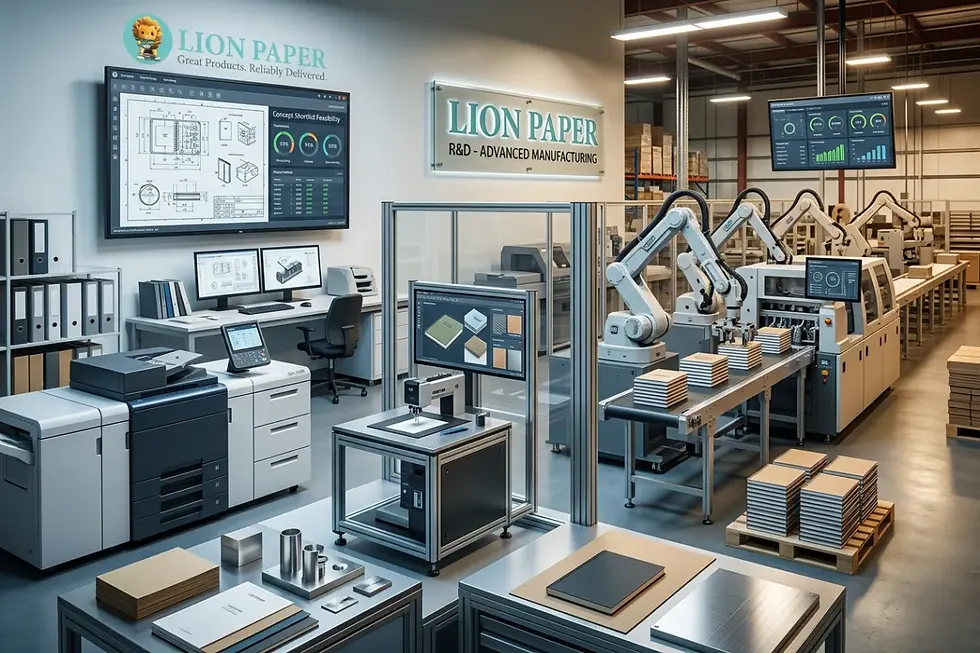
Agile prototyping and dual-site manufacturing coordination streamline the path from sketch to shipment.
Once the physical master sample receives quality sign-off, production tooling and standardized SOPs transfer to large-scale automated facilities, such as Lion Paper's 10,000-square-meter Cambodia manufacturing hub. This dual-site synergy allows international brands to achieve rapid 7-to-10-day prototype turnarounds while leveraging Cambodia's cost efficiencies, tariff optimization benefits, and 5-million-plus annual notebook capacity for mass production runs.
How Do China-Cambodia Dual Facilities Optimize Total Landed Cost and Speed for Shortlisted AI Concepts?
Managing paper goods manufacturing across international markets requires balancing time-to-market against total landed costs. Utilizing a synchronized China-Cambodia manufacturing network delivers distinct operational and financial advantages when scaling shortlisted AI stationery designs:
Tariff and Trade Mitigation: Manufacturing mass volumes in Cambodia provides significant customs duty relief for North American and European retail distribution, lowering landed unit costs compared to single-origin sourcing.
Agile Prototyping Combined with High-Volume Output: Product development teams benefit from rapid raw-material access and advanced prototyping capabilities in China, paired with Cambodia's automated production lines for large seasonal orders.
Stringent Quality Control and Multi-Framework Compliance: Consistent operating procedures, defect catalogs, and AQL Level II sampling protocols govern both facilities. Production adheres to ISO 9001, FSC chain-of-custody, SMETA, WCA, GSV, FAMA, and CPSIA consumer safety regulations.
Sustainable Material Sourcing: Dual-site operations streamline access to traceable FSC-certified papers, recycled board substrates, soy-based low-VOC inks, and plastic-free retail packaging, helping brands meet strict ESG benchmarks.
Comprehensive Multi-Category Integration: Beyond standalone notebooks, integrated dual-facility networks support companion stationery collections—including planners, filing products, organizer bags, desk accessories, and premium rigid gift packaging—under a unified quality management umbrella.
By uniting digital generative ideation with robust dual-site physical engineering, brands can turn creative AI concepts into commercially viable, market-leading stationery collections with reduced lead times and protected margins.
To move your digital stationery concepts from initial render to high-precision physical production, explore https://app.lionpaper-istyle.com/imagina. Share your shortlisted mockups and preliminary specifications with our engineering team to initiate structural review, material matching, and rapid prototype development through Contact Our Engineering Team.
FAQ
What file formats are required to convert an AI stationery mockup into a manufacturing RFQ?
While AI mockups are typically generated as raster PNG or JPEG files, preparing a production RFQ requires converting these visuals into vector-based CAD die-lines (Adobe Illustrator AI or PDF format with separate layers for cutting, creasing, and foil/emboss spot colors) alongside a structured specification sheet detailing trim size, paper GSM, board caliper, and binding mechanics.
How long does it take to produce a physical prototype from an AI stationery concept?
Through an agile R&D setup, an unprinted structural white dummy can typically be produced in 2 to 3 business days to verify sizing, page bulk, and spine mechanics. A fully finished, printed pre-production sample incorporating custom materials, foil stamping, and dyed page edges generally requires 7 to 10 working days.
How do you ensure paper opacity and bleed resistance match the visual look of an AI mockup?
AI mockups cannot simulate liquid ink absorption or fiber transparency. To guarantee bleed resistance and prevent ghosting, physical engineering selects high-opacity, acid-free woodfree papers (typically 100 gsm to 120 gsm) or specialized coated stocks, followed by standardized fountain pen and rollerball ink draw-down tests during initial sampling.
Why is dual-site manufacturing beneficial for scaling shortlisted AI stationery products?
A dual-site China-Cambodia manufacturing network allows brands to conduct rapid R&D, structural design, and prototype validation in an agile development center (such as Jiaxing), while scaling commercial mass production in an automated Cambodia facility to benefit from tariff optimization, competitive labor rates, and reliable multi-million-unit capacity.


Comments