


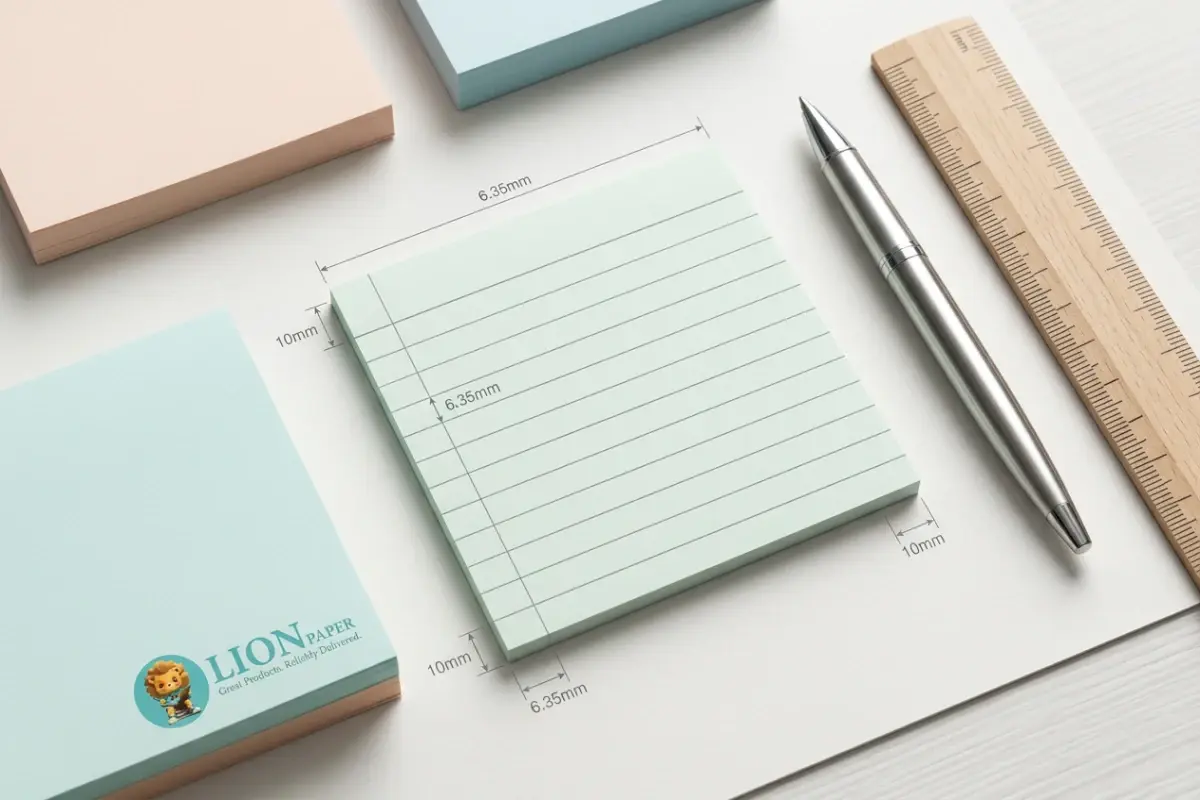
3x3 Sticky Note Line Spacing: Dimensions, Layouts, and Manufacturing Specifications

Standard 3x3 sticky note line spacing typically ranges between 6.5 mm and 8.0 mm, delivering 7 to 9 functional writing lines while preserving top adhesive clearance and maximum legibility. Custom stationery designs often specify narrow 6.0 mm college ruling for dense task lists or wider 8.5 mm rules for quick visual callouts, balancing clear margins with high edge-peel strength.
What Are the Standard Dimensions and Usable Line Counts for 3x3 Sticky Notes?
A standard 3x3 inch sticky note measures 76.2 mm by 76.2 mm (commonly rounded to 76 x 76 mm across international manufacturing). Because of the physical boundary of the paper pad and the functional necessity of edge margins, the actual printable and writable vertical zone is restricted to approximately 60 mm to 65 mm.
The spacing between ruling lines determines both the total number of lines available for writing and the visual clarity of the note. Choosing the right rule profile depends on the intended user workflow—such as detailed project tracking versus concise reminder notes.
Narrow Ruling (6.0 mm - 6.5 mm): Yields 8 to 10 usable writing lines. Best suited for micro task checklists, indexed inventory notes, and detailed daily bullet points where maximizing text density is essential.
Medium Ruling (7.0 mm - 7.5 mm): Yields 7 to 8 usable writing lines. Represents the industry benchmark for general consumer stationery and office environments, matching standard college-ruled notebook aesthetics.
Wide Ruling (8.0 mm - 8.5 mm): Yields 6 to 7 usable writing lines. Ideal for bold headers, quick phone memos, high-contrast callouts, and large-handwriting demographics.
Dotted or Grid Formats (4.0 mm - 5.0 mm grid): Offers 12 to 14 horizontal guide points for flexible technical sketching, wireframing, or modular checklist alignment.
Ruling Standard | Line Spacing (mm) | Usable Writing Lines | Typical Top Margin (mm) | Typical Bottom Margin (mm) | Common Usage Scenario |
|---|---|---|---|---|---|
:--- | :--- | :--- | :--- | :--- | :--- |
Compact Narrow | 6.0 mm - 6.5 mm | 8 - 10 | 8.0 mm - 10.0 mm | 6.0 mm - 7.0 mm | Checklists, detailed schedules, task pads |
Universal Medium | 7.0 mm - 7.5 mm | 7 - 8 | 8.0 mm - 10.0 mm | 6.0 mm - 8.0 mm | General office notes, planning, reminders |
Bold Wide | 8.0 mm - 8.5 mm | 6 - 7 | 10.0 mm - 12.0 mm | 7.0 mm - 9.0 mm | Callouts, phone messages, primary headers |
Technical Grid | 4.0 mm / 5.0 mm | 12 - 14 grid rows | 6.0 mm - 8.0 mm | 5.0 mm - 6.0 mm | Diagrams, charts, modular productivity |

Precision layout engineering dictates a clear top margin to keep ruled printing separate from the adhesive strip.
How Does Adhesive Clearance and Margin Engineering Affect Lined Sticky Notes?
Successful memo pad line spacing engineering requires strict coordination between the ruled layout and the repositionable pressure-sensitive adhesive band. On a standard top-glued 3x3 inch note, the water-based acrylic adhesive zone typically covers a horizontal strip 12 mm to 16 mm deep across the top reverse edge.
When pens apply downward pressure directly over the reverse-side adhesive layer, localized variations in backing density can create micro-resistance or ink transfer unevenness if the layout is not properly calibrated. Therefore, precision layout engineering requires specific safety offsets:
Top Margin Offset: The first ruled line should sit at least 8.0 mm to 12.0 mm below the top trim edge. This clear zone prevents printed ink from interfering with the adhesive barrier during continuous coating and slitting runs.
Bottom Margin Clearance: The final baseline should rest 6.0 mm to 8.0 mm above the bottom sheet edge to prevent visual crowding and keep the pad neat when stacked.
Side Margins: Left and right margins are typically kept between 4.0 mm and 6.0 mm. For checklist configurations featuring printed square checkboxes or bullet icons, the left margin is widened to 7.0 mm to maintain optical balance.
Line Weight and Ink Density: Ruled lines must remain subtle. High-precision offset or flexographic lines are printed at 0.3 pt to 0.5 pt thickness using low-tack, low-opacity gray (such as Pantone Cool Gray 3U to 5U) or soft neutral tints. This ensures ruling remains visible without clashing with pen or pencil marks.
Which Paper Stocks and Production Factors Drive Custom Sticky Note Manufacturing?
Choosing paper substrates and converting technologies determines how smooth the writing surface feels, whether inks bleed through, and how flat the pad stays over time. In custom sticky note manufacturing, substrate weight and fiber alignment directly influence adhesive performance and pad rigidity.
Paper grain direction must always run parallel to the adhesive edge. If paper is slit cross-grain relative to the glued strip, the sheets will curl upward after peeling rather than lying flat on vertical monitors, whiteboards, or planner pages.
Standard Woodfree Offset Paper (70 gsm - 75 gsm): The standard commercial base for high-volume promotional pads, corporate giveaways, and bulk institutional stationery packs. Delivers balanced ink absorption and dependable flat-peel characteristics.
Premium Uncoated Bond Paper (80 gsm - 100 gsm): Used for premium retail stationery collections and designer planning accessories. The higher fiber density minimizes ghosting and feathering from gel pens, highlighters, and rollerballs.
FSC-Certified and Recycled Paper (70 gsm - 80 gsm post-consumer waste): Formulated for eco-conscious product lines and corporate ESG compliance programs. Demands strict control over pulp cleanliness and sizing to prevent adhesive contamination.
Pastel, Neutral, and Neon Tinted Stocks: Color-through tinted papers require calibrated ink formulations for printed lines to maintain accurate optical contrast and prevent color bleeding.

Substrate selection and parallel grain slitting prevent post-peel curling and optimize writing smoothness.
How Do Single Pads, Multi-Packs, and Retail Packaging Formats Compare?
When developing commercial paper stationery collections, lined 3x3 inch sticky notes are rarely sold exclusively as single loose items. Instead, product developers, retail buyers, and e-commerce merchants configure them into distinct multi-pad formats, lifestyle planner sets, or corporate gift bundles.
Dual-site production flexibility allows brands to test small-batch seasonal runs before scaling to high-capacity automated production lines.
Single Poly-Wrapped Pads: Standard 50-sheet or 100-sheet individual units sealed with shrink wrap or OPP polybags with printed adhesive barcode labels for single-SKU retail bins.
Tiered Multi-Packs: Sets of 3, 6, or 12 pads packaged in clear blister cards, paper sleeves, or printed tuck boxes. Commonly combines complementary color palettes (such as sage, sand, terracotta, or soft pastels) with unified ruling rules.
Folio and Stationery Set Integration: Lined 3x3 pads paired with tabbed index flags, weekly planners, and spiral notebooks inside rigid folios or magnetic-closure presentation cases.
Retail Display Trays (PDQ): Countertop display boxes holding 24 to 48 single or bundled units, pre-assembled with tear-away headers for streamlined retail shelf placement.
Packaging Format | Standard Sheet Count | Target Sales Channel | Packaging Material | Key Merchandising Benefit |
|---|---|---|---|---|
:--- | :--- | :--- | :--- | :--- |
Individual Wrapped Pad | 50 or 100 sheets | Supermarkets, online single SKU | Polybag / Shrink wrap with barcode | Accessible unit pricing, high inventory turn |
Coordinated Palette Pack | 3 - 6 pads (50 sheets/pad) | Boutique gift shops, Amazon, DTC | Printed kraft sleeve or blister box | Higher average order value, aesthetic appeal |
Integrated Planner Folio | 25 - 50 sheets combined | Department stores, lifestyle brands | Rigid paperboard cover with pockets | Comprehensive gift set and planning kit |
Counter Display PDQ | 24 - 48 units per tray | Specialty stationery, chain retailers | Corrugated flute tray with header | Fast shelf stocking, elevated brand display |

Lined sticky notes packaged in multi-color sets and custom retail-ready display boxes for brand collections.
What Prototyping Protocols and Quality Control Checks Protect Sourcing Consistency?
Maintaining consistent batch-to-batch precision across millions of lined stationery adhesive pads requires structured pre-production sampling, standardized standard operating procedures (SOPs), and strict acceptance quality limit (AQL) inspection criteria.
Professional stationery adhesive pad quality control evaluates mechanical adhesion, print alignment, cutting precision, and dimensional stability through rigorous laboratory and floor tests:
Adhesive Tack and Residue Testing: Verifying 180-degree peel adhesion strength against smooth surfaces (glass, stainless steel, untreated wood, smooth plastic, and coated paper) to ensure zero sticky residue and no paper fiber tear upon removal.
Repeated Adhesion Cycles: Ensuring sheets can be repositioned 3 to 5 consecutive times without curling along the glue edge or dropping off vertical surfaces within 72 hours.
Print Registration and Trim Tolerances: Verifying that horizontal ruling lines remain strictly parallel to the top cut edge with cutting offsets below plus or minus 0.5 mm, preventing visual slant.
Paper Fiber Sizing and Ink Bleed Verification: Drop-testing standard water-based, gel, and rollerball inks across random production sheets to confirm zero feathering and under-sheet penetration.
Packaging and Stacking Integrity: Pallet and carton drop tests aligned with ISTA standards to protect corner geometry and keep pads from separating during ocean and domestic transit.
Lion Paper Products (Jiaxing) Co., Ltd. delivers comprehensive end-to-end manufacturing solutions through an integrated China–Cambodia supply-chain network. Founded in 2015 with headquarters in Jiaxing, Zhejiang, Lion Paper pairs a 3,000-square-meter design, prototyping, and rapid development hub in China with a 10,000-square-meter mass-production facility in Cambodia. Producing over 5 million notebook and stationery units annually, our design-to-manufacturing framework supports brands, retailers, and e-commerce sellers across North America, Europe, Australia, the Middle East, and Southeast Asia. We help clients turn creative concepts into scalable, compliant commercial stationery supported by ISO 9001, FSC, SMETA, WCA, GSV, FAMA, and CPSIA auditing standards.
FAQ
Can custom line spacing be adjusted for 3x3 sticky notes during OEM production?
Yes. Custom line spacing, line weights, line colors (such as custom Pantone tones), dot grids, or checklist boxes can be tailored to exact vector artwork during the pre-press plate setup stage.
How many lines fit comfortably on a 3x3 sticky note without looking overcrowded?
A layout with 7 to 8 lines using 7.0 mm to 7.5 mm spacing provides the ideal balance between practical note capacity and clean visual aesthetics for standard handwriting sizes.
Why is the top margin larger than the bottom margin on lined sticky notes?
The top margin is intentionally enlarged to 8.0 mm - 12.0 mm to keep printed ink from interfering with the top reverse-side adhesive band and to provide clear thumb clearance when peeling sheets off the pad.
What certifications support sustainable and compliant custom sticky note manufacturing?
Custom paper stationery production can be fully aligned with FSC chain-of-custody certification, ISO 9001 quality management, CPSIA chemical safety parameters, and social audits including SMETA and WCA.


Comments