


3 Powerful Paper Goods Trends Your Customers Will Love in 2026
- Leo Xia

- 3 days ago
- 8 min read
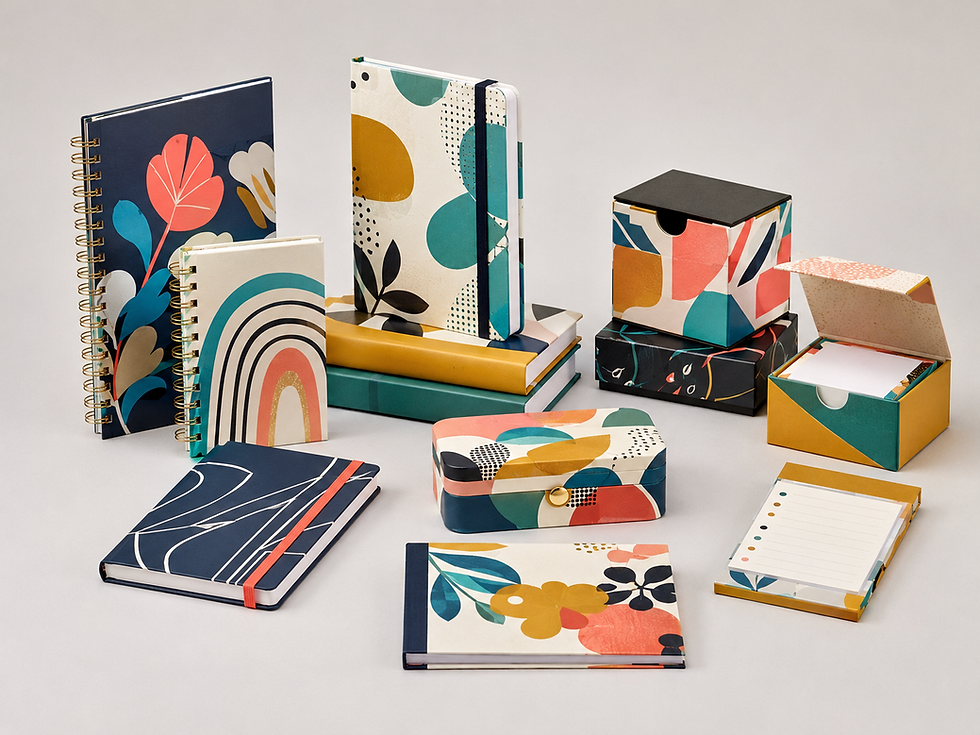
If you're wondering what paper goods customers will be buying in 2026, three trends stand out above the rest:
Giftable stationery collections are replacing single products. Customers want coordinated notebooks, planners, note cards, gift bags, stickers, and packaging that work together as one collection.
Function is becoming just as important as design. Buyers now look for practical features such as lay-flat binding, storage pockets, tear-off pages, planners with trackers, and writing-friendly paper.
Premium materials and sustainable production are no longer optional. FSC-certified paper, recyclable materials, premium finishes, and consistent manufacturing quality have become baseline expectations for many retailers.
For brands, retailers, and product developers, success in 2026 won't come from adding more SKUs. It will come from creating complete paper goods programs that combine beautiful design, everyday usability, and reliable production quality
Quick Content Reach:
3 Powerful Paper Goods Trends Your Customers Will Love in 2026
Walk through almost any stationery retailer today, and you'll notice something interesting.
Customers are spending more time comparing products. They open notebooks before buying them. They test planner layouts. They touch paper, examine covers, and even look at packaging before making a decision.
Beautiful artwork still matters—but it's no longer enough.
Across specialty stationery stores, lifestyle retailers, gift shops, and home décor chains, paper goods are becoming more experience-driven. Products are expected to solve real problems, feel premium in the hand, and fit naturally into gifting occasions.
This shift creates exciting opportunities for brands that understand where the market is heading.
Based on recent market observations across leading stationery and lifestyle brands, here are the three biggest paper goods trends shaping 2026.
Why Paper Goods Are Becoming More Giftable, Functional, and Retail-Ready
Consumers today don't simply buy notebooks.
They buy organization.
They buy inspiration.
They buy gifts.
They buy products that fit their lifestyle.
That's why successful brands are expanding beyond individual products and building complete collections that share the same artwork, color palette, and design language.
For manufacturers, this means production is becoming more sophisticated. Consistent color matching, multiple product formats, premium finishing, and reliable quality control are now essential—not optional.
Trend 1: Giftable Stationery Collections Are Replacing Single Products
One of the clearest shifts heading into 2026 is the move away from standalone stationery.
Instead of launching one notebook, brands are introducing complete product families.
A single artwork or seasonal theme may now appear across:
Rather than asking customers to purchase one product, brands invite them into an entire collection.
This approach creates a stronger retail presentation while encouraging multiple purchases during a single shopping trip.
Why Customers Love Coordinated Collections
Gift shopping has become easier than ever.
A customer buying a notebook may also choose matching note cards and gift wrapping without searching for complementary designs.
The result is higher perceived value and a more enjoyable shopping experience.
Retail buyers appreciate this approach as well because coordinated collections create attractive merchandising displays that require less effort to assemble.
Instead of displaying unrelated products, stores can build complete lifestyle stories around a single theme.
Popular Collection Ideas for 2026
Collection Theme | Products Included | Customer Benefit |
Botanical Collection | Notebook, journal, note cards, gift bag | Elegant gifting |
Nordic Minimalist | Planner, calendar, desk pad, wrapping paper | Clean home office style |
Cute Lifestyle | Stickers, journals, planners, bookmarks | Social media appeal |
Seasonal Gift Set | Greeting cards, gift tags, tissue paper, bags | Easy holiday shopping |
Student Collection | Spiral notebook, planner, sticky notes | Back-to-school convenience |
Expert Manufacturing Insight
From a production perspective, developing collections requires more than printing matching artwork.
Every product should feel like it belongs together.
That means maintaining consistent:
Color accuracy
Paper quality
Foil finishes
Packaging materials
Structural details
Brand presentation
Retailers increasingly notice these details, especially when collections appear together on store shelves.
Trend 2: Functional Planners Are Becoming Everyday Productivity Tools
The planner market continues to grow—but customers now expect much more than attractive covers.
Modern planners are designed to support real life.
Instead of focusing only on decoration, brands are investing in features that improve everyday use.
These practical improvements make products more valuable while encouraging repeat purchases.
The Features Customers Actually Notice
Today's buyers pay attention to details that were once considered secondary.
Popular features include:
Lay-flat binding
Storage pockets
Elastic closures
Ribbon bookmarks
Monthly and weekly layouts
Goal trackers
Budget pages
Mood trackers
Tear-off shopping lists
Tabbed sections
Pen loops
Durable covers
Each feature makes planning easier while giving customers a reason to choose one product over another.
Function has become a competitive advantage.
Better Writing Experience Matters
Paper quality has also become much more important.
Consumers increasingly look for:
Smooth writing
Minimal ink bleed
Thicker paper
Acid-free materials
Comfortable page layouts
Even seemingly small improvements—such as better spacing between writing lines or improved page sequencing—can significantly improve customer satisfaction.
Brands that listen carefully to customer feedback often discover that usability drives stronger long-term loyalty than decorative design alone.
Manufacturing Perspective
Creating high-quality planners involves careful attention throughout production.
Successful projects often include:
Interior layout verification
Page order checks
Binding durability testing
Pocket attachment inspection
Cover material consistency
Writing performance evaluation
These quality checks help reduce production issues before products reach retailers.
Example: Features That Add Value
Feature | Customer Value | Retail Advantage |
Lay-flat binding | Easier writing | Premium positioning |
Storage pocket | Extra organization | Higher perceived value |
Elastic closure | Better durability | Everyday usability |
Goal tracker pages | Productivity support | Stronger differentiation |
Thick FSC paper | Better writing experience | Sustainability appeal |
Trend 3: Premium Materials and Sustainable Production Have Become the New Standard
For years, sustainability was considered a competitive advantage.
In 2026, it's becoming a basic expectation.
Retailers, distributors, and consumers increasingly expect paper goods to reflect responsible sourcing without sacrificing quality or design. At the same time, premium finishes continue to play an important role in making products feel gift-worthy.
The winning formula isn't choosing between sustainability and luxury. It's delivering both.
Customers want products that look beautiful, feel premium, and align with their values.
Materials That Continue to Gain Momentum
Paper selection has become one of the most important decisions during product development.
Instead of asking, "Which paper is the least expensive?" many brands are now asking, "Which paper delivers the best customer experience?"
Several material choices continue to gain popularity across the paper goods industry:
FSC-certified paper from responsibly managed forests
Recycled paper with improved print performance
Uncoated premium writing paper
Soft-touch laminated covers
Linen-textured paper
Cotton-blend paper for specialty stationery
Recyclable packaging materials
Plastic-free presentation where possible
These materials help products communicate quality before customers even begin writing.
Premium Finishes That Increase Perceived Value
Consumers often decide whether a product feels "premium" within seconds.
Surface finishes play a surprisingly large role in that first impression.
Popular finishing techniques include:
Gold foil stamping
Silver foil details
Embossing
Debossing
Spot UV coating
Painted page edges
Rounded corners
Fabric spines
Ribbon markers
Magnetic gift boxes
The key is balance.
A tasteful finish enhances a product. Too many decorative effects can distract from the overall design.
Brands that maintain a clean, cohesive aesthetic often achieve a more timeless look while keeping production costs under control.
Manufacturing Insight: Consistency Builds Trust
Premium materials only deliver value when manufacturing quality remains consistent.
Retail buyers expect every shipment to meet the same standard.
That means manufacturers need strong quality control throughout the production process, including:
Color consistency across multiple SKUs
Accurate foil registration
Reliable binding strength
Clean die-cut edges
Consistent cover materials
Stable paper performance across production runs
These details may not appear in a product description, but they strongly influence customer satisfaction, retailer confidence, and repeat orders.
Comparison: The Three Biggest Paper Goods Trends for 2026
The trends shaping 2026 all point toward the same conclusion: customers expect more than attractive products. They expect complete experiences.
Trend | What's Driving It | Customer Benefit | Opportunity for Brands |
Giftable Collections | Lifestyle gifting and coordinated merchandising | Easier shopping and better presentation | Increase average order value with matching product families |
Functional Design | Everyday productivity and organization | Better usability and long-term satisfaction | Differentiate products through practical features |
Premium & Sustainable Materials | Higher quality expectations and environmental awareness | Greater trust and stronger perceived value | Build long-term brand reputation through responsible production |
Rather than treating these trends as separate opportunities, successful brands are combining them into one product strategy.
Imagine a coordinated botanical collection that includes an FSC-certified planner, matching notebook, greeting cards, gift bags, and premium gift box. Each item shares the same design language while serving a different customer need.
That is exactly the kind of complete collection many retailers are looking for.
How Brands Can Build a Stronger Paper Goods Collection in 2026
Launching new products every season isn't always the best growth strategy.
Many successful brands are instead expanding around one strong design concept.
For example, a single illustration or artwork can be adapted into multiple products that appeal to different customer groups and price points.
A practical collection might include:
Hardcover journal
Weekly planner
Spiral notebook
Desk pad
Greeting cards
Gift tags
Sticker sheets
Gift bags
Wrapping paper
Storage box
This approach creates visual consistency while improving production efficiency.
It also allows retailers to merchandise products together, creating stronger shelf displays and encouraging customers to purchase more than one item.
Questions Every Retail Buyer Should Ask Before Developing New Paper Goods
Choosing the right manufacturing partner is just as important as choosing the right design.
Before starting a new collection, retailers and brands should ask questions such as:
Can the manufacturer produce multiple paper goods in one coordinated collection?
How is color consistency maintained across different product formats?
Are FSC-certified or recycled paper options available?
What quality control processes are used before shipment?
Can premium finishes be combined without affecting production efficiency?
Is packaging designed for both retail presentation and transportation?
Clear answers to these questions help reduce risk and improve product quality from the beginning of a project.
Final Thoughts
The paper goods industry continues to evolve, but one thing is becoming increasingly clear: customers are looking for products that combine thoughtful design, everyday functionality, and dependable quality.
Brands that embrace coordinated collections, prioritize practical user experiences, and invest in premium, responsibly sourced materials will be better positioned to meet changing customer expectations in 2026 and beyond.
For manufacturers, this shift presents an opportunity to move beyond simply producing individual products. The greatest value now comes from helping brands develop complete paper goods programs that deliver consistency, creativity, and lasting quality.
As customer expectations continue to rise, the businesses that succeed will be those that understand not only what products people buy—but why they buy them.
—Leo Xia, CEO, Lion Paper Products
You design, we deliver.
FAQs:
Q1: What paper goods are expected to be most popular in 2026?
Giftable stationery collections, functional planners, premium notebooks, greeting cards, desk accessories, and coordinated packaging are expected to remain among the strongest-performing paper goods categories in 2026.
Q2: Why are stationery collections becoming more popular?
Consumers increasingly prefer coordinated products that share the same design theme. Collections also make gift shopping easier and help retailers create more attractive in-store displays.
Q3: What makes a paper product feel premium?
Customers often associate premium quality with thicker paper, smooth writing surfaces, durable binding, elegant finishes, thoughtful layouts, and consistent manufacturing quality.
Q4: Why is sustainable paper important for brands?
Responsible sourcing has become an important purchasing factor for many retailers and consumers. Using FSC-certified or responsibly sourced materials demonstrates a commitment to long-term sustainability while strengthening brand credibility.
Q5: How can manufacturers help brands stand out in a competitive market?
Experienced manufacturers add value by offering material recommendations, production expertise, quality control, coordinated product development, and consistent execution across multiple product categories.
Are you looking for a reliable manufacturer? Reach out to Lion Paper for a free quote and consultation. Let’s collaborate on creating custom writing paper products that will set your brand apart from the competition!
About Lion Paper
Company Name: Lion Paper Products
Office Address: 20th floor, Chuangyedasha Building, No. 135, Jinsui Road, Jiaxing City, Zhejiang Province, China
Factory Address: No.135, Xuri Road, Jiaxing City, Zhejiang, China
Email: Leoxia@lion-paper.com
Audit Certifications: ISO9001:2015/FSC/SEDEX SMETA/Disney FAMA/GSV/SQP


Comments