


How Moleskine Wins the Stationery Shelf: A Full Breakdown

Executive Summary
Moleskine wins shelf space by selling a story you can hold—then backing it up with a tight core notebook system, premium pricing discipline, and a constant drumbeat of limited editions and collaborations.
For CEOs, the takeaway is clear: Moleskine isn’t “just a notebook brand”—it’s a platform that turns a simple object into an identity product, which keeps it resilient even when buyers also use digital tools.
For procurement leaders, the playbook is practical: standardize the “hero spec” (sizes, paper, layouts), then build margin-rich upgrades (packs, gift boxes, collabs, personalization, and B2B custom editions).
The broader tailwind is a growing global stationery market, which supports premium segments when the brand story and product system are strong.
Quick Content Reach:
Moleskine's People - Brand Positioning & Target Customers
Brand Keywords
Moleskine’s positioning is built around heritage + creativity + design discipline. It anchors itself as the “legendary notebook” and frames handwriting as the best way to generate ideas, which gives emotional value to an everyday product. It also signals modern relevance by linking its sustainability narrative to FSC certification and science-based climate targets, which matters to today’s buyers and retail partners.
Procurement insight: When a brand sells “meaning” (not just paper), shoppers tolerate premium pricing and are more likely to gift, collect, and rebuy.

Who Is Actually Buying? (Personas & Use Cases)
Moleskine’s buyers cluster into a few high-value personas that map cleanly to repeatable use cases.
Creative professionals (designers, writers, artists): They buy the classic notebook as a “daily tool,” and often keep past books as an archive.
Gift buyers: Limited editions, boxed sets, and collabs convert well because the product already “looks like a gift.”
Students and young professionals: The brand’s standard sizes/layouts reduce decision fatigue, which helps retail conversion.
Corporate clients: Custom editions become branded objects that carry a message and feel premium in the hand.
Hybrid analog-digital users: Smart writing products bridge paper and app workflows, keeping the brand relevant in modern work styles.
CEO insight: These personas share one trait—they want an object that feels intentional, not generic.
Product - Product Structure & SKU Logic
Hero Lines – What Really Pays the Bills?
Moleskine’s engine is the Classic Notebook system: consistent design cues, repeatable specs, and familiar options.

That hero product stays stable: hard cover, rounded corners, elastic closure, ribbon, inner pocket, and lay-flat opening are part of the “signature.”
Even the paper spec is standardized (ivory-colored, 70 g/m², acid-free), which helps procurement, forecasting, and retail replenishment.
Why this matters: A strong hero line reduces SKU chaos while still letting the brand “refresh” with layouts and colors.
Extensions – How They Build a Product Universe
Moleskine expands outward without breaking the core identity. It adds value through limited editions, themed collections, collaborations, and giftable bundles, which bring higher price points and seasonal energy. It also stretches into smart writing and apps, which keeps the brand present in modern note workflows.
Procurement insight: Extensions work best when they share core components (same size families, binding, and print templates).
Size & Paper Matrix
Moleskine uses a simple matrix: pick size, then layout, then cover type, and you’re done.
Example size system (Classic Notebook): Pocket, Medium, Large, XL, XXL.
Example layout system: Dotted, Ruled, Squared, Plain.
Baseline paper spec: 70 g/m², acid-free; FSC-certified sources are stated on product pages.
Table example (SKU logic you can copy):
Decision Layer | Moleskine Pattern | Why It Sells | What Buyers Like |
Size | Pocket → XXL | Easy self-selection | “Fits my bag / desk” |
Layout | Ruled / Dotted / Plain / Squared | Minimal confusion | “Matches my habit” |
Cover | Hard vs soft (plus specials) | Clear upgrade path | “Feels premium” |
Add-ons | Personalization, sets, gift boxes | Higher AOV | “Gift-ready” |
Procurement insight: This matrix is a blueprint for building a clean catalog that still feels “wide.”
Release Rhythm – Core vs Limited vs Collabs
Moleskine keeps the core steady and uses limited editions to create urgency and collector behavior.
The limited edition page shows a steady stream of themed drops and collaborations (for example: Peanuts, NASA-inspired, fashion/design collabs, and 2026 planners). This approach gives retailers “newness” without forcing the brand to reinvent the basic notebook each season.
Place - Channels & Sales Model
Offline Footprint
Moleskine supports offline sales with a store locator that distinguishes brand stores and retail partners. That structure signals a blended strategy: owned retail for brand experience, and partners for scale and convenience.
Retail shelf lesson: Premium stationery wins when packaging, materials, and “hand feel” communicate value instantly.

Online Presence
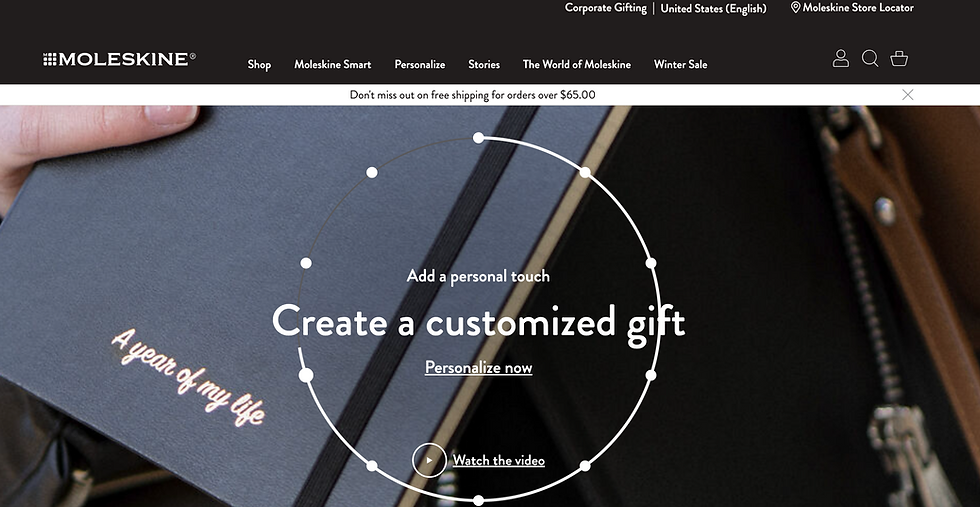
Moleskine’s DTC site is not only a shop—it’s a brand theater: product storytelling, personalization prompts, memberships, and limited edition discovery.
Even a single core SKU (like the Classic Notebook) includes strong conversion details: clear specs, shipping thresholds, and a “Personalize” action.
B2B & Gifting
Moleskine’s corporate gifting program positions custom notebooks as storytelling tools, not commodities.
It highlights customization levers that matter to B2B buyers: custom cover, branded paperband, custom packaging, inner-page printing, end papers, and inserts/add-ons.
Procurement insight: B2B wins when customization options are modular and spec-ready (templates, MOQs, and lead times).

Price - Pricing & Margin Structure
Retail Price Ladder
Moleskine uses a classic ladder: accessible entry, premium core, then higher-priced limited editions and boxed sets.
For example, the Classic Notebook hard cover is listed at $26.00 on the official site.
Limited edition and gift-box items often list higher prices, reflecting higher perceived value and gifting intent.
CEO insight: Pricing stays strong when the “why” is clear—heritage, design, and collectability.

Bundles & Sets
Moleskine uses sets and gift packaging to increase average order value and reduce “single-item” hesitation.
Corporate gifting also reinforces bundling logic by offering custom packaging and add-ons that elevate the moment.
Margin Logic (Simple, Logical Estimate)
Premium stationery typically carries healthy gross margins when the brand owns the story and standardizes components.
A simple way to model it is to treat the hero notebook as the scale driver and limited editions/custom work as margin boosters (because they support higher pricing).
Example estimate model (for planning, not a claim):
SKU Type | Demand Pattern | Cost Control | Price Power | Margin Role |
Core classics | High + steady | Strong (repeat specs) | Medium-high | Base volume |
Limited editions | Seasonal spikes | Medium | High | “Profit pop” |
Custom B2B | Project-based | Varies | High (value-based) | Relationship engine |
Procurement note: If you want Moleskine-like margins, protect three things: paper spec stability, finishing consistency, and packaging discipline.
Promotion - Marketing & Growth Playbook
Main Channels
Moleskine’s marketing is built to be “seen in the wild”: gifting, social sharing, and collector drops that feel like culture moments.
It also links brand purpose to action by working with the Moleskine Foundation and donation initiatives, which can improve trust and brand affinity.

Content Strategy
Moleskine sells the practice of writing, not just the object.
That content strategy supports higher conversion because it gives buyers a reason to choose paper in a digital world, including hybrid “smart writing” options.
Seasonal Campaigns
Limited edition releases and dated planners provide built-in seasonal cycles that retailers love.
This cadence also reduces discount pressure because shoppers perceive drops as time-bound and collectible.
Supply Chain, Sustainability & Risks
Production Footprint
Moleskine states it operates with a broad partner network, which suggests a design-led brand model supported by external manufacturing.
This model scales well because the brand can focus on product design, storytelling, and channel execution, while managing quality through specs and audits.
Materials & Certifications
Moleskine’s sustainability credibility is strengthened by specific, checkable standards and programs.
It states it has been FSC™ certified since 2008, which is a concrete claim buyers can understand and verify through FSC’s certificate tools.
It also states that strategic suppliers are members of Sedex, and that suppliers are compliant with SA8000 (or equivalent) and ISO 14001 (or equivalent).
For climate, Moleskine says its emissions reduction targets were validated by the Science Based Targets initiative (SBTi), a widely used corporate climate framework.
Procurement checklist (copy/paste):
Ask for FSC Chain-of-Custody certificate code, then verify in FSC’s public database.
Request recent audit evidence aligned to SA8000 (or equivalent social compliance).
Request environmental management proof aligned to ISO 14001 (or equivalent).
For quality, require ISO 9001 at key factories (common in stationery manufacturing).
Inventory Model & Launch Cadence
Moleskine’s system suggests a “core replenishment + seasonal drops” structure. This model reduces inventory risk because the core items stay stable, while limited editions can be planned as smaller, higher-margin runs.
Risk Factors
Premium stationery carries real risks, and Moleskine’s public positioning hints at how it manages them.
Regulatory risk (chemicals): For EU sales, REACH shapes chemical compliance expectations; for California, Proposition 65 drives disclosure rules.
Digital substitution risk: Smart writing products reduce the “paper vs digital” tradeoff by offering paper-to-app workflows.
Sustainability scrutiny: Claims like FSC and SBTi work best when they are verifiable and consistently communicated.
Working With Lion Paper Products
The best way to apply the Moleskine playbook is to build a clean hero system first, then add profitable upgrades.
At Lion Paper Products, we specialize in custom notebook & stationery with flexible solutions tailored to your brand—whether you’re launching a retail-ready core line, a limited edition drop, or a corporate gifting program.
We offer:
Expert guidance on size, paper, and binding
FSC-certified and eco-friendly options
High-quality offset printing
Pre-production samples for approval
Reliable timelines and global shipping
If you want Moleskine-level shelf presence without Moleskine-level guesswork, we can help you spec, sample, and scale with confidence.
Final Words
Moleskine wins because it turns a simple notebook into a repeatable system: one hero product, a clean SKU matrix, premium pricing logic, and a steady pipeline of drops and collaborations. If you’re a stationery CEO or procurement manager, the smartest next move is to borrow the structure—not the look—then build your own brand story on top of verifiable quality and certifications.
—Leo Xia, CEO, Lion Paper Products
You design, we deliver.
FAQs:
Q1: What’s the simplest “Moleskine-style” SKU system to start with?
Start with 2–3 sizes, 2 layouts, and one hero binding, then add a limited edition every season.
Q2: What paper details do premium buyers notice most?
They notice acid-free claims, paper weight/feel, show-through, and lay-flat performance.
Q3: How can I verify FSC claims from a supplier?
Ask for the FSC certificate code and verify it in FSC’s public database tools.
Q4: Which factory certifications help a stationery brand sell to large retailers?
ISO 9001 (quality management) and ISO 14001 (environmental management) are common signals retailers trust.
Q5: How does corporate gifting change the product spec?
Corporate gifting usually needs branding surfaces (cover, paperband, inner pages) and upgraded packaging for “gift moment” impact.
Q6: What’s the biggest risk when copying premium notebook brands?
The biggest risk is adding too many SKUs too fast; keep the hero line stable and let drops do the excitement.
Reference
Moleskine – About Us
Moleskine – Classic Notebook product page (specs, FSC statement, price)
Moleskine – Limited Editions (examples of collabs and pricing)
Moleskine – Corporate Gifting & Strategic Partnerships (customization options)
Moleskine – Store Locator (stores + retail partners)
Moleskine – Sustainable Creativity (FSC since 2008, SBTi statement, Sedex/SA8000/ISO14001 supplier claims)
Moleskine – Smart Writing Set FAQ (Ncoded, Bluetooth + app workflow)
FSC – Public Certificate Search / FSC certificate database guidance
ISO – ISO 9001:2015 overview page
ISO – ISO 14001:2015 overview page
SAI – SA8000 program page
Sedex – Official site
SBTi – Official site
European Commission – REACH regulation overview
California OEHHA – Proposition 65 overview
Fortune Business Insights – Stationery Products Market (market size figures)
Grand View Research – Stationery Products Market (market size figures)
Are you looking for a reliable manufacturer? Reach out to Lion Paper for a free quote and consultation. Let’s collaborate on creating custom writing paper products that will set your brand apart from the competition!
About Lion Paper
Company Name: Lion Paper Products
Office Address: 20th floor, Chuangyedasha Building, No. 135, Jinsui Road, Jiaxing City, Zhejiang Province, China
Factory Address: No.135, Xuri Road, Jiaxing City, Zhejiang, China
Email: Leoxia@lion-paper.com
Audit Certifications: ISO9001:2015/FSC/SEDEX SMETA/Disney FAMA/GSV/SQP



Comments