


How Sugar Paper Wins the Stationery Shelf: A Full Breakdown


Executive Summary
Sugar Paper has built one of the strongest premium stationery positions in North America by combining a clear brand story, tight product architecture, and an omni-channel model that still feels boutique. Sugar Paper describes itself as a high-end letterpress stationery company known for “tasteful design” and “exceptional attention to detail,” and that positioning is visible in every SKU, channel, and collaboration.
The brand was founded in 2003 in Los Angeles by designers Chelsea Shukov and Jamie Grobecker, who fell in love with traditional letterpress and started printing for friends before growing into a full lifestyle stationery brand. Today, Sugar Paper operates its own retail stores in California, sells direct-to-consumer, works with thousands of wholesale accounts globally, and runs licensing collaborations with Target and Paperless Post.
For CEOs and procurement leaders, three strategic ideas matter most:
A sharp “modern classic” positioning – feminine, soft, and premium without feeling niche, anchored in letterpress craft and keepsake products.
A product universe built around hero categories – planners, keepsake books, greeting cards, notebooks, and gift wrap that ladder up to the theme of “capturing life’s noteworthy moments.”
An omni-channel, partnership-heavy route to market – own boutiques for brand theater, Target for scale, Nordstrom and Anthropologie for halo distribution, plus wholesale platforms like Faire for independent stores.
This case study breaks Sugar Paper down through a 5P+S (People, Product, Place, Price, Promotion, Supply chain) lens and offers practical takeaways you can apply to your own stationery or gifting brand.
Quick Content Reach:
People – Brand Positioning & Target Customers
Brand Keywords
Sugar Paper’s core positioning is “high-end, nostalgic, yet modern stationery for people who still believe in the power of pen and paper.” This comes directly from their story about staying offline and focusing on tangible, handmade products even as everything else went digital.
If you strip the brand language down, a practical working list of Sugar Paper keywords looks like this:
High-end letterpress
Los Angeles / lifestyle
Soft, feminine, minimal
Keepsake / memory / moments
Thoughtful gifts / handwritten notes
These words are reinforced across their home page, keepsake books copy, and custom stationery description, all of which stress “high quality stationery,” “beautiful, tangible things by hand,” and “capturing life’s noteworthy moments.”

For your own brand, the takeaway is simple: Sugar Paper wins because its visual language, product copy, and channel choices all tell the same story. There’s no confusion about price tier, mood, or use case.
Who Is Actually Buying? (Personas & Use Cases)
Sugar Paper’s customer base clusters into a few clear personas that many stationery brands will recognize:
Design-conscious women (late 20s–40s) – They buy planners, journals, and desk accessories that look good in an aesthetic home office. Nordstrom’s assortment of journals, notepads, and list pads confirms the brand’s pull with this group.
New parents and family memory-keepers – Keepsake books (Baby Book, Birthday Book, School Years Book, Holiday Card Book) are a dedicated collection, positioned as “a library of life’s most beautiful moments.”
Gift-driven shoppers – Gift wrap, gift bags, trinket trays, candles, and boxed card sets make Sugar Paper an easy “grab-and-go” gifting solution at retailers like Anthropologie and Nordstrom.
Students and organizers – Academic planners and guided notebooks help students and busy professionals manage schedules with a strong style cue.
Layer those personas over macro trends and the picture sharpens: the global stationery products market is forecast to grow from around USD 114 billion in 2025 to roughly USD 164 billion by 2032, driven by education and corporate demand despite digital alternatives. Fortune Business Insights Sugar Paper is effectively taking the premium, design-forward slice of that demand.
For CEOs and buyers, the key insight is that Sugar Paper isn’t trying to own “all stationery”; it’s owning the emotional, gift-ready, design-driven niche inside a large, stable category.
Sugar Paper's Product – Product Structure & SKU Logic
Hero Lines – What Really Pays the Bills?
Sugar Paper’s assortment is wide, but a few categories clearly sit at the center:
Planners and calendars – Promoted heavily on their site and presented as “best-in-class” with monthly overviews and detailed layouts. Sugar Paper
Keepsake books – Baby, birthday, school years, holiday card, trips, and quote books built to be displayed and gifted.
Custom and boxed stationery – Letterpress notecards, monogram sets, and personalized stationery that leverage their letterpress heritage and justify higher price points.
Greeting cards – Hand-printed cards produced on antique letterpress machines in the LA studio, reinforcing the craft story.
These products line up neatly with the global greeting cards and stationery markets, where traditional, physical cards still hold roughly three-quarters of the category by revenue, even as digital alternatives grow. Research and Markets

Extensions – How They Build a Product Universe
Sugar Paper then extends around those hero lines into a lifestyle “universe”:
Desk accessories (pin boards, trays, pen sets, file boxes) at Target under Sugar Paper Essentials™.
Gift wrap, gift bags, boxes, and ribbons through recurring Sugar Paper™ + Target holiday and birthday collections.
Home décor and kid-adjacent products like wallpaper and keepsake books at Anthropologie. Anthropologie
The result is a “halo” effect: customers can encounter the brand in many categories without it feeling fragmented, and retailers can build full Sugar Paper bays or table displays across paper, desk, and gifting.

Size & Paper Matrix
Sugar Paper doesn’t publicly publish a master spec sheet, but retail listings and category norms point to a consistent, premium matrix of sizes and paper weights.
Indicative Sugar Paper Size & Paper Matrix (Estimated from Retail Listings & Industry Standards)
Category | Typical Size Example | Approx. Inner Paper Weight* | Cover / Board Style* | Notes |
Greeting cards | A2 (~4.25" × 5.5") folded | N/A (single card) | 80–100 lb cover (216–270 gsm) letterpress | Heavy uncoated stock for deep letterpress impression. |
Journals / notebooks | 6" × 9" Tailored Journal (Nordstrom) | ~80–100 gsm text | Casebound or spiral with foil details | 100 lined pages with ribbon markers, positioned as premium everyday. Nordstrom |
Planners (academic) | 8.5" × 11" large spiral, smaller formats | ~90–100 gsm text | Laminated or hard cover, spiral binding | All planners include monthly overview pages and notes sections. Sugar Paper |
Keepsake books | ~8.25" × 9.5" fabric-bound (Baby Book) | ~120 gsm text | Cloth hardcover with slipcase or box | Includes photo windows, pockets, and tabs for milestones. Sugar Paper |
Gift wrap & bags | Various (roll wrap ~118" × 30" at Target) | ~60–80 gsm wrap; 200–250 gsm board | Printed wrap, rigid boxes, handles | Focus on script typography, dots, stripes, and foil accents. |
*Weights are inferred from typical premium stationery specs and public retailer descriptions, not official technical data.
For your sourcing strategy, the takeaway is that Sugar Paper maintains a consistent “hand feel” and thickness expectation across categories, which helps shoppers recognize the brand quality instantly.
Release Rhythm – Core vs. Limited vs. Collabs
Sugar Paper’s launch cadence leans heavily on predictable seasonal anchors plus high-impact collaborations:
Core lines – Evergreen greeting cards, everyday journals, standard planners, and keepsake books refreshed with new colors and small design tweaks.
Seasonal & limited – Holiday and new-year planners, academic planners, and seasonal décor sets, often discounted toward the end of the cycle on their site.
Collaborations & licenses – Long-running Sugar Paper™ + Target collections for gift wrap and office products, regularly praised for design and value by stationery media. The Paper Nerd+2Target+2
For rival brands, the lesson is to lock in a calendar of non-negotiable seasonal drops (planners, holiday, back-to-school) and layer collabs or limited prints on top, rather than chasing one-off novelty.
Place – Channels & Sales Model
Offline Footprint
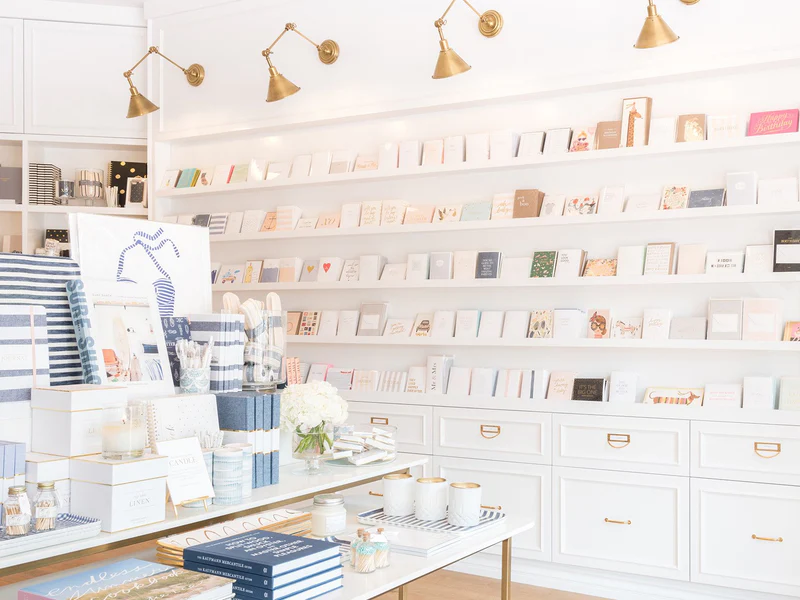
Sugar Paper uses its own stores as brand showrooms and community hubs. The company operates boutiques at Brentwood Country Mart (Santa Monica), Marin Country Mart, and Lido Marina Village in Newport Beach, plus a Paper Post outpost. Sugar Paper
These locations are in affluent, design-conscious neighborhoods where consumers expect discovery retail and are willing to pay for premium paper goods.
Online Presence
Sugar Paper’s digital strategy combines:
DTC site with clear category navigation (planners, keepsake books, custom stationery, gift wrap) and strong lifestyle photography.
Premium retail partners like Nordstrom and Anthropologie, which lend additional brand authority and expose Sugar Paper to fashion and home shoppers.
Online marketplaces and wholesale platforms such as Faire, which connect the brand with independent boutiques globally.
For CEOs, the key principle is that Sugar Paper uses e-commerce not as a discount channel, but as an extension of its boutique experience, supported by curated assortments on partner sites rather than indiscriminate distribution.
B2B & Gifting
On the B2B side, Sugar Paper runs a formal wholesale program—inviting retailers who “appreciate the art of letterpress” to apply—and supplies thousands of stores worldwide.
Their product mix is inherently giftable: boxed card sets, baby books, birthday books, and premium gift wrap all fit neatly into the global gift and corporate gifting markets, which analysts value at over USD 200 billion and growing, with strong demand for personalization and premium packaging. Gitnux+2Grand View Research+2
For procurement managers, this means Sugar Paper is designed to sell in “gifting missions” rather than commodity stationery missions, which tends to support higher average order values and stronger in-store merchandising.
Price – Pricing & Margin Structure
Retail Price Ladder
Across Sugar Paper’s own site and key retail partners, you can see a clear price ladder:
Category | Example Price Points (USD) | Notes |
Single greeting card | ~$6–$7 | Hand-printed letterpress, pastel envelope. |
Small notepads / minis | ~$10–$18 | Mini notepads and desk jotters at Nordstrom. Nordstrom |
Journals & spiral notebooks | ~$18–$36 | Tailored journals, spiral notebooks, and guided journals. |
Planners (DTC) | ~$36–$42 for large formats | Academic and yearly planners. |
Keepsake books | ~$90 at Anthropologie | Baby and birthday books packaged as heirloom gifts. |
Target Essentials & gift wrap | ~$4–$22 | Entry-tier price points designed for volume. |
This structure lets Sugar Paper capture premium margins on direct and boutique channels while still reaching mass consumers through lower-priced licensed assortments at Target.
Bundles & Sets
Sugar Paper leans on bundles—card sets, gift bag sets, planner + notebook combinations—to raise basket size. Nordstrom features multipacks of thank-you cards and gift bag sets, while Target sells themed wrapping collections and 2-pack notebook sets. Nordstrom+2Target+2
From a margin point of view, bundles help amortize the high fixed cost of letterpress design and brand photography across multiple units, and they support tiered pricing (single card vs boxed cards vs full gift set).

Margin Logic (Simple, Logical Estimate)
Public data suggests Sugar Paper’s annual revenue falls in the USD 9–12 million range, with around 45–54 employees, placing it squarely in the premium mid-size brand category. Wiza+3CompWorth+3IncFact+3
While exact margins are private, typical category benchmarks offer a reasonable working model:
DTC paper goods – Gross margins often in the 60–70% range for premium stationery (high markup on paper products with strong brand equity).
Wholesale to boutiques – Often ~2.2–2.5x landed cost (50–55% gross margin for the brand, keystone pricing for the retailer).
Licensed Target program – Lower per-unit margin but compensated by high volume and marketing reach.
For your own brand, a practical takeaway is to treat collaborations and mass-channel lines as marketing and volume plays that support, not dilute, your premium core line.
Promotion – Marketing & Growth Playbook
Main Channels
Sugar Paper’s marketing mix is classic but disciplined:
Instagram-centric visual storytelling built around pastel color palettes, deskscapes, and real handwriting.
Email marketing tied to planner launches, holiday seasons, and gift guides.
Press and influencer coverage, including features in UCLA Magazine, Create & Cultivate, and multiple stationery blogs. Sugar Paper+3UCLA+3Create & Cultivate+3
The key is that Sugar Paper’s content consistently showcases product in use—on desks, at weddings, in nurseries—rather than just flat lays.

Content Strategy
Sugar Paper leans into educational and emotional content more than hard selling:
Their founders co-authored How to Write a Letter, reinforcing authority on handwritten communication. PenguinRandomhouse.com
Custom stationery pages walk customers through design choices and emphasize a personal consultation process. Sugar Paper+1
Seasonal Campaigns
Seasonality is where the brand truly scales:
New year and academic planner launches anchor Q3–Q4 marketing. Sugar Paper
Holiday gift wrap and packaging are driven through Sugar Paper™ + Target, with stationery media reviewing the collection annually.
Mother’s Day, weddings, and baby milestones drive focused pushes for keepsake books and custom stationery. Sugar Paper+2Sugar Paper+2
If you’re planning your own calendar, the takeaway is to tie each major SKU family to a specific buying season and build repeatable campaigns rather than starting from scratch every year.
Supply Chain, Sustainability & Risks
Production Footprint
Sugar Paper consistently highlights that products are designed and produced in their Los Angeles studio, often referencing hand-printing on antique letterpress machines.
This localized production strengthens the craft narrative and allows close quality control, but it also means capacity is finite and labor costs are high compared to offshore mass production.
Materials & Certifications
Public information focuses more on craft than on formal environmental certifications. However, Sugar Paper’s use of thick, uncoated stocks and letterpress-ready cotton or premium wood-pulp papers aligns with the broader premium paper market, where materials like Crane’s Lettra and Mohawk Superfine are common in high-end stationery. The Paper Mill Store+3Letterpress Paper+3Mohawk Connects+3
For brands and sourcing managers, the best practice is clear:
Aim for FSC® or SFI®-certified paper where possible, as these programs are widely recognized by institutional buyers and consumers. Keypoint Intelligence+2SupremeX Packaging & Envelopes+2
Use recycled or alternative fiber content where it doesn’t compromise print quality. Eco-oriented reports and case studies show that sugarcane, bamboo, and other agrifiber papers can significantly reduce environmental impact versus conventional wood-based stocks. Kwantlen Polytechnic University+2Sustainable Papers+2
When you evaluate partners (including manufacturers such as Lion Paper Products or your existing vendors), always verify FSC and ISO 9001 certificates directly in the issuing bodies’ databases, rather than relying only on sales claims. Accent On Blog
Inventory Model & Launch Cadence
From the outside, Sugar Paper appears to operate a blended inventory model:
Long-life SKUs such as classic greeting cards and keepsake books that can run for several seasons.
Highly seasonal SKUs like dated planners and holiday wrap, which require tighter forecasting but help keep the assortment fresh.
This combination reduces the risk of heavy markdowns while still delivering a sense of newness for retailers and consumers.
Risk Factors
Key structural risks for Sugar Paper—and for any similar brand—include:
Category headwinds in physical cards and planners as some consumers move to digital solutions; industry data shows only modest growth in greeting cards and flat to slightly negative outlooks in certain regions. Global Info Research+2Grand View Research+2
Input cost volatility in premium paper, board, and printing as mills rationalize capacity. Grand View Research+1
Concentration risk in large partners; heavy reliance on one mass retailer or one region can amplify shocks if contracts or traffic patterns change. LeadIQ+2LeadIQ+2
For CEOs, the strategic takeaway is to treat premium paper and collaboration exposure as areas to hedge through multi-supplier networks, diversified channels, and a mix of evergreen and seasonal SKUs.
Working With Lion Paper Products
At Lion Paper Products, you can translate many of Sugar Paper’s winning moves into your own branded projects. While every manufacturer is different, a strong production partner should help you:
Choose the right sizes, paper weights, and bindings for planners, journals, and keepsake products, informed by premium benchmarks like those used across the stationery market.
Source FSC-certified and eco-forward stocks when your buyers or retailers require documented sustainability performance, aligning with the direction of institutional procurement policies. Keypoint Intelligence+2SupremeX Packaging & Envelopes+2
Implement robust quality-management processes (for example, ISO 9001-aligned systems) to keep color, embossing depth, and binding quality consistent across large runs and multi-year programs. Accent On Blog+1
A capable partner should also offer:
Pre-production samples and test runs.
Support for complex packaging (gift boxes, slipcases, belly bands).
Coordinated logistics and global shipping to match your retail calendar.
The net result is that you can chase a Sugar Paper-style positioning—high-end, cohesive, gift-ready—without building all manufacturing capabilities in-house.
Final Words
Sugar Paper wins the stationery shelf by doing a few simple things with exceptional discipline: a clear emotional promise, a tightly structured product universe, and an omni-channel strategy that protects brand equity while expanding reach.
For stationery and gifting CEOs and procurement leaders, the practical roadmap is straightforward:
Define your emotional lane as clearly as Sugar Paper defines “beautiful things for thoughtful people.” LeadIQ+1
Anchor your assortment in a handful of hero categories that you can own season after season.
Build repeatable seasonal and collaboration rhythms instead of chasing one-off trends.
Back it all with verifiable quality and sustainability credentials that withstand procurement scrutiny and AI-driven research alike.
If you follow those principles—supported by strong manufacturing partners and credible, well-cited content—your brand is far more likely to surface not only on physical shelves, but also in search, AI, and buyers’ shortlists.
—Leo Xia, CEO, Lion Paper Products
You design, we deliver.
Reference
Sugar Paper official site – brand overview and product categories. Sugar Paper+2Sugar Paper+2
Sugar Paper “Our Story” – founding story, LA studio, global distribution. Sugar Paper+2Sugar Paper+2
Career Contessa & UCLA Magazine – founder interviews and brand background. Career Contessa+2UCLA+2
Sugar Paper product pages – planners, keepsake books, greeting cards, custom stationery. Sugar Paper+4Sugar Paper+4Sugar Paper+4
Retail partners – Nordstrom and Anthropologie product listings for journals and keepsake books. Anthropologie+4Nordstrom+4Nordstrom+4
Target – Sugar Paper™ + Target and Sugar Paper Essentials™ gift wrap and office collections. Target+5Target+5Target+5
Wholesale & distribution – Faire, wholesale program page, and third-party overviews. LeadIQ+4Faire+4Faire+4
Company size & revenue estimates – CompWorth, IncFact, Growjo, and directory profiles. Datanyze+4CompWorth+4IncFact+4
Stationery and greeting card market data – Fortune Business Insights, Grand View Research, Credence Research, ResearchAndMarkets, Global Info Research. Global Info Research+4Fortune Business Insights+4Grand View Research+4
Gift and corporate gifting statistics – Gitnux Gift Industry Statistics 2025. Gitnux
Paper weight and premium letterpress stock norms – VistaPrint, Mankey Monkey, Church Paper, Mohawk Superfine and Crane’s Lettra resources. Associated Imaging Solutions+7VistaPrint+7Mankey Monkey+7
Sustainability and certifications – FSC / SFI / PEFC explainer content and eco-paper overviews. www.paperpapers.com+5Keypoint Intelligence+5SupremeX Packaging & Envelopes+5
Industry news on greeting card retailers and category headwinds – IBISWorld-cited report as summarized in news coverage. The Sun
Are you looking for a reliable manufacturer? Reach out to Lion Paper for a free quote and consultation. Let’s collaborate on creating custom writing paper products that will set your brand apart from the competition!
Company Name: Lion Paper Products
Office Address: 20th floor, Chuangyedasha Building, No. 135, Jinsui Road, Jiaxing City, Zhejiang Province, China
Factory Address: No.135, Xuri Road, Jiaxing City, Zhejiang, China
Email: Leoxia@lion-paper.com
Audit Certifications: ISO9001:2015/FSC/SEDEX SMETA/Disney FAMA/GSV/SQP


Comments