


Hardcover Notebook Guide: Daily Use and Bulk Orders
- Leo Xia

- Dec 30, 2025
- 13 min read
Global demand for paper notebooks is still growing even in a digital-first world. Recent market research estimates the global paper notebooks market at about USD 27.31 billion in 2025, rising to roughly USD 29.33 billion in 2026 and USD 55.66 billion by 2035, supported by a projected 7.38% CAGR. Global Growth Insights Within this market, hardcover notebooks are one of the fastest-growing cover types, with analysis showing hardcover products growing at around 4.27% CAGR between 2025 and 2030 thanks to their durability and premium feel. Mordor Intelligence
This guide gives you a clear, practical overview of hardcover notebooks for daily use and for bulk orders, with simple tables, step-by-step checklists, and compliance-ready details that procurement teams can both understand.
Quick Content Reach:
Key Takeaways (1-Minute Summary)
Hardcover notebooks are rigid-cover notebooks designed for durability, structure, and long-term use. They protect the pages better than most softcover or spiral formats, which makes them popular with students, professionals, and brands that use notebooks as gifts or onboarding tools.
The paper notebooks market is expanding, and hardcover formats are gaining share as customers move toward premium, eco-friendlier, design-focused products. Mordor Intelligence
For daily users, the right hardcover notebook depends on size, paper weight, page layout, and binding style. For bulk buyers, the key checks are spec clarity, print quality, sustainability credentials (FSC® paper), and factory standards (ISO 9001 / ISO 14001) rather than price alone. ISO
What Is a Hardcover Notebook? (Definition & Core Specs)
Simple Definition
A hardcover notebook is a paper notebook with a rigid cover, usually made from thick board wrapped in paper, PU, cloth, or leather. The hard cover protects the pages, gives a solid writing surface, and helps the notebook survive daily carry, travel, and long-term storage.

Standard Features at a Glance
Most hardcover notebooks share a few core components:
A board cover (often 2–3 mm board)
An outer material (paper, PU, cloth, or leather)
A spine and binding (usually case-bound or section sewn)
An inner page block (typically 80–240 pages)
Endpapers, a ribbon marker, and sometimes an elastic band and back pocket
Industry data shows that in the wider stationery market, paper products such as notebooks and diaries still hold the largest share, accounting for more than 45% of the stationery segment in 2024, which confirms how central notebooks are to everyday work and study. Market Data Forecast
When a Hardcover Notebook Is the Best Choice
Hardcover notebooks are the best choice when you care about durability, presentation, or branding. They stack well, look more premium than most softcovers, and can be customized with foil, debossing, or full-color wraps, making them ideal for long-term projects, journaling, corporate gifting, onboarding kits, and client meetings.
Hardcover Notebook Specs at a Glance (Comparison Tables)
Table: Popular Sizes vs Use Cases
Most hardcover notebooks fall into a few standard sizes that match common bags and desks.
Size | Approx. Dimensions | Portability | Typical Use Cases |
A6 | 105 × 148 mm | Very high | Pocket notes, travel, quick lists |
A5 | 148 × 210 mm | High | Daily journaling, meeting notes |
B5 | 176 × 250 mm | Medium | Project notebooks, creative work |
A4 | 210 × 297 mm | Low | Lecture notes, documentation, plans |
US Letter | 8.5 × 11 in | Low | Office documents, training manuals |
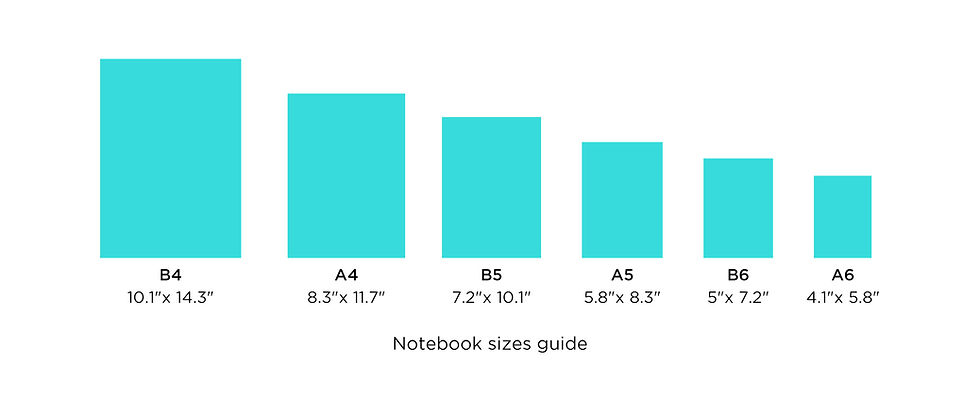
Market research shows A4 notebooks hold about 37% of the paper notebook market by size, mainly because schools and offices rely on that format. Mordor Intelligence
Table: Paper Types & Layouts
Paper type and layout decide which pens you can use and how you organize notes.
Paper Weight | Finish | Layout | Best For |
70–80 gsm | Smooth | Ruled | Daily notes, students, general office use |
80–90 gsm | Smooth/velvet | Dot-grid | Bullet journaling, planning, hybrid notes |
90–120 gsm | Smooth | Blank | Sketching, design, creative work |
80–100 gsm | Slight tooth | Grid / graph | Technical notes, engineering, math |
Analysts estimate that ruled pages account for roughly 45–46% of notebook sales by page style, making them the most common format globally.
Table: Binding Styles Used on Hardcover Notebooks
Different bindings change how long a notebook lasts and how flat it opens.
Binding Style | Lay-Flat Ability | Durability | Typical Use |
Case-bound, section-sewn | Good to excellent | High | Premium journals, corporate gifts |
Perfect-bound (glue) | Medium | Medium | Budget hardcovers, promotional items |
Hybrid lay-flat | Excellent | High | Design notebooks, planners |
Staple + hard casing | Limited | Low–medium | Small promotional booklets |
Market data suggests sewn bindings are growing at about 4.5% CAGR, reflecting buyers’ interest in stronger, longer-lasting notebooks.
Common Variations: Sizes, Paper Types, and Binding Styles
1. Sizes
Hardcover notebooks come in multiple sizes so they can serve different work styles. Smaller formats (A6, pocket) favor portability, mid-sized options (A5, B5) balance desk use with mobility, and large formats (A4, US Letter) suit heavy note-takers and documentation. Education-focused market research confirms that students and institutions still drive demand for larger paper products, especially in A4 and similar sizes. Mordor Intelligence
2. Paper Types and Page Layouts
Paper choice defines both writing comfort and ink performance. Standard 70–80 gsm paper works for ballpoint and gel pens, while 90–120 gsm sheets better handle fountain pens and markers. Recent industry reports note a growing interest in dot-grid and specialty layouts as bullet journaling and structured planning become mainstream. DataHorizzon Research
3. Binding Styles
Binding style affects how a hardcover notebook feels in daily use. Case-bound or section-sewn notebooks are ideal when you need a book that opens well and survives years of use, such as project archives or professional journals. Glue-only perfect binding is cheaper but more prone to spine cracking over time, which is why premium segments increasingly favor sewn or hybrid lay-flat bindings.

Who Uses Hardcover Notebooks: Use Cases and Scenarios
Students
Students use hardcover notebooks when they want durability over a semester or an entire degree. Market analysis shows that students account for roughly 61% of paper notebook end-user share, confirming that academic use is still the largest demand driver. Mordor Intelligence
Office Workers and Professionals
Professionals choose hardcover notebooks because they look more formal in meetings and stand up to travel and daily carry. In the broader stationery market, the corporate and home-office segment continues to expand as remote and hybrid work models sustain demand for physical note-taking and planning tools. Grand View Research+2Global Market Insights Inc.+2
Journal Writers
Journal writers value hardcover notebooks for their long life and bookshelf presence. Consumer studies show that more than half of users still prefer handwriting tools for thinking and planning, even when they also use digital apps, which explains why high-quality journals remain a growth niche. Global Growth Insights
Travelers
Travelers and field workers use compact hardcover notebooks because the rigid cover protects pages in backpacks and luggage. Here, A6 or A5 sizes with elastic bands and strong binding avoid torn pages and bent corners during flights, trains, or site visits.
Companies and Brands
Companies and brands rely on custom hardcover notebooks as onboarding gifts, event handouts, and client presents. Corporate gifting reports show that office and stationery products are a stable sub-segment in the global gifting market, which is forecast to grow significantly through 2030 as more companies use gifts to support retention and brand recall. Global Market Insights Inc

How to Choose the Right Hardcover Notebook (Step-by-Step)
1. Match the Notebook to Your Purpose
The first decision is matching the notebook to your actual use. Daily carry might call for an A5 with 80–120 gsm paper and a simple ruled layout, while a deep work journal or reference book might benefit from thicker paper, a larger format, and sewn binding for longevity.
2. Look at the Cover Material and Durability
The second decision is the cover material, because it dictates durability and aesthetic. PU and coated paper covers resist spills and scuffs, cloth covers feel premium and warm, and leather (or leather-like options) suits executive gifts and brand statements. In bulk scenarios, the right cover material also balances long-term wear with weight and shipping cost.
3. Choose the Right Paper and Layout
The third decision is the paper itself. Lower weights (70–80 gsm) keep notebooks light and are fine for ballpoint or gel pens, while higher weights (90–120 gsm) reduce show-through and handle fountain pens better. Global stationery analyses show that paper products still represent the largest share of stationery revenue, so upgrading paper quality can be a simple way to differentiate your product. Market Data Forecast+2Global Market Insights Inc.+2
4. Check the Binding Style
The fourth decision is binding style, which affects comfort and lifespan. Case-bound or section-sewn notebooks are better suited to long-term projects, project archives, or corporate records. Market reports note that sewn bindings are gaining share as buyers look for stronger construction and better lay-flat behavior in premium and business notebooks. Mordor Intelligence+2360 Research Reports+2
5. Think About Extra Features You May Need
The fifth decision is whether you need extra features. Ribbon markers, elastic closures, pen loops, numbered pages, index pages, and expandable pockets all make a hardcover notebook more useful. Advanced layouts and indexing features are especially attractive to professionals and journalers who use notebooks for planning and structured reflection. DataHorizzon Research+1
6. For Bulk Buyers: What to Check Before Ordering
For bulk buyers, the final decision is about risk management and quality assurance. Before placing a large order, you should:
Lock a clear spec sheet (size, paper weight, layout, cover material, binding, features).
Request digital proofs and physical samples before mass production.
Verify paper sourcing (for example, FSC-certified paper and packaging if sustainability matters to your brand). FSC United States+5Forest Stewardship Council+5Forest Stewardship Council+5
Confirm factory certifications, particularly ISO 9001 for quality management and, if relevant, ISO 14001 for environmental management, since these show structured, audited processes. ISO+5ISO+5ISO+5
Clarify lead times, shipping options, and damages policy.
These checks keep your bulk hardcover notebook orders predictable and easier to justify in internal ESG or procurement reporting.

1. Hardcover vs Softcover Notebooks
Hardcover notebooks beat softcover notebooks on durability and perceived value. Softcovers are lighter and cheaper, which suits throw-away or short-term projects, while hardcovers are better for long-term notes, journaling, and gifts where first impressions matter.
2. Hardcover vs Spiral Notebooks
Hardcover notebooks beat spiral notebooks on presentation and archive safety, while spirals win on easy tear-out and 180-degree lay-flat. Spiral and Wire-O formats remain popular in education and design because they fold back on themselves, but the exposed wire can bend or catch on bags and clothes. Mordor Intelligence+1
3. Hardcover vs Lay-Flat Notebooks
Lay-flat notebooks are a binding style rather than a cover choice. Many modern hardcover notebooks now use lay-flat or hybrid binding so you get both the rigid cover and the ability to write across the gutter comfortably. When a spec mentions “lay-flat hardcover,” it usually means a sewn or engineered binding that opens flat on its own.
4. Hardcover vs Perfect-Bound Notebooks
Hardcover notebooks with sewn binding outperform perfect-bound notebooks on spine strength and long-term durability. Perfect-bound notebooks may look neat when new, but glue-only spines are more likely to crack with heavy use or when forced fully open, which is why they’re often used for catalogs and promotional items rather than daily journals.
5. Quick Summary Table
Type | Durability | Lay-Flat | Portability | Best For |
Hardcover | High | Medium–High* | Medium | Long-term notes, journaling, gifting |
Softcover | Medium | Medium | High | On-the-go notes, low-cost projects |
Spiral | Medium | High | Medium | Class notes, design, sketching |
Perfect-bound | Low–Medium | Low–Medium | Medium | Catalogs, short-life notebooks |
*If sewn or designed as lay-flat.
Customization and Bulk Ordering for Companies and Brands
1. Why Businesses Choose Custom Hardcover Notebooks
Businesses choose custom hardcover notebooks because they sit on desks and in bags for months or years. Corporate stationery and notebook demand grows alongside the global stationery products market, which is projected to reach around USD 163.91 billion by 2032, driven by paper products, writing instruments, and branded stationery. Fortune Business Insights+2Global Market Insights Inc.+2
2. Cover Design and Material Choices
Cover design is where your brand shows up first. You can choose from simple logo debossing, foil stamping, screen printing, or full-color wraps across PU, cloth, or paper-over-board covers. The best corporate designs usually keep branding subtle and let color, texture, and a short message carry the rest.
3. Paper Layout and Page Count
Page layout and count should match how recipients will use the notebook. A5 notebooks with 192–240 pages and ruled or dot-grid layouts work for most employees and clients. For project logbooks or documentation, larger sizes and higher page counts make more sense.
4. Binding Style for Custom Projects
Binding style decides how well the notebook holds up as a branded object. Case-bound and section-sewn bindings can survive long campaigns and travel, while cheaper glue-only options are better for promotional runs where lifespan is less critical. For premium gifting, lay-flat hardcover notebooks provide the best user experience.
5. Packaging Options
Packaging turns a notebook into a gift. Belly bands, printed sleeves, rigid boxes, and plastic-free wraps all influence perception and unboxing. As packaging regulations and consumer expectations shift toward recyclability, more brands now prefer FSC-certified paper packaging and avoid unnecessary plastics.
6. What to Confirm Before Bulk Ordering
Before you confirm a bulk run of custom hardcover notebooks, you should validate a few details:
Final technical spec (size, pages, paper, cover, binding, extras)
Print method and color references (Pantone or CMYK)
Proofing stages (digital + one physical sample)
Paper and packaging sourcing (FSC or equivalent where needed)
Factory certifications (ISO 9001 for quality, ISO 14001 if environmental performance is important)
Production lead time, logistics plan, and damage handling
7. Who Typically Orders in Bulk?
Common bulk buyers include HR teams building onboarding kits, marketing and events teams preparing conference giveaways, universities and business schools, and companies in consulting, tech, and finance that use notebooks as ongoing relationship tools.

Quality, Sustainability & Certifications (Trust Signals)
1. Paper & Cover Certifications (FSC, PEFC)
For paper-based products like hardcover notebooks, FSC® certification is the most widely recognized forest-related label. FSC describes itself as “the world’s most credible forest certification system” and notes that FSC-certified paper and packaging help brands prove responsible sourcing to customers and stakeholders. Surveys cited by FSC report that around 80% of consumers who recognize the FSC logo trust brands more when they see FSC-certified products, which is a strong credibility boost for corporate notebooks and gift sets. ca.fsc.org
2. Factory & Process Standards (ISO 9001, ISO 14001)
For manufacturing processes, ISO 9001:2015 is the core international standard for quality management systems (QMS). ISO explains that ISO 9001 provides a framework to consistently meet customer and regulatory requirements and to improve performance over time, and it’s used in almost every sector worldwide. ISO+6ISO+6ISO+6
For environmental performance, ISO 14001 sets out requirements for environmental management systems that help organizations manage their environmental responsibilities more systematically. Many printing and packaging plants adopt ISO 14001 alongside ISO 9001 to demonstrate control over emissions, waste, and resource use. ISO+1
For large brands and global programs, buyers often also look at social compliance frameworks such as Sedex/SMETA or BSCI audits. These systems do not replace ISO or FSC certification, but they complement them by focusing on working conditions, health and safety, and ethical business practices.
Partner With Lion Paper Products
Lion Paper Products can serve as a strategic partner if you need a focused supplier for hardcover notebook projects and bulk orders. Because your requirements will vary by region, audience, and budget, the most efficient starting point is a clear specification and a short conversation with a specialist team.
Lion Paper Products can help you refine the size, paper, layout, cover, binding, and packaging for your notebooks so they match both everyday use and corporate gifting needs. If your project requires specific certifications, such as FSC-certified paper or production in ISO 9001/ISO 14001-certified facilities, you should raise those requirements early so they can be considered during supplier and material selection. ISO+8Forest Stewardship Council+8Forest Stewardship Council+8
To move forward, you would typically share your target quantities, preferred timeline, budget range, and any branding guidelines so the team can prepare tailored options and samples.
Conclusion: How to Pick and Source the Right Hardcover Notebook
Hardcover notebooks remain one of the most dependable tools for learning, planning, and branding in a world that is otherwise digital. Market data confirms that paper notebooks and wider stationery products continue to grow, with hardcover formats gaining ground as buyers seek durability, sustainability, and better design.
For individuals, the best way to choose a hardcover notebook is to start with purpose, then refine size, paper weight, binding style, and extra features. For companies and bulk buyers, the most important steps are creating a clear spec, checking print and binding quality, and verifying FSC and ISO certifications so your notebooks support your brand, your users, and your ESG commitments.
If you apply the frameworks and checklists in this Hardcover Notebook Guide: Daily Use and Bulk Orders, you’ll be able to choose or spec notebooks that feel good in daily use, tell the right story about your brand, and stand up to scrutiny from both customers and compliance teams.
—Leo Xia, CEO, Lion Paper Products
You design, we deliver.
FAQs:
Q1: Is the market for hardcover notebooks still growing?
A: Yes, the market for hardcover notebooks is still growing. Global paper notebook studies show the overall notebooks market is projected to increase from around USD 27.31 billion in 2025 to more than USD 55 billion by 2035, and within that, hardcover cover materials are forecast to grow at more than 4% CAGR, slightly ahead of some lower-value segments.
Q2: Which size is best for everyday carry?
A: For everyday carry, A5 hardcover notebooks offer the best balance of page space and portability. Research on stationery use shows strong demand for mid-sized notebooks in corporate and student markets because they fit common bags while still providing enough space for structured notes and planning.
Q3: What paper weight should I choose for fountain pens?
A: For fountain pens and wet inks, 90–120 gsm paper is usually the safest range. Industry and consumer reports on notebook quality highlight ghosting and bleed-through as key complaints for lower-weight paper, which is why premium journals and brand notebooks often adopt thicker stocks in that range.
Q4: What certifications should I look for in a notebook manufacturer?
A: For paper and packaging, you should look for FSC® or similar forest certification labels, which confirm responsible sourcing and traceability across the supply chain. For factory processes, ISO 9001:2015 is the key quality management standard, and ISO 14001 is an important environmental management standard. ISO and FSC both provide public resources and certificate databases that allow buyers to verify claims.
Reference
Mordor Intelligence – Paper Notebook Market Size, Share & 2030 Trends Report (size segmentation, A4 share, ruled pages, sewn binding, hardcover cover CAGR, student end-user share). Mordor Intelligence
Global Growth Insights – Paper Notebooks Market Size, Share, Growth, and Industry Analysis to 2035 (global market size 2025–2035, 7.38% CAGR, classic hard cover segment). Global Growth Insights+2360 Research Reports+2
Business Research Insights – Paper Notebooks Market (trend toward sustainability, recycled paper share estimates). Business Research Insights
Market Data Forecast – Global Stationery Market Size, Share & Trends 2025–2033 (paper products segment share, education and corporate drivers). Market Data Forecast
Grand View Research / Fortune Business Insights – Stationery Products Market (global stationery products size and CAGR, regional insights, corporate and home-office demand). Grand View Research+2Fortune Business Insights+2
Mordor Intelligence – Global Stationery and Supplies Market (end-user segments including educational institutions, corporate and home-office users). Mordor Intelligence
FSC – Paper & Packaging and Paper, Print & Packaging (FSC certification overview for paper, notebooks, and packaging; consumer trust statistics). Forest Stewardship Council+5Forest Stewardship Council+5ca.fsc.org+5
ISO – ISO 9001:2015 – Quality management systems — Requirements and related resources (role of ISO 9001 as the international QMS standard, benefits, applicability across sectors). ISO+6ISO+6ISO+6
Stationery market and design insight sources – Product segment analysis and notebook design trends (demand for dot-grid, journaling, and premium layouts). DataHorizzon Research+1
Are you looking for a reliable manufacturer? Reach out to Lion Paper for a free quote and consultation. Let’s collaborate on creating custom writing paper products that will set your brand apart from the competition!
Company Name: Lion Paper Products
Office Address: 20th floor, Chuangyedasha Building, No. 135, Jinsui Road, Jiaxing City, Zhejiang Province, China
Factory Address: No.135, Xuri Road, Jiaxing City, Zhejiang, China
Email: Leoxia@lion-paper.com
Audit Certifications: ISO9001:2015/FSC/SEDEX SMETA/Disney FAMA/GSV/SQP


Comments