


Different Types of Paper Used in Notebook Printing
- Leo Xia

- May 28
- 16 min read

The best paper for notebook printing depends on the notebook’s use, price point, writing tools, and target market. For most school and office notebooks, woodfree offset paper between 60–80 GSM is a practical choice. For premium journals, 80–120 GSM cream, ivory, cotton, or high-opacity paper gives a better writing feel. For eco-focused buyers, FSC-certified, PEFC-certified, recycled, EU Ecolabel, or Blue Angel paper can support sustainability claims when documents and chain-of-custody records are verified.
Professional buyers should compare paper by GSM, opacity, brightness, smoothness, ink absorption, stiffness, certification, MOQ, lead time, and final notebook positioning. GSM is measured under ISO 536, opacity can be measured under ISO 2471, and brightness can be measured under ISO 2470-1, so these terms should be written clearly in RFQs and purchase contracts.
Quick Content Reach:
Why Paper Choice Matters in Notebook Printing
Paper is not just a raw material. It shapes the full notebook experience. A buyer can select a beautiful cover, strong binding, and clean artwork, but if the inner paper feels rough, bleeds ink, or looks too thin, the product may still disappoint the user.
For professional stationery buyers, the right paper choice affects four things: user satisfaction, production cost, brand value, and repeat orders. This is why paper selection should happen early in notebook development, not after the design is finished.
Notebook buyers often focus on price per unit. That makes sense, especially for large school, corporate, or retail orders. Still, the lowest paper cost does not always create the best margin. A slightly better paper can lift the perceived value of a notebook and reduce complaints about ink bleeding, page curling, or poor print results.
The global paper market is also changing. FAO reported that world paper and paperboard production fell to 401 million tonnes in 2023, with graphic paper production down by 9%. This matters because supply, cost, and availability can shift by region and paper grade.
For buyers, the smart approach is simple: match the paper to the product purpose.
Notebook Type | Buyer Priority | Common Paper Direction |
School exercise book | Cost, smooth writing, bulk supply | 55–70 GSM offset paper |
Office notebook | Clean print, daily use, stable supply | 70–80 GSM woodfree paper |
Premium journal | Touch, opacity, brand value | 80–120 GSM cream or ivory paper |
Bullet journal | No bleed, dot clarity, page strength | 100–120 GSM high-opacity paper |
Eco notebook | Certification, recycled content | FSC, PEFC, recycled, EU Ecolabel, Blue Angel |
Corporate gift notebook | Premium look, logo quality | 80–100 GSM ivory or cream paper |
Key Paper Specifications Buyers Should Know
Before choosing between paper types, buyers should understand the basic paper terms used by mills and notebook factories.
GSM means grams per square meter. It tells you the weight of one square meter of paper. In buying documents, GSM is one of the first specs to confirm. ISO 536 is the international standard for determining paper and board grammage, and the current ISO 536:2019 version was reviewed and confirmed in 2025.
For notebooks, common inner paper ranges include:
GSM Range | Typical Use | Buyer Note |
55–60 GSM | Low-cost school notebooks | Light, economical, higher show-through risk |
60–70 GSM | Standard exercise books | Good for pencil and ballpoint pens |
70–80 GSM | Office notebooks | Better feel and opacity |
80–100 GSM | Journals and planners | More premium, lower show-through |
100–120 GSM | Bullet journals, premium stationery | Better for gel pens and markers |
120 GSM+ | Art, sketch, specialty notebooks | Higher cost and thicker spine |
GSM does not equal thickness by itself. Two papers with the same GSM can feel different because of bulk, fiber type, coating, and finishing.
Opacity and Show-Through
Opacity tells buyers how much print or writing shows through the page. This is critical for double-sided notebook use. ISO 2471 specifies a method for determining paper opacity by diffuse reflectance.
A thin paper with good opacity can work better than a heavier paper with poor formation. For buyers, opacity should be tested with real writing tools, not only judged by hand feel.
Brightness and Whiteness
Brightness affects how clean the page looks and how printed ruling appears. ISO 2470-1 covers the measurement of ISO brightness for white and near-white pulps, papers, and boards.
Very bright white paper can look clean and modern. Cream or ivory paper feels softer and may be better for long writing sessions. For premium journals, many buyers choose a warmer shade because it feels calmer and more refined.
Smoothness and Ink Absorption
Smooth paper gives a better writing feel, especially for ballpoint, gel, and fountain pens. But paper that is too smooth or poorly sized may cause slow ink drying. Rougher paper can absorb ink faster, but it may feather with fountain pens.
For bulk orders, ask the supplier to test the paper with:
Ballpoint pen
Gel pen
Fountain pen
Rollerball pen
Pencil
Highlighter
A short writing test can prevent expensive claims after shipment.
Woodfree Offset Paper
Woodfree offset paper is one of the most common choices for notebook inner pages. “Woodfree” usually means the paper is made mainly from chemical pulp rather than mechanical pulp. It is widely used for writing, printing, books, notebooks, and office paper.

Best Uses for Notebooks
Woodfree offset paper works well for:
School exercise books
Spiral notebooks
Composition books
Office notebooks
Corporate notebooks
Standard planners
It accepts offset printing well, including ruled lines, grids, dots, logos, and light background patterns.
Pros and Cons for Bulk Buyers
Pros | Cons |
Stable supply in many markets | Not always premium in touch |
Good for offset printing | Lower GSM may show through |
Cost-effective | Quality varies by mill |
Easy to source in many GSM options | Very white grades may feel harsh to some users |
Ideal GSM Range
For school notebooks, 60–70 GSM is common. For office and retail notebooks, 70–80 GSM often gives a better balance. For journals, 80 GSM or higher is usually safer.
Bond Paper
Bond paper is known for writing, printing, and office use. It is often used in business stationery, letterheads, forms, and notebooks that need a clean writing surface.

Common Notebook Applications
Bond paper is suitable for:
Office notebooks
Meeting notebooks
Training manuals
Business pads
Corporate stationery sets
It is usually chosen when buyers want a clean and professional feel.
Writing and Printing Performance
Bond paper often performs well with ballpoint and gel pens. It can also work for digital and offset printing, depending on the surface and paper grade.
The buyer should still test ink behavior. Some bond papers absorb ink quickly, while others are smoother and need more drying time.
When Buyers Should Choose It
Choose bond paper when the notebook is aimed at office users, corporate gifting, training programs, or professional writing. It is a safe, familiar option with a business-friendly image.
Recycled Paper
Recycled paper is a strong option for buyers who want a greener notebook story. It can be made with post-consumer waste, pre-consumer waste, or a mix of recycled fiber sources.

Sustainability Benefits
Recycling is already a major part of the paper value chain. AF&PA reported that about 46 million tons of paper were recycled in the United States in 2024, with a paper recycling rate of 60%–64%.
For notebook buyers, recycled paper can support sustainability programs, retail eco ranges, and corporate ESG purchasing.
Quality Risks to Check
Recycled paper is not automatically low quality. Many recycled grades print and write very well. Still, buyers should check:
Shade consistency
Dirt spots
Odor
Smoothness
Opacity
Ink bleed
Certification documents
Batch consistency
Recycled paper can look natural, off-white, greyish, or speckled. This can be a design advantage if the brand wants an earthy look.
Buyer Questions for Suppliers
Ask the supplier:
Question | Why It Matters |
What recycled content percentage is used? | Supports accurate product claims |
Is it post-consumer or pre-consumer fiber? | Affects sustainability value |
Can you provide certification? | Reduces greenwashing risk |
Is the shade stable across batches? | Protects brand consistency |
Can you provide writing samples? | Confirms real user performance |
FSC-Certified Paper
FSC-certified paper is important for buyers who sell into markets where responsible sourcing matters. FSC Chain of Custody certification allows companies to label FSC products and make FSC claims in sales documents, as long as the certified material is controlled through the supply chain.

Why Certification Matters
Certification gives buyers a way to verify that paper claims are not just marketing language. FSC labels can include FSC 100%, FSC Mix, and FSC Recycled. FSC states that FSC Recycled labels identify products made with 100% recycled fibre, while the label’s mobius loop shows the recycled fibre percentage.
How to Verify Paper Claims
For bulk notebook orders, do not accept only a logo on artwork. Buyers should verify:
Supplier FSC certificate number
Legal company name on the certificate
Certificate scope
FSC claim on invoice
FSC claim on delivery note
Approval for FSC label use on final artwork
This is especially important when the notebook is sold through large retailers, schools, government buyers, or corporate gift channels.
Best Markets for FSC Notebooks
FSC paper is useful for:
European retail stationery
North American corporate gifts
School and university supplies
Eco notebook ranges
Private label stationery
Brand merchandise
PEFC-Certified Paper
PEFC is another well-known forest certification system. PEFC maintains databases for certificate holders, certified products, accredited certification bodies, and endorsed national certification schemes.

When PEFC Works Well
PEFC-certified paper can be suitable when the buyer’s market accepts PEFC claims or when regional suppliers have better access to PEFC-certified material.
Buyer Verification Points
Check the PEFC certificate, chain-of-custody scope, invoice claim, and artwork approval. Like FSC, PEFC claims must be traceable through documents, not just printed on the notebook.
Cream Paper
Cream paper is popular in journals, planners, diaries, and reading-heavy notebooks. It has a warm tone that feels softer than bright white paper.

Eye Comfort and Reading Feel
Cream paper can reduce the sharp glare that some users feel with very bright paper. This makes it a strong choice for journals and long-form writing.
Best Uses in Journals and Planners
Use cream paper for:
Hardcover journals
Personal diaries
Wellness planners
Reading notebooks
Luxury writing sets
Premium branded notebooks
Premium Positioning Benefits
Cream paper often gives a notebook a more thoughtful and refined feel. It pairs well with linen covers, leatherette covers, foil stamping, ribbon markers, and rounded corners.
For buyers, the key is shade control. Ask for a paper shade sample before production and keep an approved reference sample for repeat orders.
Ivory Paper
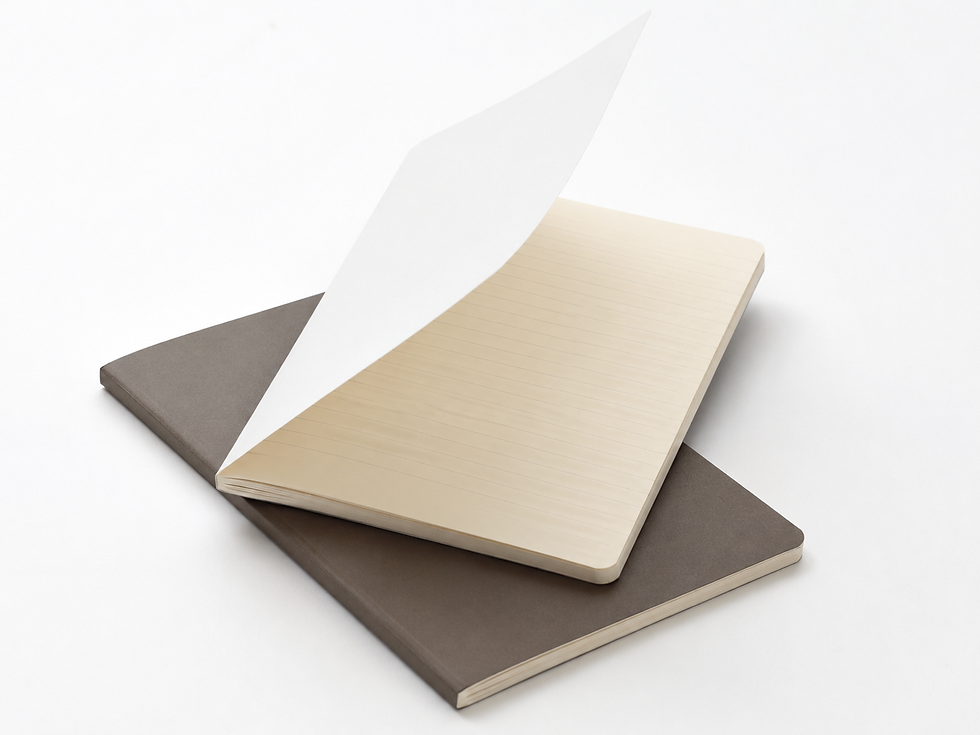
Ivory paper is close to cream paper but often has a cleaner, more elegant look. It is widely used in premium notebooks and planners.
Soft Color and Luxury Appeal
Ivory paper works well when the brand wants a soft, upscale page tone without looking too yellow. It is common in executive notebooks, gift notebooks, and high-end retail journals.
Printing Results on Ivory Paper
Printed lines, grids, and dots may look softer on ivory paper than on bright white paper. This can be a good thing. It gives the page a calmer look.
Still, buyers should test logo colors and ruling colors before mass production. Pale grey ruling may become too light on ivory paper.
Best Notebook Categories
Ivory paper is a good fit for:
Premium journals
Corporate gift notebooks
Executive notebooks
Planners
Hardcover diaries
Boutique stationery collections
Kraft Paper
Kraft paper is known for its brown, natural look. It is often linked with eco-friendly, handmade, or rustic design.

Eco-Friendly Visual Style
Kraft paper creates a natural look without needing heavy decoration. It is often used for notebook covers, dividers, envelopes, belly bands, and packaging.
Uses for Covers and Dividers
Kraft paper is better for notebook covers and separator pages than for standard writing pages. Its color and texture can make writing less clear, especially with pencil or light ink.
Limitations for Inner Pages
Kraft paper may not be ideal for daily note pages because:
Writing contrast is lower
Color printing is harder
Ink behavior varies
Surface may feel rough
It may not suit premium writing users
For buyers, kraft is best used as a design material, not always as the main inner page.
Stone Paper
Stone paper is a synthetic alternative made mainly with mineral powder and resin. It is known for water resistance and a smooth feel.

Water Resistance and Durability
Stone paper can be useful for notebooks used outdoors, in kitchens, on factory floors, or in travel settings. It resists water better than normal pulp paper.
Writing Feel and Ink Behavior
Stone paper feels very smooth. Ballpoint pens often write well on it, but gel pens and fountain pens may dry more slowly. Buyers should test ink drying before approving a stone paper notebook.
Production and Cost Considerations
Stone paper can be more expensive and may not suit every market. It can also require special handling in printing and binding. Use it when durability is a real selling point, not only as a novelty.
Cotton Paper
Cotton paper is made from cotton fibers or cotton-rich pulp. It is often used for premium stationery, certificates, art paper, and luxury writing products.

Premium Writing Performance
Cotton paper can feel soft, strong, and elegant. It is often chosen for brands that want a heritage or luxury image.
Best Uses for Luxury Notebooks
Cotton paper works well for:
Luxury journals
Limited-edition notebooks
Fountain pen notebooks
Artist writing books
Premium stationery gift sets
Cost and MOQ Factors
Cotton paper usually costs more than standard offset paper. It may also require higher MOQ or longer lead time. For buyers, it is best used for high-margin collections rather than low-cost mass notebooks.
Coated Paper
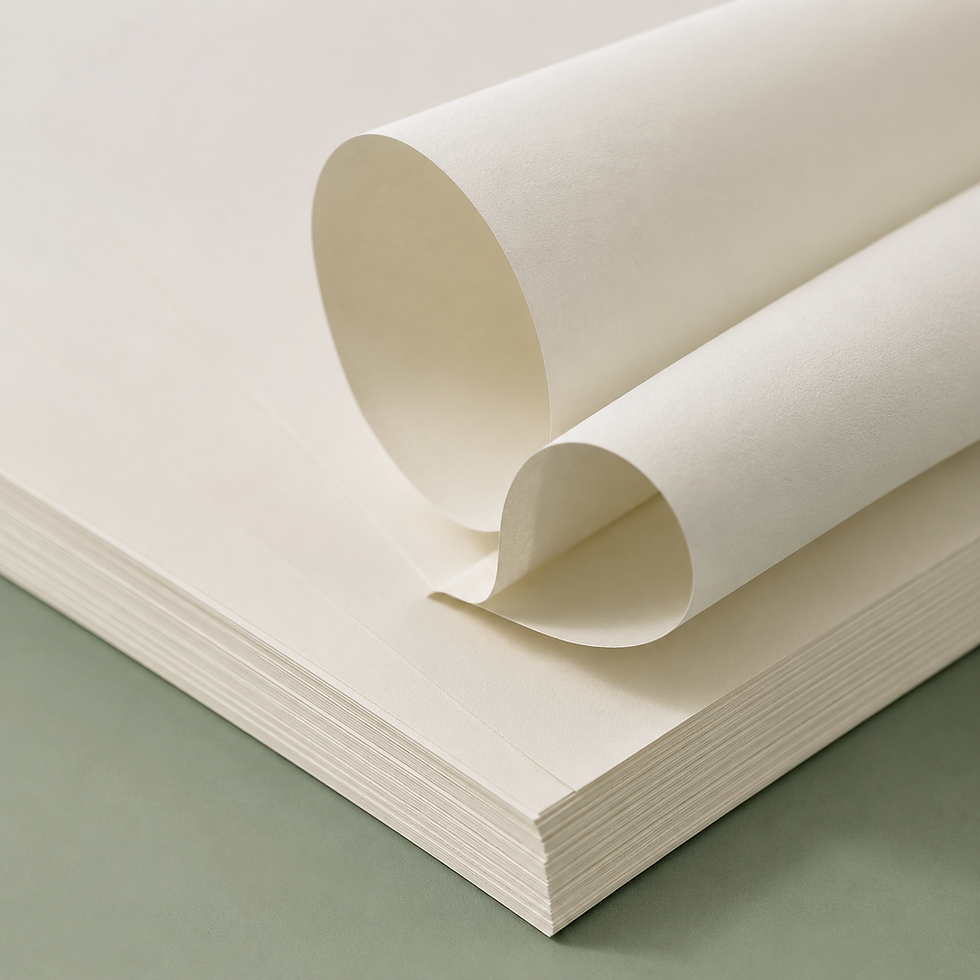
Coated paper has a surface treatment that improves print sharpness and color appearance. It can be gloss, matte, or silk.
Gloss, Matte, and Silk Finishes
Coated paper is useful when the notebook needs strong color printing. It can make images, brand pages, calendars, and inserts look clean and bright.
Best Uses for Covers and Inserts
Use coated paper for:
Printed covers
Advertising inserts
Brand story pages
Sticker sheets
Color dividers
Product catalog pages inside notebooks
Why It Is Rare for Writing Pages
Coated paper is usually not the best choice for notebook writing pages. Ink may sit on the surface and dry slowly. Pencil may feel slippery. For inner pages, uncoated writing paper is usually more practical.
Lightweight Thin Paper
Lightweight paper is used when buyers want many pages without making the notebook too bulky.

Best for High-Page-Count Notebooks
This paper is common in:
Daily planners
Large diaries
Study notebooks
Bible-style journals
Travel notebooks
Compact notebooks with many pages
Opacity and Bleed-Through Concerns
The main risk is show-through. A 60 GSM paper with strong opacity may work well. A poor 70 GSM paper may still disappoint users. This is why opacity and writing tests matter.
Buyer Testing Checklist
Before approving lightweight paper, test:
Test | Pass Standard |
Ballpoint writing | Smooth, no tearing |
Gel pen writing | Limited bleed |
Double-sided writing | Acceptable show-through |
Print ruling | Clear but not harsh |
Page turning | No weak or limp feel |
Binding | No page wave after production |
Colored and Specialty Papers
Colored and specialty papers help brands create a distinct product. They are common in gift notebooks, creative journals, and custom stationery.

Colored Inner Pages
Colored inner pages can make a notebook stand out. Soft pastel pages may work for lifestyle notebooks. Darker colors are better for dividers or art sections.
Watermarked Paper
Watermarked paper gives a classic and formal feel. It works well for executive notebooks, certificate books, and premium business stationery.
Custom Texture Paper
Textured paper adds touch value. Linen texture, laid texture, and felt texture can make the notebook feel more premium. Buyers should test writing smoothness, because heavy texture may affect pen movement.
Paper Selection by Notebook Type
Different notebook categories need different paper. A good sourcing decision starts with use case, not paper name.
School Exercise Books
School notebooks need stable quality and good price control. The paper should work with pencil, ballpoint pen, and basic gel pens.
Best options:
55–70 GSM offset paper
Recycled paper for eco school ranges
FSC-certified paper for institutional buyers
Spiral Notebooks
Spiral notebooks are used for school, office, and casual writing. Pages must turn easily without tearing around punched holes.
Best options:
70–80 GSM woodfree paper
80 GSM paper for retail quality
High-opacity paper for double-sided use
Hardcover Journals
Hardcover journals need better inner paper because the product feels more premium from the start.
Best options:
80–100 GSM cream paper
80–100 GSM ivory paper
100 GSM high-opacity paper
Cotton blend paper for luxury ranges
Planners and Bullet Journals
Planners often include printed layouts, calendars, habit trackers, and color sections. Bullet journals need clean dot printing and low ink bleed.
Best options:
100–120 GSM smooth paper
Ivory paper for premium planners
High-opacity offset paper
FSC-certified paper for branded retail lines
Corporate Gift Notebooks
Corporate buyers care about brand image, logo quality, and reliable delivery.
Best options:
80–100 GSM ivory paper
FSC-certified woodfree paper
Cream paper for luxury gifts
Coated inserts for brand pages
Printing Compatibility by Paper Type
Notebook printing usually includes ruling, dots, grids, logo pages, color dividers, or custom inserts. The wrong paper can cause poor line sharpness, ink set-off, or slow drying.
Offset Printing Compatibility
Offset printing works well for most woodfree, bond, cream, ivory, and recycled papers. Buyers should confirm ink density and drying time, especially for full-page designs.
Digital Printing Compatibility
Digital printing can be useful for short runs, samples, and personalized notebooks. But not every paper runs well on every digital press. Heat, toner adhesion, and paper curl should be checked.
Ink Bleeding and Drying Time
Ink bleeding is a product complaint that buyers can prevent. Test real pens on real production paper. A lab sheet is helpful, but a finished notebook sample is better.
Ruling, Dots, Grids, and Full-Color Printing
For ruling and grids, avoid lines that are too dark. Users want guidance, not distraction. For dot grid notebooks, dot size and contrast matter. For full-color inserts, coated or smoother paper may be better.
Cost Factors for Notebook Paper Buyers
Paper often represents a large part of notebook cost. Even a small GSM change can affect the final price, weight, freight, and shelf feel.
Raw Material Price Fluctuations
Paper prices can move with pulp costs, energy costs, demand, shipping, exchange rates, and regional supply. CEPI’s 2024 Key Statistics report notes that the European pulp and paper industry data is compiled from national associations and additional sources such as Eurostat, showing why regional data matters for sourcing decisions.
MOQ and Lead Time
Common paper grades are easier to source. Custom shade, special GSM, cotton content, FSC claim, or recycled content may increase MOQ and lead time.
Custom GSM and Color Costs
A non-standard GSM may require mill production instead of stock paper. Custom color also needs shade approval and batch control.
Waste Rate in Production
Notebook production has waste from trimming, printing setup, folding, binding, and rejected sheets. Buyers should ask if the quoted price includes normal waste.
Sustainability and Certification Checklist
Sustainability claims must be clear, honest, and document-backed. This protects the buyer, the brand, and the supplier.
The EU Ecolabel covers printed paper products, envelopes, paper carrier bags, wrapping paper, and stationery products. It is awarded to products that meet criteria covering sustainable or recycled fibres, restricted hazardous substances, and manufacturing impacts such as emissions, energy use, and waste.
Common Certifications and Claims
Certification or Claim | What Buyers Should Check |
FSC | Valid chain-of-custody certificate and invoice claim |
PEFC | Valid certificate and product scope |
EU Ecolabel | Product group, license, and criteria fit |
Blue Angel | Recycled paper criteria and valid label use |
Recycled content | Percentage, fiber source, and supporting documents |
Carbon claim | Method, boundary, and third-party proof |
Documents to Request Before Production
Ask for:
Paper mill certificate
Supplier chain-of-custody certificate
Test report for GSM, opacity, or brightness
Recycled content declaration
Ecolabel license, if used
Final artwork approval for logos
Pre-production sample
Signed golden sample
This step is not red tape. It is risk control.
Paper Testing Checklist Before Bulk Orders
A professional buyer should never approve notebook paper by catalog description alone. Always test samples.
Check Samples Under Real Writing Conditions
Use the same kind of pens your target users will use. For school notebooks, test pencil, eraser, and ballpoint. For journals, test gel pen and fountain pen. For planners, test highlighters.
Test Fountain Pen and Gel Pen Bleed
Fountain pen users are strict. If your notebook claims to be fountain-pen friendly, test multiple nibs and inks. Look for feathering, bleed-through, and long drying time.
Compare Print Sharpness
Print the actual ruling, dots, grids, and logo on the selected paper. Do not judge from blank paper only.
Review Certifications and Supplier Documents
Check certificates before artwork is printed. A missing certificate can delay shipment or force packaging changes.
Best Paper Recommendations by Use Case
Best Paper for School Notebooks
Choose 60–70 GSM woodfree offset paper. It offers a good cost-performance balance and works well for standard writing.
Best Paper for Premium Journals
Choose 80–120 GSM cream, ivory, cotton, or high-opacity paper. The page should feel smooth, strong, and calm.
Best Paper for Eco-Friendly Notebooks
Choose recycled paper with FSC Recycled, PEFC, EU Ecolabel, or Blue Angel support where relevant. Make sure all claims are backed by documents.
Best Paper for Corporate Buyers
Choose 80–100 GSM ivory or cream paper with FSC or PEFC certification. Add a coated brand insert if the notebook needs strong color printing.
Best Paper for Bullet Journals
Choose 100–120 GSM high-opacity paper. Test gel pens, markers, and dot clarity before approving production.
Sample RFQ Table for Notebook Paper Buyers
Use this table when asking suppliers for notebook quotations.
RFQ Item | Example Requirement |
Notebook type | A5 hardcover journal |
Inner paper | 100 GSM ivory woodfree paper |
Certification | FSC Mix or FSC Recycled, if available |
Page count | 192 pages |
Printing | 1C grey dot grid |
Opacity | Supplier to provide test data or sample |
Binding | Smyth sewn or lay-flat binding |
Sample test | Gel pen, fountain pen, highlighter |
Packaging | Individual shrink wrap or paper band |
Documents | FSC certificate, invoice claim, pre-production sample |
MOQ | 3,000–5,000 pcs |
Lead time | To be confirmed after paper approval |
Common Paper Selection Mistakes
Choosing by GSM Only
GSM matters, but it is not the whole story. Opacity, smoothness, sizing, stiffness, and shade also matter.
Ignoring End-User Pens
A notebook for school users and a notebook for fountain pen users need different paper testing.
Approving Blank Paper Only
A blank paper sample is useful, but it does not show final print performance. Always test printed pages.
Using Sustainability Claims Without Proof
Claims like “eco,” “green,” or “sustainable” need evidence. Certifications and invoice claims should match the product.
Forgetting Freight Weight
A higher GSM paper can raise notebook weight. This may affect carton weight, freight cost, and retail handling.
Conclusion: Choosing the Right Notebook Paper
The right notebook paper is the one that fits the user, the brand, and the buying goal. A school exercise book needs cost control and stable supply. A premium journal needs better touch, opacity, and writing comfort. An eco notebook needs clear certification and honest claims.
For professional stationery buyers, the best sourcing process is simple: define the notebook use, set the paper specs, test real writing tools, verify documents, approve a golden sample, and keep the same paper reference for repeat orders.
When buyers understand the different types of paper used in notebook printing, they can make smarter decisions, reduce production risk, and build notebooks that customers want to buy again.
—Leo Xia, CEO, Lion Paper Products
You design, we deliver.
FAQs:
Q1: What is the best paper for notebook printing?
The best paper depends on the notebook type. For standard school and office notebooks, 60–80 GSM woodfree offset paper is a safe choice. For premium journals, 80–120 GSM cream, ivory, cotton, or high-opacity paper is better.
Q2: What GSM is best for notebook pages?
Most notebooks use 60–100 GSM inner paper. School notebooks often use 60–70 GSM. Office notebooks often use 70–80 GSM. Premium journals and bullet journals often use 100–120 GSM.
Q3: What is the difference between offset paper and bond paper?
Offset paper is widely used for printing and notebook inner pages. Bond paper is often linked with office writing, letterheads, and business stationery. Both can work for notebooks, but final performance depends on the exact grade.
Q4: Which paper is best for premium journals?
Premium journals often use 80–120 GSM cream, ivory, cotton, or high-opacity paper. The best option should feel smooth, show little ink through the page, and match the brand’s design style.
Q5: Is coated paper suitable for notebook inner pages?
Usually no. Coated paper is better for covers, inserts, dividers, and brand pages. For normal writing pages, uncoated paper is usually easier to write on.
Reference
Are you looking for a reliable manufacturer? Reach out to Lion Paper for a free quote and consultation. Let’s collaborate on creating custom writing paper products that will set your brand apart from the competition!
About Lion Paper
Company Name: Lion Paper Products
Office Address: 20th floor, Chuangyedasha Building, No. 135, Jinsui Road, Jiaxing City, Zhejiang Province, China
Factory Address: No.135, Xuri Road, Jiaxing City, Zhejiang, China
Email: Leoxia@lion-paper.com
Audit Certifications: ISO9001:2015/FSC/SEDEX SMETA/Disney FAMA/GSV/SQP

Comments