


The Different Types of Gift Wrapping Paper: A Complete 2026 Guide
- Leo Xia

- Dec 22, 2025
- 12 min read
Gift wrapping has shifted from “just paper” to a strategic part of gifting, branding, and sustainability. Recent market research estimates that global gift wrapping products were worth about USD 18–19 billion in 2023–2024 and are on track to reach roughly USD 27–31 billion by 2030, growing around 7–8% per year. Paper and board account for the majority of this market and wrapping paper is the single largest product segment.Grand View Research

At the same time, holiday and gifting seasons create huge amounts of packaging waste. One consolidated analysis of holiday waste data reports that Americans spend around USD 12.7 billion on gift wrap and that paper waste from gift wrap alone consumes nearly 30 million trees, with thousands of tons of non-recyclable foil paper landfilled each year.Gitnux No wonder brands and households are paying much closer attention to which types of gift wrapping paper they use.
This guide walks through:
The main occasions for gift wrapping paper
The Different Types of Gift Wrapping Paper by texture and finish
Extra factors like thickness, print quality and sustainability
How to choose the right wrap step by step
Quick Content Reach:
Introduction: Why Choosing the Right Gift Wrapping Paper Matters
The wrap is the first “emotion touchpoint” before a gift is opened. For brands, it works like a miniature billboard in someone’s hands; for families, it sets the tone for the celebration.
Choosing the right type of gift wrapping paper matters because:
It changes how premium the gift feels. Luxury finishes, foils, or textured paper can make even a simple item feel special.
It affects environmental impact. Shiny, plastic-coated, or glitter-heavy wraps are often not recyclable and frequently end up in landfill. Investigations into holiday waste highlight that millions of pounds of plastic-coated wrapping paper are discarded each year.AP News
It influences customer loyalty. Consumer research shows that 39% of shoppers now say sustainable packaging is “very important” when they buy, up from 28% in 2019.First Insight Gift wrap that looks good and aligns with people’s values is more likely to be photographed, shared, and remembered.
For corporate buyers, gift wrapping paper is also part of compliance. New rules like the EU Packaging and Packaging Waste Regulation (PPWR) will require packaging placed on the EU market to be minimized, recyclable, correctly labeled, and increasingly reusable from 2030 onward.ERP Global That makes choosing the right materials and certifications essential, not optional.

Common Occasions for Gift Wrapping Paper

Everyday Gifts (Birthdays, Thank You, Housewarming)
For everyday gifting, you want wraps that are:
Versatile and not tied to a single holiday
Easy to store and cut
Affordable enough for frequent use
Trends show strong demand for matte or semi-gloss printed paper, simple geometric patterns, and neutral color palettes that work all year. Packaging design forecasts for 2026 highlight minimalism with personality—clean layouts, bold typography, and warm, human color tones rather than cluttered graphics.
Kid-Related Occasions (Baby Showers, Kids’ Birthdays)
For baby showers and kids’ birthdays, wraps often feature:
Bright colors and playful characters
Extra-strong paper to survive excited unwrapping
Coordinated gift bags, tissue, and stickers
Many parents now look for non-toxic, recyclable paper and water-based inks, reflecting wider concerns about children’s exposure to chemicals. Gift wrapping trend reports already point to more eco-friendly, child-safe designs with simple patterns that still feel fun.
Holiday Wrapping (Christmas, Hanukkah, New Year)
The holiday season is the peak of gift wrap consumption—and waste. One market summary estimates that wrapping paper used in the US each year could circle the equator multiple times, and that 3,000 tons of foil wrapping paper in the US alone are discarded annually because they can’t be recycled.
To reduce this impact in 2026, more people are turning to:
Reusable fabric wraps (including Japanese-style furoshiki)
Plain kraft paper decorated with ribbon, stamps, or children’s drawings
Recycled, FSC-certified gift wrap without plastic glitter
Sustainability guides from major news outlets encourage households to use up old wrap but switch long-term to recyclable paper, fabric wraps, or even newspaper and brown bags decorated at home.
Religious & Cultural Celebrations (Eid, Diwali, Easter)
Religious and cultural celebrations often involve distinctive colors and symbols:
Gold foil, jewel tones, and intricate motifs for Diwali and Eid
Light pastels and floral patterns for Easter
Red and gold for Lunar New Year
Brands serving global customers increasingly create culturally specific wrapping collections while still using recyclable paper and avoiding plastic-based laminates where possible, aligning with circular economy and anti-waste policies such as PPWR.
Elegant & Luxury Occasions (Weddings, Anniversaries, Corporate Gifts)
For luxury events and corporate gifting, the focus shifts to:
Heavy-weight paper
Soft-touch coatings, embossing, or letterpress details
Minimalist color palettes (e.g., white with wax seal, or muted neutrals)
Luxury and packaging design case studies point to “quiet luxury” in 2025–2026—simple wraps in white or earthy tones, completed with a monogram, wax seal, or fabric ribbon instead of busy patterns.
Types of Gift Wrapping Paper by Texture and Finish
Not all gift wrap is created equal. Understanding the Different Types of Gift Wrapping Paper by texture and finish helps you balance aesthetics, cost, and recyclability.

Key Texture & Finish Types (with Example Use Cases)
Typical Texture | Best For | Recyclability Notes* | |
Matte paper | Smooth, uncoated | Everyday gifts, eco-look branding | Usually recyclable if plain, no plastic or glitter |
Satin / semi-gloss paper | Soft sheen, smooth | Birthdays, retail gift wrap | Often recyclable if not laminated or metallic |
High-gloss coated paper | Slick, shiny | Mass-market holiday wrap | May be non-recyclable if plastic-coated |
Kraft paper (brown or dyed) | Slightly rough, fibrous | Rustic, eco-friendly, e-commerce packaging | Usually recyclable; check inks and tapes |
Tissue paper | Very thin, crinkly | Clothing, delicate items, inside boxes | Often recyclable; avoid plastic glitter |
Foil / metallic paper | Mirror-like, crisp | Luxury gifts, weddings, holidays | Often non-recyclable; treat as residual waste |
Embossed / textured paper | Raised patterns, tactile | Premium products, small boxes, corporate gifts | Recyclable depends on coatings and foils |
Laminated or film-backed wrap | Very smooth, tear-resistant | High-moisture or long-distance shipping | Commonly non-recyclable in curbside systems |
Fabric wraps (e.g., cotton, furoshiki) | Soft, draping | Reusable gifting, luxury, eco-conscious brands | Reusable; not paper, but a key wrap alternative |
*Always check local recycling rules; guidance varies by region.
Matte and Satin Papers
Pros: Easy to write on, good print quality, usually recyclable.
Best for: Stationery brands, everyday retail use, and minimalist aesthetics.
Sustainability tip: Choose FSC-certified or recycled content papers and water-based inks. FSC’s paper and packaging program provides Chain of Custody certification so brands can prove their fiber comes from responsibly managed forests.Forest Stewardship Council
Kraft Papers
Pros: Strong, tear-resistant, and visually signal “natural” and “eco.”
Best for: Rustic or organic brands, online sellers, and reusable wrapping.
Trend: Packaging trend reports for 2026 emphasize kraft-based wraps combined with earthy, vibrant color palettes and simple typography.
Foil and Metallic Papers
Pros: High impact, very festive, great for luxury gifting.
Cons: Often laminated with plastic or metallic films, making them hard or impossible to recycle in standard paper streams. Studies of holiday waste note thousands of tons of foil wrapping paper being discarded each year.
Best for: Limited, high-value uses where the “wow” factor outweighs the environmental cost—or where you can pair it with recycling instructions and minimal overall packaging.
Textured, Embossed, and Specialty Papers
Pros: Add tactile delight and a “premium” feel without needing heavy graphics. Packaging design forecasts for 2026 highlight tactile finishes and soft-touch coatings as key ways to create emotional connection.
Best for: Corporate gifting, wedding favors, boutique retail packaging.
Note: Always confirm whether embossing, coatings, or flocking interfere with recyclability.
Fabric and Reusable Wraps
While not technically paper, fabric wraps are now a mainstream alternative:
Inspired by Japanese furoshiki techniques, fabric squares can be tied in many ways and reused for years.
Great for eco-conscious, design-driven brands and for families who want to cut waste without losing the joy of unwrapping.
Additional Gift Wrapping Paper Considerations
Thickness and Durability
Paper thickness (often measured in GSM) influences how your wrap behaves:
Lightweight (around “tissue” territory):
Ideal for layering inside boxes, not as the only outer wrap.
Standard gift wrap weight:
Good balance of cost and strength, works for most boxed items.
Heavy-weight or board-like wraps:
Best for sharp corners, heavy gifts, and premium presentation.
Under new regulations like PPWR, packaging weight and volume must be reduced to the minimum necessary while still protecting the product.ERP Global This pushes brands toward balancing durability with material efficiency instead of over-wrapping.
Print Quality and Design Trends in 2026
Packaging and gift-wrap design trends for 2026 suggest:
Minimalism with a twist: Simple layouts, bold type, and hand-drawn elements.
Hyper-sustainable storytelling: Designs that visibly communicate recycled content, forest stewardship, or carbon-reduced printing.
Soft, earthy color palettes: Inspired by interior trends (“earthy vibrancy”) using ochres, olive greens, muted blues, and plums.
Interactive and tech-enhanced wraps: QR codes that link to gift messages, microsites, or AR effects.
To support these looks while staying responsible, printers increasingly adopt ISO 14001-certified environmental management systems, which provide a globally recognized framework for controlling environmental impacts, resource use, and compliance across printing and packaging operations.
Eco-Friendly and Sustainable Options
You don’t need to sacrifice beauty to go sustainable. Market reports and surveys highlight three big shifts:
Certified and recycled papers
FSC and similar schemes certify forest management and supply-chain traceability. Many packaging firms now hold FSC Chain of Custody certification, allowing them to label wrapping and tissue paper with FSC logos after annual audits.
Consumer behavior change
A 2024 survey from ALPLA and Packaging Technology Today found 87% of Americans reuse gift bags, ribbons, and wrapping paper and 60% recycle wrapping materials during the holidays.
First Insight’s work with the Wharton School reports that 39% of consumers now see sustainable packaging as “very important”, up from 28% in 2019.
Policy and EPR pressure
Beyond PPWR in the EU, Extended Producer Responsibility (EPR) schemes and packaging levies (such as those introduced in the UK) shift recycling costs from taxpayers to producers, with fees varying by material. This makes non-recyclable laminates and glitter-heavy paper more expensive over time.
How to Choose the Perfect Gift Wrapping Paper for Your Occasion
Use this simple, five-step process to pick the right wrapping paper every time.
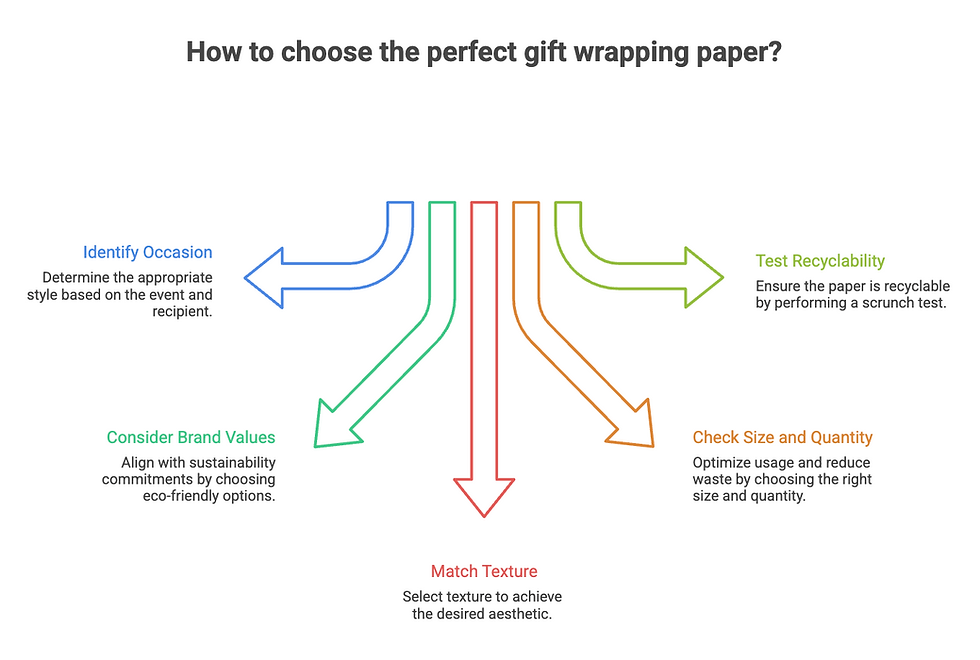
Identify the occasion and recipient
Is this a child’s birthday, a luxury corporate gift, or a minimalist wedding?
For formal and corporate exchanges, lean toward premium textures and quiet colors. For kids and casual events, brighter patterns and playful themes are fine.
Consider brand values (e.g., sustainability)
If you’re a business, your wrap is part of your ESG story.
Review your sustainability commitments and check whether your wrapping paper supplier offers FSC-certified, recycled, or compostable options and can provide documentation or certificate codes.
Match texture to the desired aesthetic
Rustic / eco: Uncoated kraft or recycled matte wrap with simple black or white inks.
Premium: Soft-touch or embossed wraps with restrained metallic accents.
Playful: Color-rich satin or semi-gloss paper with character art or hand-drawn patterns.
Check size and quantity needed
For households, multi-roll packs of versatile designs and neutral colors reduce leftovers.
For businesses, look at ordered quantities, roll widths, and flat sheet formats that minimize off-cuts and “empty space,” aligning with regulations that now require packaging volume to be minimized and excess void fill reduced.
Test for ease of folding, taping, and recycling
Do a quick “scrunch test”: if the paper wrinkles and holds its shape when crumpled, it’s more likely recyclable; slick, plastic-like finishes may not be.
Try one gift: see whether corners fold cleanly, tape sticks well, and the paper doesn’t tear on sharp edges.
Following this sequence makes it easy to navigate the Different Types of Gift Wrapping Paper and pick one that fits the moment, the message, and the planet.
How Lion Paper Products Can Help
Company Snapshot
Lion Paper Products started in Jiaxing, in 2015, focused on exporting paper products, lifestyle items, and stationery. Over time, it built its own paper product factories in Cambodia, supporting a one‑stop paper gift and stationery solution for global customers.
Core Strengths
Wide catalog: gift wrap, gift bags, lifestyle items, stationery, and holiday times items.
Multi‑country factory footprint that helps optimize tariffs and lead times
Experience working with major retailers and brand owners in the US, UK, EU...
Best For
Large and mid‑size retailers
Brands looking to bundle wrapping paper + gift bags under one supplier
Suggested Buying Process
Share your seasonal line‑up (Christmas, birthdays, party themes).
Shortlist designs from Lion Paper’s catalog or request OEM/ODM concepts.
Approve samples and packaging.
Lock in a production and shipping calendar before peak season.
Conclusion
The Different Types of Gift Wrapping Paper now sit at the crossroads of design, emotion, and environmental responsibility. Market data shows a fast-growing global gift wrapping products industry, driven by more gifting occasions, e-commerce, and demand for visually striking presentation. At the same time, statistics on wrapping paper waste and consumer surveys reveal a clear shift toward sustainability, reuse, and recyclability.
For households, small brands, and large enterprises alike, the path forward is similar:
Choose textures and finishes that match the emotion of the occasion
Prefer certified, responsibly sourced, and recyclable materials
Work with partners that hold credible certifications like FSC and ISO 14001
Stay ahead of evolving packaging regulations and EPR fees
Do that, and your gifts will look better, feel better, and leave a lighter footprint—long after the paper has been unwrapped.
Don't know how to choose the right type of custom gift wrapping paper? Contact Lion Paper Products for the new ideas and solution to gift wrapping paper.
—Leo Xia, CEO, Lion Paper Products
You design, we deliver.
FAQs:
Q1: Is all gift wrapping paper recyclable??
A: No. Plain, non-laminated paper without glitter or metallic film is often recyclable, while shiny or plastic-coated wraps and many metallic or glitter papers are not. Recycling guidance from environmental agencies and news outlets advises consumers to avoid plastic films and heavy glitter if they want their wrap to be accepted in curbside paper streams. Always check local rules.
Q2: What is the most eco-friendly type of gift wrap for 2026??
A: The most eco-friendly choices usually combine:
Recycled or FSC-certified kraft or matte paper
Water-based inks
Minimal or no plastic lamination and no glitter
FSC certification verifies responsible forest management and tracked supply chains, while recycled content reduces pressure on forests and landfills.Forest Stewardship Council+2Zenpack+2 Fabric wraps such as furoshiki are an even lower-waste choice when reused many times.
Q3: How can I check if a wrapping paper supplier is FSC-certified??
A: Use the official FSC certificate search or dashboard to look up the supplier by name or certificate code. The database lists valid forest management and Chain of Custody certificates, including status and scope, so buyers can verify that their wrapping paper and stationery products legitimately carry FSC labels.
Q4: How do new packaging regulations affect gift wrapping paper??
A: Regulations like the EU Packaging and Packaging Waste Regulation (PPWR) and national EPR schemes are tightening requirements for:
Recyclability (materials must be compatible with standard recycling streams)
Minimization (no unnecessary weight, layers, or empty space)
Labelling (clear disposal and material information)
From 2030, packaging sold in the EU must generally be recyclable and minimized, with harmonized labels and extended producer responsibility fees that reward more sustainable designs. For gift wrapping paper, that means less mixed-material lamination and more straightforward, paper-based solutions.
Q5: Are consumers really willing to pay more for sustainable wrapping??
A: Yes—up to a point. Market and consumer research shows that:
39% of consumers now rank sustainable packaging as “very important” in their purchase decisions, up significantly since 2019.
Surveys of US holiday shoppers report that 87% reuse wrap or gift bags and 60% recycle wrapping materials, indicating strong behavioral support for greener choices.
While cost still matters, many brands win loyalty and online “unboxing” visibility by investing slightly more in attractive, sustainable wrapping that aligns with customer values.
Q6: What’s the best choice of wrapping paper for corporate gifts??
A: For corporate gifts, look for:
Heavy-weight matte or soft-touch wraps in your brand colors
Clean, minimal designs with your logo or a subtle pattern
FSC-certified or recycled paper, backed by documentation for ESG reports
Suppliers with ISO 14001 and clear compliance with EPR and regional packaging rules
This combination delivers a premium unboxing experience while supporting sustainability goals and corporate reporting needs.
Reference
Grand View Research – Gift Wrapping Products Market Size and Share Report, 2030 (market size, share of paper & board, wrapping paper as leading segment).Grand View Research
TechSci Research – Global Gift Wrapping Products Market (2024–2030 forecasts, CAGR, drivers and challenges).TechSci Research
Gitnux – Holiday Waste Statistics (wrapping paper miles discarded, billions spent on gift wrap, foil wrap waste, tree consumption).Gitnux
Packaging Technology Today / ALPLA – 87% of Americans Reuse Gift Wrapping This Year… (holiday reuse and recycling behaviors).Packaging Technology Today
First Insight + Wharton Baker Retailing Center – Consumer surveys on sustainable packaging importance (39% rate sustainable packaging as very important).First Insight
FSC – Paper & Packaging, Certification & Labels (FSC labels, Chain of Custody, certificate search tools).Forest Stewardship Council
Zenpack – FSC-Certified Packaging and Boxes (FSC Chain of Custody in practice, recognition stats, wrapping and tissue paper as certified products).Zenpack
Grounded Packaging – ISO 14001 (definition of ISO 14001 environmental management system certification).Grounded Packaging
ERP-Recycling – PPWR Packaging and Packaging Waste Regulation (objectives, minimization, recyclability, labelling, reuse targets).ERP Global
AP News – The holiday shopping season comes with tons of extra emissions. Here’s how to do it sustainably (holiday climate impact, wrapping paper recyclability and tests, promotion of furoshiki and brown paper).AP News
The Business Research Company – Corporate Gifting Global Market Report 2025 (market size in 2024, forecast to 2029, growth trends).The Business Research Company
Design Craft – Gift Wrapping Trends for 2025 (sustainable materials and expressive designs).The Design Craft
VistaPrint – Packaging Design Trends 2026 and KB Packaging / Holidaypac / Zenpack trend articles (minimalism with personality, tactile finishes, hyper-sustainable materials, interactive packaging).Holidaypac+3VistaPrint+3KB Packaging+3
Good Housekeeping – “Earthy Vibrancy” color palette of 2026 (earth-inspired hues influencing design and packaging palettes).Good Housekeeping
AP News & cultural design sources on furoshiki and Japanese wrapping concepts (fabric wraps and tsutsumu as care-driven wrapping philosophy).AP News+1
Are you looking for a reliable manufacturer? Reach out to Lion Paper for a free quote and consultation. Let’s collaborate on creating custom writing paper products that will set your brand apart from the competition!
Company Name: Lion Paper Products
Office Address: 20th floor, Chuangyedasha Building, No. 135, Jinsui Road, Jiaxing City, Zhejiang Province, China
Factory Address: No.135, Xuri Road, Jiaxing City, Zhejiang, China
Email: Leoxia@lion-paper.com
Audit Certifications: ISO9001:2015/FSC/SEDEX SMETA/Disney FAMA/GSV/SQP

Comments