


Canton Fair Phase 3 Insights for Stationery Buyers

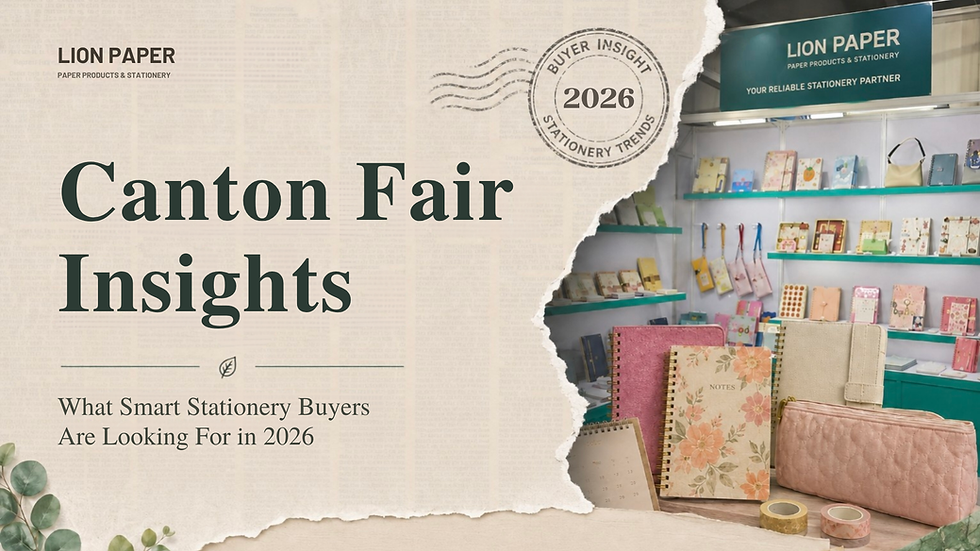
After this Canton Fair, I kept thinking about one moment that happened several times at our booth. And I sketched this article, Canton Fair Phase 3 Insights for Stationery Buyers, hoping this can be really helpful!
A buyer would pick up a notebook, touch the cover, open the pages, look at the matching pouch beside it, and then ask a very practical question:
“Can this be made as a full set?”
That question says a lot about where the stationery and lifestyle goods market is going.
Buyers are not short of new products.They see hundreds of them at every trade show.
What they are short of is something more valuable:
A product idea that can become a real commercial program — with clear design logic, realistic pricing, stable production, packaging options, and a launch plan that reduces risk.
As the CEO of Lion Paper, this was my biggest takeaway from the Canton Fair.
The strongest sourcing opportunities are no longer built around one beautiful sample. They are built around product systems that help buyers make faster, safer, and more profitable decisions.
Quick Content Reach:
Why did buyers stop at certain products?
At a trade show, attention is expensive.

Buyers move quickly. They have limited time, many booths to visit, and too many suppliers saying similar things.
From our booth conversations, four things made buyers stop.
The first was strong visual identity.
Textured notebooks, quilted patterns, woven effects, plush covers, lace-edge notebooks, eco-friendly paper products, desk calendars, wall calendars, and cute original themes all attracted attention. These products worked because they gave buyers an immediate reason to look twice.
But visual attraction alone is not enough.
For a buyer, the real question is not simply:
“Is this product beautiful?”
The better question is:
“Can this product help my category stand out — and still make commercial sense?”
That second question is where many products fail.
A sample can be attractive on the table but difficult to price, difficult to produce consistently, difficult to package, or difficult to extend into a full retail range.
That is why the best product development starts with both creativity and business logic.
Why are buyers asking for sets instead of single items?
One important pattern we saw at the fair was the shift from single-item interest to collection-based interest.
When buyers saw a PU pencil pouch matched with notebooks in the same design direction, the conversation changed.
They were no longer only asking about one notebook.They were asking about the whole set.
This matters because buyers today are thinking like merchandisers.
A notebook alone may be easy to understand, but a coordinated collection gives them more commercial options:
It can create a stronger shelf story. It can support seasonal campaigns. It can increase basket value. It can reduce the work of matching colors, materials, packaging, and accessories across different suppliers. It can make internal approval easier because the product logic is clearer.
For brands, retailers, e-commerce sellers, distributors, and gift companies, this is becoming more important.
A buyer does not want to assemble a collection from scattered ideas.They want to see how one design direction can become a sellable range.
At Lion Paper, this is one of the areas we are strengthening after the fair.
Instead of presenting a notebook as an isolated item, we are developing more complete product proposals around use scenarios such as back-to-school, office organization, gifting, journaling, planning, boutique retail, and seasonal promotion.
That is more useful for the customer.

What does “retail-ready” really mean for stationery sourcing?
Many suppliers use the phrase “one-stop solution.”
But buyers do not need a slogan.They need decisions to become easier.
For me, a retail-ready stationery proposal should answer five questions clearly.
First, who is the product for?A student collection, a women’s lifestyle journaling line, a corporate gifting set, and a mass-market retail program should not be developed in the same way.
Second, what is the commercial role of the product?Is it a hero item, an add-on item, a gift item, a seasonal item, or a traffic-driving price-point product?
Third, how can the design be extended?One strong theme should be able to move across notebooks, planners, calendars, pouches, sticky notes, greeting cards, packaging, and small accessories if the customer needs a larger program.
Fourth, what are the realistic cost choices?Material, binding, printing, cover finish, inner page structure, packaging, and order quantity all affect final margin.
Fifth, can the supplier produce it consistently after the sample is approved?This is where trust is tested. A good sample wins attention. Stable mass production wins long-term business.
When these questions are answered early, buyers can move faster. Their internal teams can evaluate more clearly. Their risk goes down.
That is the real value a supplier should bring.

Which product directions showed stronger commercial potential?
Several product directions received repeated attention during this Canton Fair.
Textured notebooks and journals were one of them. Quilted, woven, plush, and lace-edge designs created strong tactile interest. These products are especially suitable for gift, lifestyle, student, and boutique retail markets when the color story and packaging are well planned.
Cute original themes also performed well. Designs like strawberry cat and orange dog attracted designers and brand customers because they felt warm, emotional, and easy to understand. But the value of this type of design is not only in the artwork. The bigger value comes when the theme can extend into a small collection — for example, notebook, pouch, sticky notes, calendar, gift bag, and greeting card.
Calendars and planners also received clear attention. Some buyers were interested in desk and wall calendar formats for community, office, retail, and seasonal use. This reminded us that calendars should not be treated as simple date products. A good calendar can be part of a planning system, a gifting program, or a branded seasonal campaign.
Eco-friendly paper products continued to receive inquiries, but the market is becoming more practical. Buyers do not only ask whether a material is sustainable. They ask whether the product can still meet quality expectations, price targets, packaging needs, and delivery schedules.
Small accessories such as pouches, sticky notes, and small leather goods also showed strong potential. These items are valuable because they help complete a product range without making the program too heavy.
The conclusion is clear:
A product with buyer interest should not stay as a single sample. It should be turned into a clearer commercial offer.
That means not only “showing the product,” but also preparing the price logic, packaging direction, matching items, target market, and production plan behind it.
What should buyers expect from a stronger stationery supplier?
After this fair, I believe buyers should expect more from suppliers than product catalogs.
A good supplier should help reduce uncertainty in four areas.

1. Product development risk
Buyers need fresh ideas, but they also need those ideas to be manufacturable.
A design that looks good but cannot be produced consistently creates problems later. A supplier should be able to guide material choices, finishing methods, binding options, packaging structures, and cost trade-offs before the project goes too far.
This saves time and prevents painful redesigns after pricing.
2. Margin risk
In stationery and paper goods, margin is often decided by small details.
Paper weight, cover board thickness, printing method, accessory combination, packaging style, and production location can all change the final cost.
A supplier that understands this can help customers protect the design value while still working toward a realistic target price.
The goal is not to make products cheaper.The goal is to make the cost structure smarter.
3. Launch timing risk
Many stationery and gift programs are seasonal.
Back-to-school, Christmas, Ramadan, Valentine’s Day, Mother’s Day, corporate gifting, retail campaigns, and new-year planning products all depend on timing.
A delayed sample, unclear quotation, unstable production schedule, or packaging change can put the whole launch at risk.
This is why sampling speed, communication discipline, and production planning matter so much.
4. Supply chain risk
A sample is only the beginning.
The real test is whether the supplier can maintain quality, manage materials, control packaging, follow compliance requirements, and deliver consistently when the order moves into production.
This is where Lion Paper’s dual-location structure brings practical value to customers.
Our Jiaxing, China base supports design development, engineering communication, rapid prototyping, and project coordination. Our Cambodia facility supports efficient mass production and global delivery planning.
For buyers, the value is flexibility.
They can develop faster, compare production options more clearly, and build a stronger path from concept to delivery.
What did the Canton Fair teach us about booth display and buyer communication?
The fair also gave us a very honest reminder:
A booth should not just display products. It should help buyers understand where to look and what to do next.
If every sample has the same visual priority, buyers may miss the strongest ideas.
For future exhibitions, we will improve our display logic in several ways.
Hero products will have clearer positions. High-potential items should be visible immediately, not hidden too low or mixed into a crowded shelf.
Collections will be shown more completely. When a buyer sees a notebook, they should also be able to understand the matching pouch, packaging, calendar, sticky notes, or gift item that could belong to the same range.
Color stories will be more controlled. A coordinated color system helps buyers understand the commercial direction faster.
Interactive areas will stay, but they will be more purposeful. Drawing, live customization, and hands-on product areas are valuable when they help buyers experience the product and start better conversations.
The goal is simple:
When a buyer enters the booth, they should not feel, “There are many samples here.”
They should feel, “I can see how this supplier thinks about my category.”
That is a very different level of trust.
How is Lion Paper responding after the Canton Fair?
For Lion Paper, this Canton Fair was not only about collecting inquiries.

It was about understanding what buyers need next.
We are now putting more focus on complete product development systems, especially in notebooks, journals, planners, calendars, paper stationery, pouches, organizers, gift packaging, eco-friendly paper products, and lifestyle organization collections.
Our team will continue to improve three areas.
The first is design-to-manufacturing development. We want to help customers move from trend direction and product idea to workable sample and production plan with less friction.
The second is full-category collection planning. We will build more product families instead of isolated samples, so buyers can evaluate a complete retail opportunity rather than a single item.
The third is global supply chain execution. With our China and Cambodia operations, we will continue improving speed, cost flexibility, quality consistency, and delivery reliability for international customers.
This is the direction we believe the market needs.
Not suppliers who only ask, “What product do you want?”
But partners who can ask better questions:
What consumer are you targeting?
What price level do you need?
What retail channel will this enter?
What packaging will help it sell?
What timing risk do we need to avoid?
What part of the collection should be the hero product?
What can be simplified to protect margin?
Better questions lead to better products.
What should buyers ask after the Canton Fair?
If you are reviewing suppliers after the fair, I would suggest asking a few questions beyond price.
Can this supplier help me build a product range, not just one item?
Can they explain cost options clearly before sampling goes too far?
Can they support both design improvement and production execution?
Can they help me prepare a retail-ready collection for my channel?
Can they manage quality and delivery when the order scales?
Can they reduce the internal work my team has to do?
These questions reveal whether a supplier is only selling samples or helping you build a commercial result.
Price will always matter.
But in today’s market, the cheapest quotation is not always the lowest risk.
A supplier who reduces development time, avoids production surprises, improves collection logic, and protects launch timing may create more value than a supplier who only wins on unit price.
Final thought-Canton Fair Phase 3 Insights: buyers do not need more noise
The Canton Fair is full of products.
Some are beautiful.
Some are creative.
Some are trendy.
Some will never become real orders.
The difference is not always design.
Often, the difference is whether the product comes with enough commercial clarity for the buyer to move forward.
That is the work we are focused on at Lion Paper.
We want to help customers turn ideas into product ranges.
We want to make sourcing decisions easier.
We want to reduce the risk between a good sample and a successful shipment.
We want to support brands, retailers, distributors, e-commerce sellers, and gift companies with products that are not only attractive, but also practical, profitable, and ready for market.
This Canton Fair confirmed something important for me:
The future of stationery sourcing is not about showing more products.
It is about helping customers make better decisions.
And that is where we will keep improving.
—Leo Xia, CEO, Lion Paper Products
You design, we deliver.
FAQs:
Q1: What should stationery buyers look for after the Canton Fair??
Stationery buyers should look for suppliers that can provide more than attractive samples. A stronger supplier should support product development, collection planning, sampling, pricing options, packaging, quality control, compliance, and delivery execution.
Q2: Why are full stationery collections more valuable than single products?
Full collections help buyers create a stronger retail story, improve shelf presentation, increase basket value, and reduce sourcing complexity. A notebook becomes more commercially useful when it can be matched with planners, calendars, pouches, sticky notes, packaging, and accessories.
Q3: What makes a stationery product retail-ready?
A retail-ready stationery product has a clear target consumer, realistic price structure, suitable packaging, production feasibility, quality control plan, and delivery timeline. It should be easy for the buyer to evaluate internally and launch into the market.
Q4: What product trends stood out at the Canton Fair?
Textured notebooks, quilted and woven finishes, plush notebooks, lace-edge notebooks, cute original design themes, planners, calendars, eco-friendly paper products, pouches, sticky notes, and coordinated stationery sets all showed strong buyer interest.
Q5: How does Lion Paper support OEM and ODM stationery projects?
Lion Paper supports OEM and ODM stationery projects through design development, sampling, manufacturing, packaging, quality control, and global delivery coordination. With operations in China and Cambodia, Lion Paper helps buyers move from product idea to retail-ready collection with more flexibility and execution confidence.
Are you looking for a reliable manufacturer? Reach out to Lion Paper for a free quote and consultation. Let’s collaborate on creating custom writing paper products that will set your brand apart from the competition!
About Lion Paper
Company Name: Lion Paper Products
Office Address: 20th floor, Chuangyedasha Building, No. 135, Jinsui Road, Jiaxing City, Zhejiang Province, China
Factory Address: No.135, Xuri Road, Jiaxing City, Zhejiang, China
Email: Leoxia@lion-paper.com
Audit Certifications: ISO9001:2015/FSC/SEDEX SMETA/Disney FAMA/GSV/SQP


Comments