


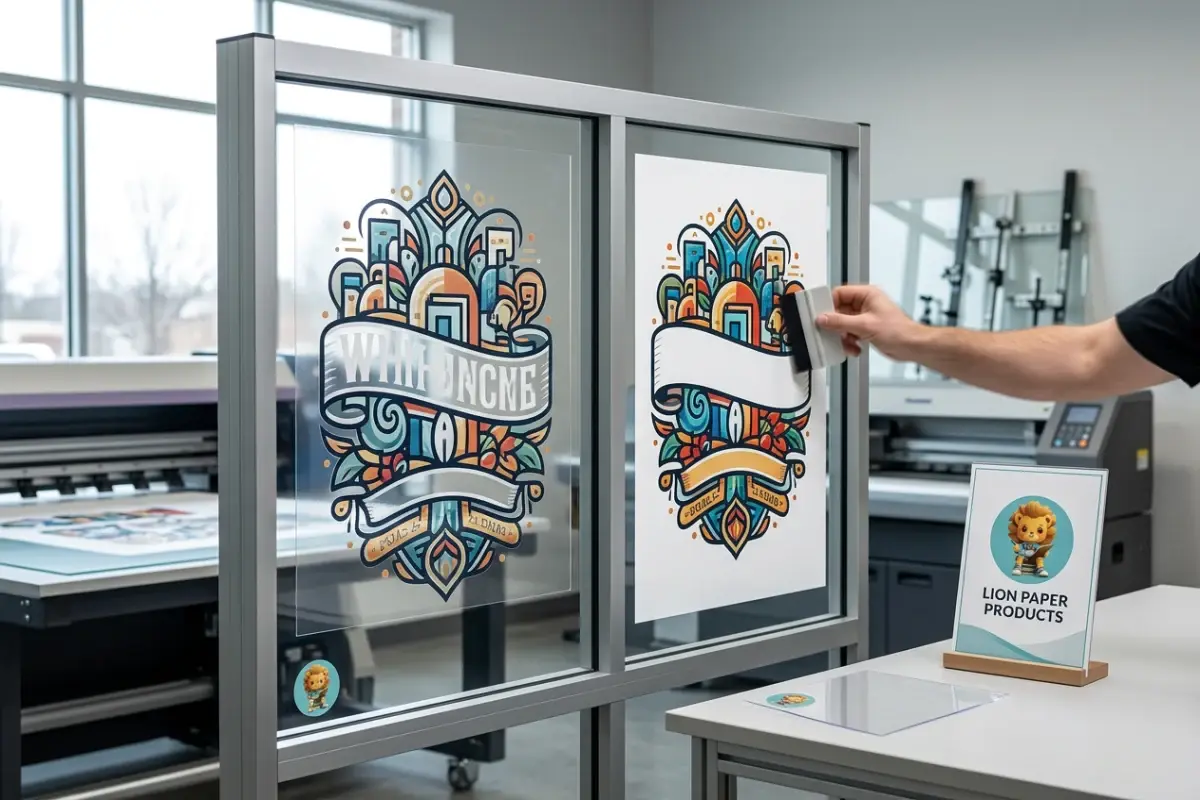
Clear vs White Vinyl Window Stickers: Engineering, Material, and Sourcing Guide

Clear vinyl window stickers offer a transparent background that mimics a die-cut decal without visual clutter, but they require white ink underprinting to prevent colors from appearing translucent against ambient light. In contrast, white vinyl window stickers feature an opaque substrate that delivers maximum color vibrancy, straightforward single-pass printing, complete privacy or light-blocking, and lower production costs for high-volume commercial programs.
What is the difference between clear and white vinyl window stickers?
Selecting the right face stock for window graphics determines visual impact, optical clarity, and manufacturing cost. The fundamental contrast between clear and white vinyl lies in substrate opacity, print layer architecture, and ambient light interaction.
Clear vinyl uses a transparent polyvinyl chloride (PVC) or polyethylene terephthalate (PET) film. Unprinted areas allow light to pass through completely, creating a seamless aesthetic on glass storefronts, automotive windows, and product display cases. However, standard process inks (CMYK) are inherently translucent. When printed directly onto clear vinyl without an opaque barrier, graphics appear washed out or blend into whatever background sits behind the glass. Achieving vibrant, readable graphics on clear vinyl requires multi-layer printing with selective white ink.
White vinyl uses an inherently opaque white PVC base film (often tinted with titanium dioxide pigments or layered with a grey/black blockout barrier). The white surface acts as a universal reflective background for standard CMYK inks, ensuring high optical density, crisp color contrast, and complete opacity without additional ink layers.
Property | Clear Vinyl Window Stickers | White Vinyl Window Stickers |
|---|---|---|
:--- | :--- | :--- |
Base Film Opacity | 0% (Transparent / Optically Clear) | 100% (Solid White / Optional Blockout) |
Ink Layer Requirement | CMYK + White Underbase (or White Flood) | Standard CMYK Process |
Graphic Readability on Glass | High contrast with white ink; washed out without white ink | Consistently high contrast across all lighting conditions |
Unprinted Area Aesthetic | Seamless glass integration ("no-label" look) | Visible white border or solid background shape |
Print Passes / Head Setup | Multi-layer (2 to 3 passes or inline multi-head) | Single-pass standard CMYK printing |
Manufacturing Cost Factor | Moderate to High (White ink consumption + slower speeds) | Standard baseline production cost |
Primary Use Cases | Minimalist logos, operating hours, see-through window decals | High-contrast promotional signs, full-coverage graphics, double-sided posters |

A selective white ink underbase provides opacity and color saturation for custom vinyl window decals on clear substrates.
How does white ink printing work on custom vinyl window decals?
When specifying custom vinyl window decals on transparent film, engineering the white ink layer is essential for structural graphic integrity and visual legibility. Commercial clear window stickers white ink setups rely on three primary configurations:
Selective White Underbase (Spot White): The print engine deposits white ink specifically beneath colored graphical elements and text, leaving negative space completely transparent. This technique ensures high color saturation and opacity for logos while retaining see-through visibility around the design.
Full Flood White Backing: A solid layer of white ink is printed across the entire surface of the graphic area. This creates a solid background behind full-color illustrations while utilizing the clear substrate perimeter for adhesion or clean-cut edges.
Day-and-Night (Sandwich Printing): For dual-visibility or backlit graphics, modern digital and UV-LED presses deposit three distinct layers in a single pass: Color + White Barrier + Color (CMYK/W/CMYK) or Color + Black Barrier + White + Color. This prevents backlight bleed-through and ensures graphics look identical in direct daylight and internal artificial illumination.
In UV-curable and screen printing systems, white ink formulated with micro-fine titanium dioxide particles requires continuous agitation systems to prevent pigment settling. Because white ink layers are applied with higher film thickness (measured in microns) than process inks, curing profiles and surface tension must be tightly managed during production to avoid embrittlement or micro-cracking during application.
What are the adhesive systems and viewing orientations for window decals?
Choosing between front-adhesive, back-adhesive, and non-adhesive static cling systems depends on installation environment, expected lifespan, and vandalism exposure.
Back-Adhesive (Exterior Mount)
Back-adhesive decals apply to the outside surface of the window glass, with the graphic facing outward toward pedestrians. This is standard for both clear and white vinyl. While installation is straightforward, exterior-mounted decals must endure UV radiation, wind, rain, road grime, temperature fluctuations, and commercial window-washing squeegees. Lamination with an anti-UV clear overcoat is recommended to prevent ink degradation and face stock shrinkage.
Front-Adhesive / Inside-Glass Mount (Second Surface Printing)
Front-adhesive decals install on the interior surface of the window, with graphics facing through the glass to the outside. This setup shields the sticker from vandalism, harsh weather, and mechanical abrasion.
Printing front-adhesive clear decals requires reverse-printing the CMYK layer directly onto the clear film (mirrored orientation), followed by a flood or spot white ink backing, and finally applying an optically clear pressure-sensitive adhesive (PSA) over the print. For white vinyl, an inside-mount effect requires specialized double-sided sandwich construction or clear film with full white backing.
Removable Adhesives vs. Static Cling
For temporary retail campaigns, removable window sticker printing balances holding strength with clean removal:
Removable Emulsion / Solvent Acrylic Adhesive: Provides reliable peel adhesion (typically 2 to 4 N/25mm initial tack) for 6 to 12 months. It resists edge-lift caused by thermal expansion of window glass and removes cleanly without leaving gummy residue on the glass substrate.
Low-Tack Ultra-Removable Micro-Suction: Utilizes microscopic suction cup technology or specialized low-tack silicones, allowing non-destructive repositioning and multi-use applications.
Static Cling (Non-Adhesive PVC): Relies on cohesive surface tension and static attraction between smooth, non-porous glass and highly plasticized PVC film. While tool-free to apply, static cling is prone to edge curling in low-humidity or cold environments and has lower durability compared to adhesive-backed vinyl.

Interior-mounted front-adhesive window stickers protect graphics against weather and mechanical wear.
How does window decal material comparison affect durability and cost?
Material formulation and production engineering dictate landed cost, conversion yield, and field longevity. Conducting a rigorous window decal material comparison helps product developers and procurement managers select the right film grade.
Monomeric vs. Polymeric PVC: Monomeric vinyl is cost-effective for short-term indoor and promotional outdoor applications (up to 1–2 years), but plasticizer migration causes shrinkage and edge-lift over time. Polymeric vinyl incorporates longer-chain plasticizers, offering 3 to 5 years of dimensional stability and weather resistance on exterior glass.
Cast Vinyl vs. Calendered Vinyl: Calendered vinyl is standard for flat architectural glass and retail display. Cast vinyl—manufactured as a liquid film poured onto a casting sheet—provides zero residual tension, making it ideal for curved vehicle glass and extreme temperature swings.
Eco-Friendly PET and PP Alternatives: Polypropylene (PP) and recycled PET films provide PVC-free alternatives for global brands meeting corporate sustainability mandates. These films offer optical clarity, tear resistance, and lower carbon footprints, paired with solvent-free water-based acrylic adhesives.
Production Cost Drivers
Ink Consumption: White digital and screen inks carry a higher raw-material cost than standard process inks. Spot white and three-layer sandwich prints increase ink volume per square meter by 30% to 120%.
Machine Throughput: Printing multi-layer white ink on industrial flatbed or roll-to-roll UV presses cuts output speed by 30% to 50% compared to single-pass CMYK white vinyl runs.
Liner Quality: Clear stickers require glassine or PET release liners with uniform siliconization to prevent optical adhesive distortion ("orange peel" effect), which increases substrate sourcing costs relative to standard clay-coated kraft (CCK) paper liners.
How should B2B buyers manage quality control, sampling, and retail packaging?
Managing custom window decal supply chains across multi-item launches requires clear technical specifications and consistent quality control protocols.
RFQ Specifications Matrix
When requesting quotes for commercial sticker and decal programs, specify the following parameters:
Substrate Spec: Film chemistry (PVC, PP, PET), thickness (gauge in microns/mils), clarity grade, and UV stabilization.
Adhesive Class: Permanent, removable, ultra-removable, or non-adhesive cling; specify release force (grams/inch).
Print Configuration: Single-pass CMYK, CMYK + Spot White, CMYK + Flood White, or 3-layer Sandwich.
Finishing & Tolerances: Individual die-cut, kiss-cut sheets, roll-fed with automated dispensing gap, split back liners for easy peeling.
Packaging Requirements: Retail hanging polybags with header cards, barcode labeling, bulk shrink wrapping, or flat-pack protective cartons.

Automated die-cutting, liner release verification, and retail packaging ensure consistent batch quality for volume window sticker production.
Quality Assurance and AQL Protocols
Consistent manufacturing relies on standardized operating procedures (SOPs) and Acceptance Quality Limit (AQL) inspection criteria. Key inspection checkpoints include:
Adhesion and Clean Removal Testing: 180-degree peel adhesion tests after 24-hour dwell on glass, combined with thermal cycling tests (-10°C to +50°C) to verify zero adhesive transfer upon removal.
Opacity and Color Density: Spectrophotometer measurements to confirm that white ink underbase density reaches a minimum opacity threshold (typically >85% opacity) to prevent background show-through.
Cross-Hatch Ink Adhesion: ASTM D3359 tape snap testing on cured ink layers to prevent flaking and delamination under humid retail conditions.
Liner Release Stability: Consistent peel release force across production lots to prevent face-stock tearing during consumer application.
Lion Paper Products integrates design-to-manufacturing workflows across its China development center and Cambodia mass-production facility. By coordinating rapid prototyping in Jiaxing with high-volume, automated production in Cambodia, Lion Paper helps stationery brands, retail chains, and enterprise buyers balance design integrity, AQL-compliant quality control, and total-cost efficiency across seasonal sticker and retail stationery collections.
Frequently Asked Questions
Can you print full-color photographs on clear vinyl window stickers?
Yes, full-color photographs and complex raster graphics can be printed on clear vinyl using digital or UV-LED inkjet presses. However, a selective white ink underbase layer must be applied directly beneath the photographic elements. Without this white underbase, mid-tones and highlights appear washed out and semi-transparent against ambient daylight.
Will removable window stickers leave sticky residue on glass storefronts?
High-grade removable window stickers formulated with solvent or emulsion acrylic adhesives do not leave gummy residue when removed within their rated lifespan (typically 6 to 12 months). Clean removability depends on cohesive adhesive strength: the bond between the adhesive and the vinyl face stock must exceed the peel adhesion between the adhesive and the glass surface.
How does static cling compare to low-tack adhesive vinyl for commercial window displays?
Static cling is glue-free, repositionable, and easy for in-store staff to install without professional tools. However, it requires a pristine, non-porous glass surface and is susceptible to edge-curling in cold or dry climates. Low-tack removable adhesive vinyl offers stronger dimensional stability, temperature resistance, and wind endurance, making it better suited for exterior-facing windows and longer retail campaigns.
Share the application surface, indoor or outdoor lifespan requirements, material preferences, artwork files, size mix, and packaging format with Lion Paper Products for a comprehensive custom sticker and decal sourcing review.
FAQ
Can you print full-color photographs on clear vinyl window stickers?
Yes, full-color photographs and complex raster graphics can be printed on clear vinyl using digital or UV-LED inkjet presses. However, a selective white ink underbase layer must be applied directly beneath the photographic elements. Without this white underbase, mid-tones and highlights appear washed out and semi-transparent against ambient daylight.
Will removable window stickers leave sticky residue on glass storefronts?
High-grade removable window stickers formulated with solvent or emulsion acrylic adhesives do not leave gummy residue when removed within their rated lifespan (typically 6 to 12 months). Clean removability depends on cohesive adhesive strength: the bond between the adhesive and the vinyl face stock must exceed the peel adhesion between the adhesive and the glass surface.
How does static cling compare to low-tack adhesive vinyl for commercial window displays?
Static cling is glue-free, repositionable, and easy for in-store staff to install without professional tools. However, it requires a pristine, non-porous glass surface and is susceptible to edge-curling in cold or dry climates. Low-tack removable adhesive vinyl offers stronger dimensional stability, temperature resistance, and wind endurance, making it better suited for exterior-facing windows and longer retail campaigns.


Comments