


Notebook Size: A Comprehensive Guide
- Leo Xia

- 1 يوليو 2025
- 3 دقيقة قراءة
Quick Content Reach:
Whether you're sourcing notebooks for school supplies, corporate gifting, or a retail stationery line, size matters. The right notebook size affects usability, design layout, cost efficiency, and even your brand perception. In this article, I’ll walk you through a comprehensive guide on notebook sizes from international standards like A4 and B5 to region-specific formats.
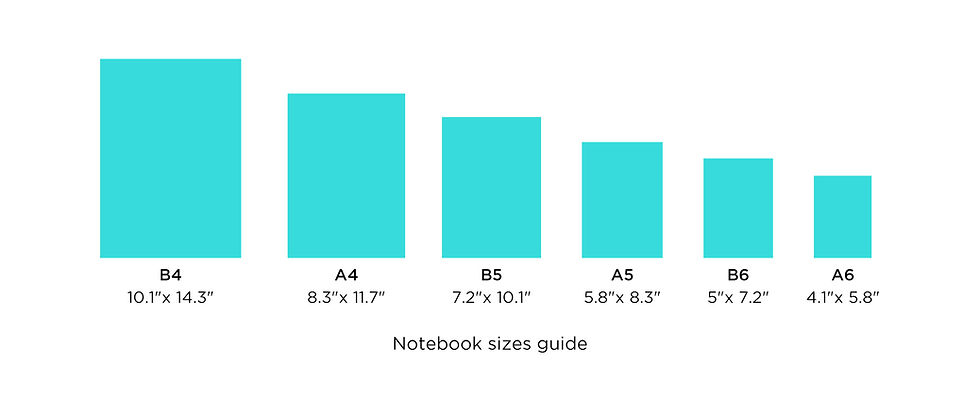
1. Common Notebook Sizes (ISO A & B Series)
A Series Sizes (ISO 216)
The A series is globally recognized and is the default in most English-speaking countries.
Size | Dimensions (mm) | Dimensions (inches) | Use Cases |
A1 | 594 x 841 | 23.3 x 33.1 | Posters, large sketches |
A2 | 420 x 594 | 16.5 x 23.4 | Art, scrapbooking |
A3 | 297 x 420 | 11.7 x 16.5 | Drawing, architecture |
A4 | 210 x 297 | 8.3 x 11.7 | School, offices |
A5 | 148 x 210 | 5.8 x 8.3 | Journals, planners |
A6 | 105 x 148 | 4.1 x 5.8 | Pocket-sized memos |

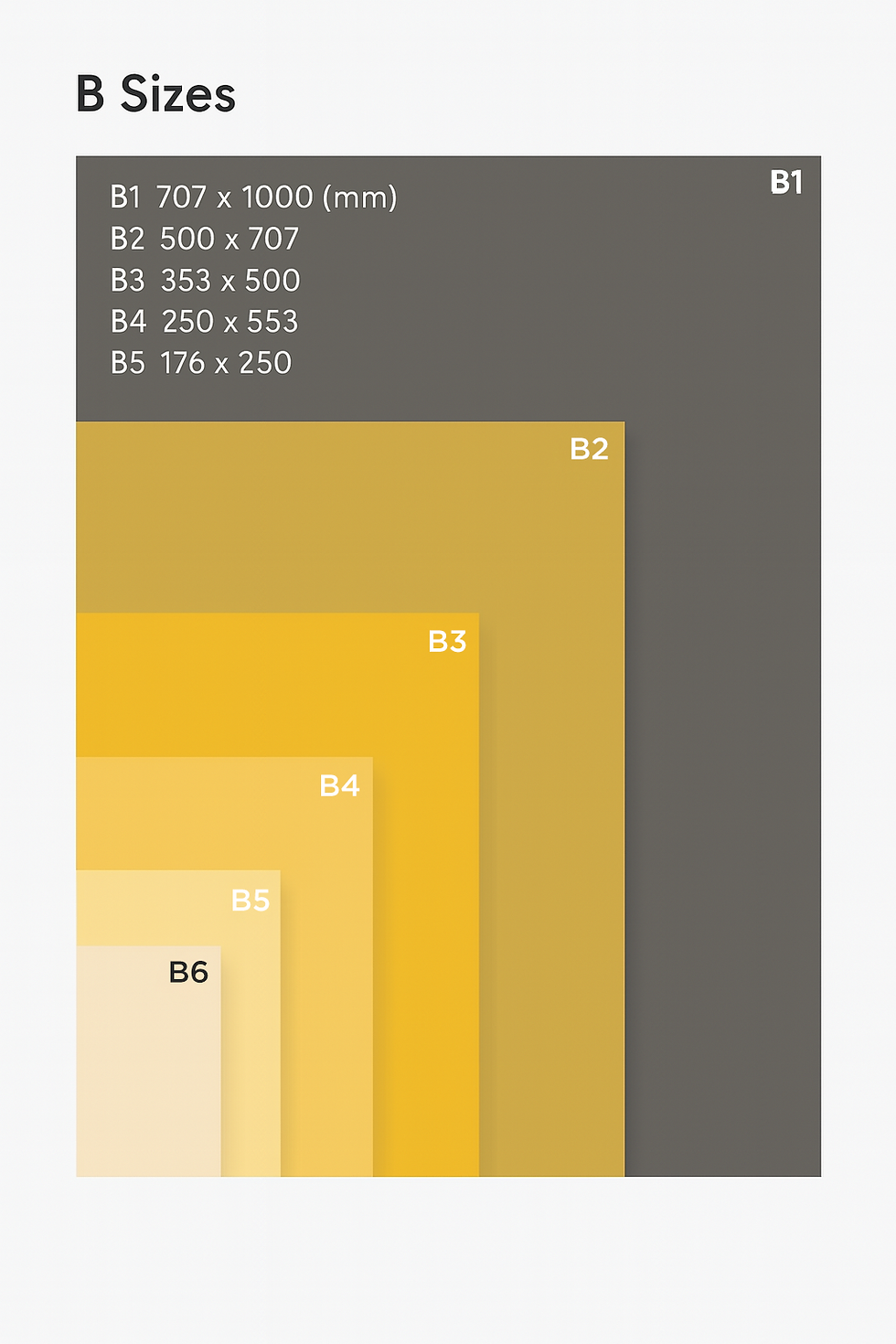
B Series Sizes (Less Common)
These offer more intermediate dimensions.
Size | Dimensions (mm) | Dimensions (inches) | Use Cases |
B1 | 707 x 1000 | 27.8 x 39.4 | Presentations |
B2 | 500 x 707 | 19.7 x 27.8 | Posters |
B3 | 353 x 500 | 13.9 x 19.7 | Portfolio books |
B4 | 250 x 353 | 9.8 x 13.9 | Art books |
B5 | 176 x 250 | 6.9 x 9.8 | Student notebooks, planners |
B6 | 125 x 176 | 4.9 x 6.9 | Pocket diaries |
2. International vs U.S. Sizes
While A and B sizes dominate globally, the U.S. still commonly uses:
Name | Dimensions (inches) | Use Cases |
Letter | 8.5 x 11 | School, offices |
Legal | 8.5 x 14 | Legal documentation |
Junior Legal | 5 x 8 | Personal notes |
These sizes don’t follow ISO standards, which can create complications in international production if not properly specified.
3. Popular Sizes by Country
Country | Common Sizes | Remarks |
USA | Letter, A5, B5 | Strong demand for spiral-bound A5 notebooks |
UK | A4, A5 | Standard academic & corporate use |
Germany | A4, B5 | Eco-notebooks with B series more common |
Australia | A5, A6 | Travel journals, compact planners favored |
Singapore | A5, B6 | Balanced between portability and usability |
4. Why So Many Sizes?
4.1 Application-Driven Needs
Students favor A4 or B5 for larger writing space.
Professionals prefer A5 or B6 for portability.
Creatives use A3 or B4 for wide canvas sketching.
4.2 Fits in Bags and Cases
Notebook buyers often consider bag size. Smaller bags (children’s backpacks, handbags) require compact notebooks, while larger bags support A4 or B5 sizes.
4.3 Budget Flexibility
Paper size directly affects cost. Offering multiple size options allows you to meet different budget levels—from premium gifting to cost-effective bulk supply.
4.4 Consumer Habits
Some buyers want roomy pages for brainstorming, while others prefer small formats for mobility. Notebook sizes must adapt to usage patterns and expectations.

5. Choosing the Right Size
Buyer Type | Best Size | Reason |
School Buyers | A4, B5 | Ample room for notes, standardized size |
Corporate Gifting | B5, A5 | Balance of function and formality |
Artists/Designers | A3, B4 | Larger surfaces for illustrations |
Travelers | A6 | Pocket-sized, easy to carry |
Retail Chains | A5, B6 | Popular sizes with diverse appeal |

Conclusion: One Size Doesn’t Fit All
The ideal notebook size depends on your end user and application. As a B2B buyer, choosing the right size can enhance your value proposition, streamline logistics, and increase customer satisfaction.
Need help deciding on the perfect notebook size? Contact Lion Paper and let us customize the ideal solution for your brand.
—Leo Xia, CEO, Lion Paper Products
FAQs:
Q1: What’s the most commonly used notebook size?
A: A5 and A4 are globally the most used sizes.
Q2: Which size is ideal for schools?
A: A4 and B5 offer enough space for student writing.
Q3: Which notebook fits in most handbags?
A: A5 or A6 sizes are handbag-friendly.
Q4: Is B5 bigger than A5?
A: Yes, it’s midway between A4 and A5.
Q5: What’s the main difference between A and B series?
A: A series follows ISO 216; B series is slightly larger and often used in Asia.
Q6: Can I order a custom size?
A: Yes, Lion Paper supports custom notebook sizes.
Q7: How should wholesalers decide on sizes?
A: Base it on your market's regional norms and customer use cases.
Are you looking for a reliable manufacturer? Reach out to Lion Paper for a free quote and consultation. Let’s collaborate on creating custom writing paper products that will set your brand apart from the competition.
